Types of Apes List with Pictures
A few years back, I found myself standing in front of an enclosure at a wildlife sanctuary, watching a chimpanzee methodically use a stick to fish for termites.
It wasn’t dramatic. No roaring. No pounding chest. Just quiet focus and problem-solving. I remember thinking how easy it is to lump all apes into one mental category-big, smart, endangered-and move on.
But the more I paid attention, the more I realized each species carries its own personality, habitat, and story.
Some live in tight-knit forest groups, others spend most of their time alone high in the canopy. Some are critically endangered, hanging on in fragmented habitats.
That curiosity pushed me to look deeper into the different types of Apes species, how they’re classified, and what truly separates one from another beyond the obvious size differences
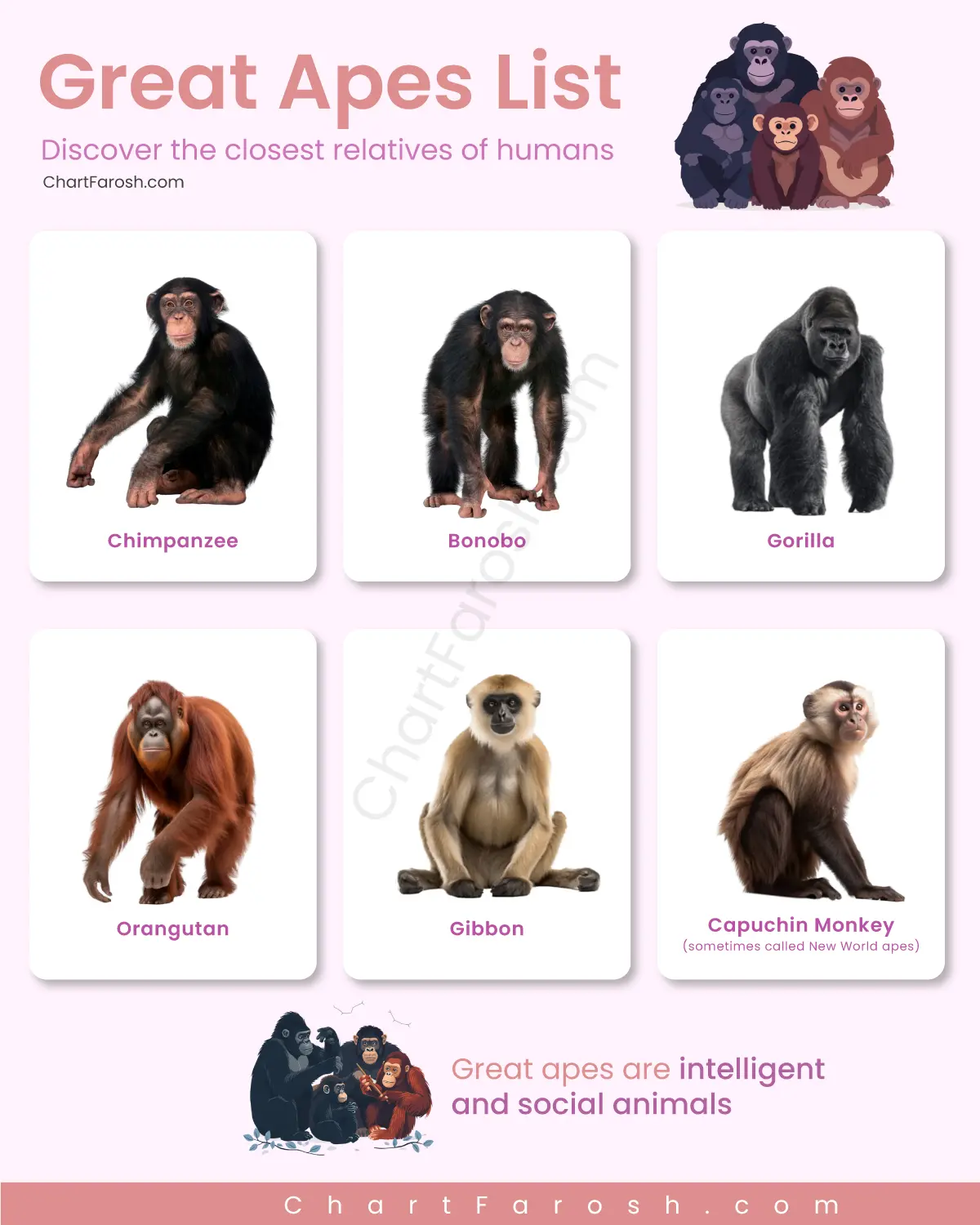
Table of Contents
Types of apes
When people search for Types of Apes and their names, they’re usually thinking of gorillas, chimpanzees, orangutans, and maybe bonobos.
Those are the great apes. But technically, apes are divided into two groups: great apes and lesser apes. Great apes include humans, chimpanzees, bonobos, gorillas, and orangutans. Lesser apes are gibbons and siamangs.
If you’re building a list of Apes breeds or organizing a printable list of Apes, it helps to understand this split.
Across Africa and Asia, the modern types of Apes species are diverse in behavior, size, and conservation status.
| Ape Type | Species | Key Feature | Habitat | Fun Fact |
| Chimpanzee | Pan troglodytes | Highly social, intelligent | African forests & savannas | Use tools in the wild |
| Bonobo | Pan paniscus | Peaceful, matriarchal | Congo Basin | Known for strong social bonds |
| Gorilla | Western & Eastern Gorilla | Largest ape species | African tropical forests | Gentle giants, mostly herbivorous |
| Orangutan | Bornean & Sumatran Orangutan | Red fur, arboreal | Rainforests in Asia | Excellent climbers, solitary |
| Gibbon | Various species | Small, fast, long arms | Southeast Asian forests | Swing from trees with brachiation |
| Capuchin Monkey (sometimes called New World apes) | Cebus spp. | Intelligent, small | South & Central America | Known for tool use |
How Many Great Ape Species Exist?
There are several recognized great ape species spread across Africa and Southeast Asia. While humans are technically great apes, most wildlife discussions focus on non-human species.
Currently, there are two chimpanzee species (chimpanzee and bonobo), two gorilla species (eastern and western), and three orangutan species (Bornean, Sumatran, and Tapanuli).
These make up the living non-human great apes. If you’re organizing a Types of Apes chart, this classification is the foundation.
Understanding the number of great apes helps clarify conservation priorities and regional biodiversity.
| Group | Species Count | Region | Example Species |
| Chimpanzees | 2 | Africa | Common Chimpanzee |
| Gorillas | 2 | Africa | Eastern Gorilla |
| Orangutans | 3 | Asia | Bornean Orangutan |
| Total (Non-human) | 7 | Africa & Asia | – |
What Makes an Ape “Great”?
The term “great ape” refers to size, brain development, and the absence of a tail.
Great apes are generally larger than lesser apes and display advanced cognitive abilities such as tool use, emotional complexity, and social learning.
They also have broader chests and more flexible shoulders for climbing and knuckle-walking.
When comparing the types of Apes species, these traits separate great apes from gibbons and siamangs.
If you’re compiling types of Apes with pictures, you’ll notice great apes have more robust builds and expressive faces.
| Feature | Great Apes | Lesser Apes | Key Difference |
| Size | Larger | Smaller | Body mass |
| Tail | None | None | Both lack tails |
| Intelligence | Highly advanced | Advanced | Tool use frequency |
| Social Structure | Complex | Pair-based groups | Group size |
Chimpanzees: The Most Widespread Great Ape
Chimpanzees are the most widespread of the African great apes, living across central and western Africa. They inhabit forests and savannas and are famous for their intelligence and tool use.
Chimpanzees form large communities with intricate social hierarchies.
When people search for Types of Apes and their names, chimpanzees are usually at the top of the list.
They’re also among the most documented types of Apes with pictures, thanks to decades of field research and wildlife photography.
| Scientific Name | Region | Diet | Status |
| Pan troglodytes | Central & West Africa | Omnivore | Endangered |
| Habitat | Forest & woodland | – | – |
| Social Group | Large troops | – | Complex hierarchy |
Bonobos: The Peaceful Relatives of Chimpanzees
Bonobos are often described as the calmer cousins of chimpanzees. Found only in the Democratic Republic of Congo, bonobos live in matriarchal societies where female alliances shape group dynamics.
They share about 98–99% of their DNA with humans, similar to chimpanzees.
In discussions about types of Apes species, bonobos stand out for their unique social structure.
Any accurate Types of Apes chart should highlight how bonobos differ behaviorally despite their close genetic similarity to chimpanzees.
| Scientific Name | Region | Social Structure | Status |
| Pan paniscus | DR Congo | Matriarchal | Endangered |
| Habitat | Rainforest | – | – |
| Diet | Fruit-heavy omnivore | – | – |
Gorillas: Gentle Giants of Africa
Gorillas are the largest living primates. Despite their size and strength, they are primarily peaceful herbivores feeding on leaves, shoots, and fruit. Gorillas live in family groups led by a dominant silverback male.
For anyone creating a list of Apes breeds, gorillas are divided into eastern and western species, each with subspecies.
Their powerful build makes them easily recognizable in types of Apes with pictures collections.
| Scientific Name | Region | Diet | Group Structure |
| Gorilla spp. | Central Africa | Herbivore | Led by silverback |
| Size | Up to 200 kg | – | Largest ape |
| Habitat | Forest | – | Ground & low canopy |
Eastern Gorillas vs Western Gorillas: Key Differences
Eastern and western gorillas differ in size, skull shape, and geographic range.
Eastern gorillas are generally larger with darker fur, while western gorillas are slightly smaller and more numerous, though still critically endangered in some subspecies.
Understanding these differences is essential when reviewing Types of Apes and their names in detail. A well-structured Types of Apes chart makes these distinctions easier to visualize.
| Feature | Eastern Gorilla | Western Gorilla | Difference |
| Size | Larger | Slightly smaller | Body mass |
| Region | East-Central Africa | West Africa | Geography |
| Conservation | Critically Endangered | Critically Endangered | Population trends |
| Skull | Broader face | Narrower face | Bone structure |
Orangutans: Tree-Dwelling Apes of Asia
Orangutans are the only great apes found outside Africa. Native to Borneo and Sumatra, they spend most of their lives in trees. Unlike gorillas and chimpanzees, orangutans are largely solitary.
Their long arms and reddish fur make them unmistakable in types of Apes with pictures searches.
When compiling a printable list of Apes, orangutans are divided into three species: Bornean, Sumatran, and Tapanuli.
| Scientific Name | Region | Lifestyle | Status |
| Pongo spp. | Indonesia & Malaysia | Arboreal | Critically Endangered |
| Diet | Fruit-heavy | – | – |
| Social Pattern | Semi-solitary | – | – |
Sumatran vs Bornean Orangutans: Habitat and Behavior Differences
Sumatran orangutans tend to be more social and spend nearly all their time in trees. Bornean orangutans are slightly larger and may travel on the ground more often.
The recently identified Tapanuli orangutan has the smallest population of all.
If you’re reviewing types of Apes species, these subtle ecological differences matter. A clear Types of Apes chart comparing habitat and behavior highlights these distinctions.
| Feature | Sumatran | Bornean | Key Difference |
| Sociality | More social | More solitary | Group interaction |
| Size | Slightly smaller | Larger | Body mass |
| Habitat | Dense rainforest | Broader forest range | Tree density |
| Status | Critically Endangered | Critically Endangered | Population size |
Rare and Critically Endangered Great Apes
Many great apes face severe threats from habitat destruction, poaching, and disease. The Tapanuli orangutan is critically endangered with fewer than a thousand individuals.
Mountain gorillas, once on the brink, have seen slight recovery due to conservation efforts.
Including conservation status in a printable list of Apes gives a clearer picture of urgency. When discussing types of Apes species, conservation cannot be separated from classification.
| Species | Status | Main Threat | Region |
| Tapanuli Orangutan | Critically Endangered | Habitat loss | Sumatra |
| Mountain Gorilla | Endangered | Poaching | Central Africa |
| Western Gorilla | Critically Endangered | Disease & hunting | West Africa |
| Bonobo | Endangered | Deforestation | DR Congo |
types of apes in south america
There are no native apes in South America. While monkeys are abundant across the continent, true apes evolved in Africa and Asia.
This distinction often causes confusion when building a list of Apes breeds or researching Types of Apes and their names by region.
South America is home to New World monkeys such as howler monkeys and capuchins, but not chimpanzees, gorillas, orangutans, or gibbons.
Any Types of Apes chart organized by continent should clearly show that apes are absent from South American ecosystems.
| Species | Habitat | Key Feature | Note |
| Capuchin Monkey | Rainforests | Small, intelligent | Often mistaken for small apes |
| Howler Monkey | Forests | Loud calls | Social groups, not true apes |
| Spider Monkey | Tropical forests | Long limbs & tail | Prehensile tail for swinging |
types of apes in india
India does not have native great apes. However, it is home to lesser apes, specifically the hoolock gibbon, the only ape species found in India.
Gibbons fall under lesser apes and differ from great apes in size and social structure.
When organizing types of Apes species by region, the hoolock gibbon deserves mention. Including it in a printable list of Apes ensures geographic accuracy for South Asia.
| Ape Species | Habitat | Key Feature | Status |
| Hoolock Gibbon | Forests of Northeast India | Small, arboreal, long arms | Endangered, India’s only ape |
| Lar Gibbon (White-handed Gibbon) | Northeast India | Agile climber | Endangered, tree-dwelling |
types of apes in africa
Africa is the heartland of great apes. It hosts chimpanzees, bonobos, eastern gorillas, and western gorillas. These species occupy forests and some woodland areas across central and western Africa.
Anyone researching Types of Apes and their names will find most great ape diversity concentrated here.
For conservation-focused discussions or a detailed Types of Apes chart, Africa stands out as the primary continent for wild great ape populations.
| Ape Species | Habitat | Key Feature | Fun Fact |
| Chimpanzee | West & Central African forests | Highly intelligent | Use tools, live in social groups |
| Bonobo | Congo Basin | Peaceful & matriarchal | Only in Democratic Republic of Congo |
| Gorilla | Central African forests | Largest ape | Gentle herbivore, lives in troops |
| Western Gorilla | West Africa | Dark fur | Critically endangered |
| Eastern Gorilla | Central Africa | Slightly larger | Includes mountain gorilla |
FAQs
How many types of apes are there?
There are seven living non-human great ape species and multiple lesser ape species like gibbons.
What are the main Types of Apes and their names?
Chimpanzees, bonobos, eastern and western gorillas, and Bornean, Sumatran, and Tapanuli orangutans.
Are there apes in South America?
No, South America has monkeys but no native apes.
What is the difference between great apes and lesser apes?
Great apes are larger, more intelligent on average, and include gorillas, chimpanzees, bonobos, and orangutans. Lesser apes include gibbons.
Where can I find a printable list of Apes?
A wildlife field guide or conservation database can provide a detailed printable list of Apes, including habitat and conservation status.