Types of Yellow Jackets
A yellow jacket nest once turned my cookout into a sprint. They poured out of a hole in the lawn. I had mowed right over the entrance. By August they owned that corner of the yard. We ate inside for a week.
There are many types of yellow jackets, and they fall into two groups. Some nest in the ground. Others nest in trees and eaves. All of them are wasps, not bees. Every female can sting.
Below you will find the common species in one chart. You will see what each one looks like and where it nests. There is a quick way to tell a yellow jacket from a bee. Real sizes and habits are included, not vague labels.
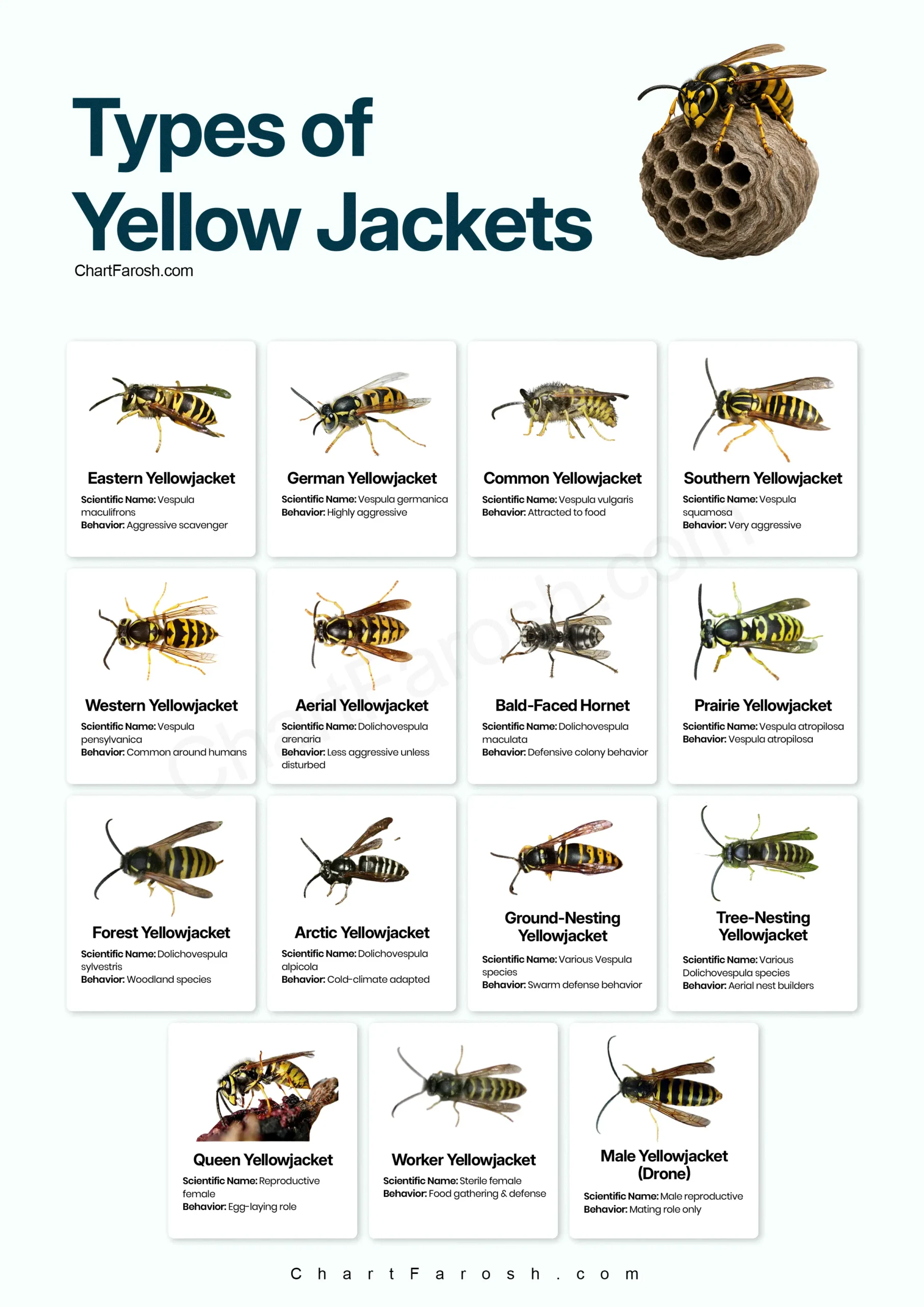
Table of Contents
Types of yellow jackets chart
| Attribute | Value |
| What they are | Social wasps, not bees |
| Two main groups | Vespula (ground) and Dolichovespula (aerial) |
| Worker size | About 1/2 in (12 mm) |
| Queen size | About 3/4 in (18 mm) |
| Colors | Black with yellow bands; some black and white |
| Nest material | Chewed wood fiber, like paper |
| Colony size by late summer | Hundreds to several thousand |
| Colony length | One year; only new queens survive winter |
| Can it sting more than once | Yes, the stinger is smooth |
| Most active | Late summer and fall |
| Diet | Insects in summer; sweets and meat in fall |
| Role in nature | Eat pest insects; minor pollinators |
The two main groups of yellow jackets
Every yellow jacket sits in one of two genera. The split comes down to where they nest. That one clue sorts most of them fast.
| Group | Where it nests | Examples |
| Vespula, the ground yellow jackets | Soil burrows, wall voids, hidden cavities | Eastern, western, German, common |
| Dolichovespula, the aerial yellow jackets | Trees, shrubs, and house eaves | Aerial yellow jacket, bald-faced hornet |
Ground nesters often take over old rodent burrows. You may not see the nest until you step near it. Aerial nesters hang a gray paper ball in the open.
Common types of yellow jackets
Most run-ins come from a short list of species. The chart below sorts them by look and nest. Sizes refer to the worker.
| Species | Scientific name | Look for | Nest | Where you find it |
| Eastern yellow jacket | Vespula maculifrons | Black and yellow bands | Underground | Eastern North America; bold scavenger |
| Western yellow jacket | Vespula pensylvanica | Yellow face, black marks | Ground | Western North America; near people |
| German yellow jacket | Vespula germanica | Bright yellow, black dots | Walls, attics, ground | Widespread; invasive outside Europe |
| Common yellow jacket | Vespula vulgaris | Bold yellow-black stripes | Hidden cavities, ground | Widespread; drawn to food |
| Southern yellow jacket | Vespula squamosa | Orange-yellow markings | Underground | Southern US; large colonies |
| Prairie yellow jacket | Vespula atropilosa | Yellow-black abdomen | Underground | Western grasslands; moderate |
| Forest yellow jacket | Vespula acadica | Black and yellow | Logs, rotting wood | Northern forests; avoids people |
| Aerial yellow jacket | Dolichovespula arenaria | Slim body, yellow marks | Trees, shrubs, eaves | North America; mild unless disturbed |
| Bald-faced hornet | Dolichovespula maculata | Black body, white face | Hanging paper nest | North America; defends nest hard |
The bald-faced hornet is not a true hornet. It is a Dolichovespula, so it counts as a yellow jacket relative. Cool-climate species like Dolichovespula alpicola live farther north.
Yellow jacket castes: queen, worker, and drone
A colony is not one kind of wasp. It runs on three roles. Knowing them helps you read a nest.
| Caste | Role | How to tell |
| Queen | Starts the colony and lays all the eggs | Largest, about 3/4 in |
| Worker | Builds, forages, and guards the nest | Sterile female, about 1/2 in |
| Drone (male) | Mates with the new queens | Longer antennae, no stinger |
Only the females sting. A drone cannot. The single overwintering queen restarts the whole cycle each spring.
Yellow jacket vs bee vs hornet
People lump these together, then guess wrong. A few traits keep them straight. Use the chart before you swat.
| Feature | Yellow jacket | Honeybee | True hornet |
| Body | Slim, smooth, shiny | Round and fuzzy | Large and stout |
| Color | Black and bright yellow | Golden-brown, hairy | Brown and yellow |
| Sting | Many times | Once, then it dies | Many times |
| Nest | Paper, ground or aerial | Wax comb in a cavity | Big paper nest |
| Diet | Insects, sweets, meat | Nectar and pollen | Insects and sweets |
The fuzzy body is the fast tell for a bee. A yellow jacket looks slim and shiny. It also stings again and again.
When yellow jackets nest and when they sting
A colony lasts one year. In spring a lone queen builds a nest the size of a golf ball. She raises the first workers herself.
Through summer the workers take over. The colony swells to hundreds, then thousands. The nest can reach the size of a football.
Late summer is the hard part. Their insect food runs short. They crash picnics and turn defensive. A sting or a squashed wasp releases an alarm scent. That scent calls the rest to attack.
Winter ends the colony. Workers and the old queen die. Only new, mated queens survive to start again.
How to stay safe around yellow jackets
Most stings happen near the nest or over food. A few habits cut the risk. None of this calls for panic.
- Keep food and sweet drinks covered outdoors. Check open soda cans before you sip.
- Do not swat or crush one near you. That releases the alarm scent.
- Move away slowly if they buzz around you. Sudden moves invite a sting.
- See a doctor fast for trouble breathing or swelling beyond the sting. That can signal an allergy.
- Leave a nest in a wall or the ground to a pest professional. Those are hard to reach safely.
Frequently asked questions
How many types of yellow jackets are there?
There are many species across two genera. North America has roughly a dozen common ones. They divide into ground nesters and aerial nesters.
What is the most aggressive yellow jacket?
The German and common yellow jackets rank among the boldest near homes. All of them defend the nest hard in late summer. That is when colonies peak and food runs low.
What is the difference between a yellow jacket and a bee?
A yellow jacket is a slim, smooth wasp that can sting many times. A honeybee is round and fuzzy. A bee stings once and then dies.
Is a bald-faced hornet a yellow jacket?
In a sense, yes. It is a Dolichovespula, a close yellow jacket relative, not a true hornet. It is black and white and builds a hanging paper nest.
Why are yellow jackets so bad in late summer?
Their natural insect food runs out by then. Colonies also hit peak size. So they swarm picnics and turn defensive around people.
Do male yellow jackets sting?
No. Only the females sting. Males, called drones, have no stinger and exist to mate.