Types of Water Bugs
I scooped a jar out of a pond as a kid and came up with something that looked like a flattened beetle wearing boxing gloves. Years later I learned it was a giant water bug, and that it could have given me a bite I would not forget. That jar started a long habit of looking closer at what lives just under the surface.
The trouble with the phrase water bug is that people use it for almost anything found near water. Some are true bugs. Some are beetles. Some are young insects that will soon crawl out and fly away.
The chart below sorts the common ones by group, size, habitat, and how much their bite can sting. Use it to name what you found in a pond, a pool, or a jar, instead of guessing.
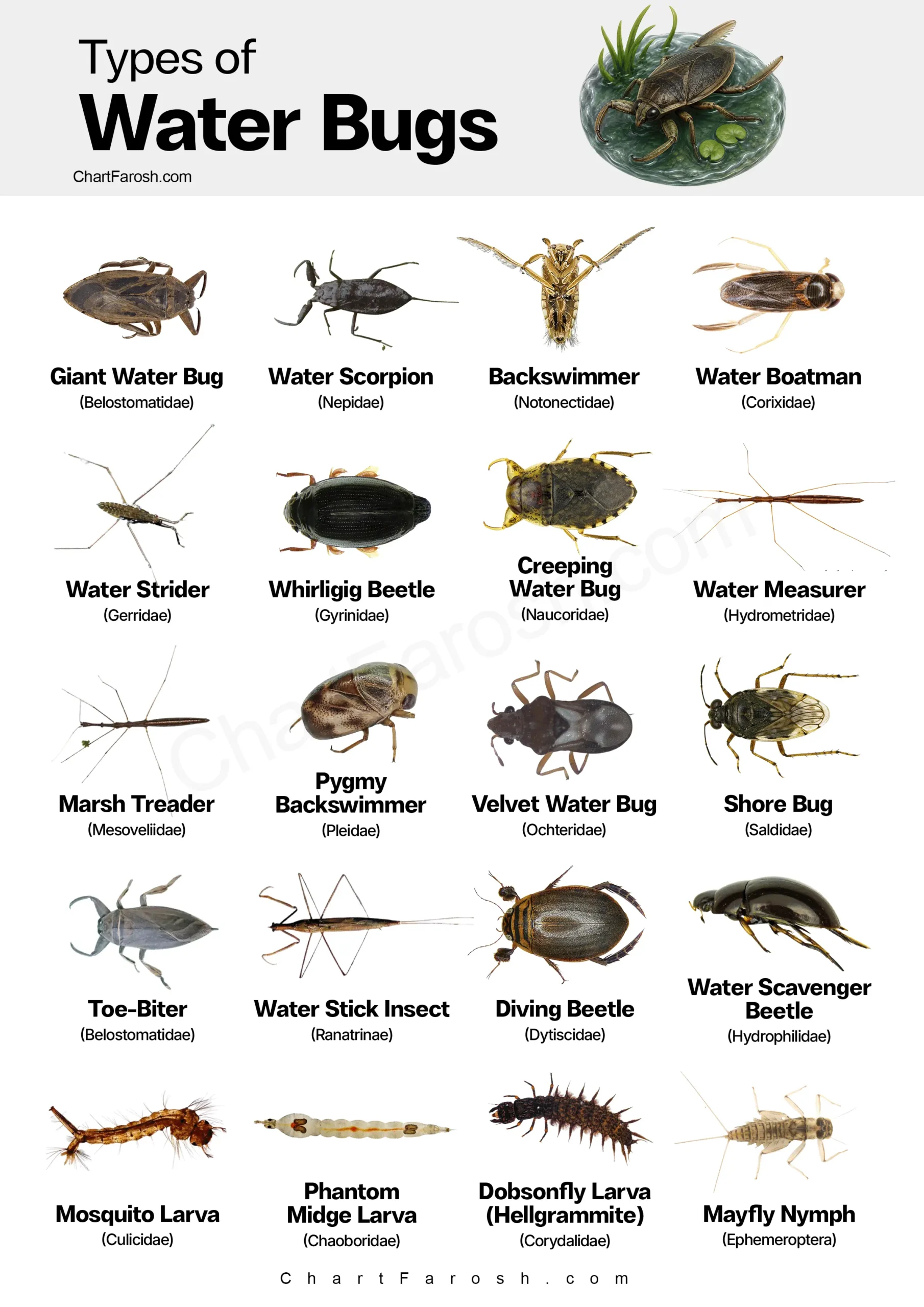
Table of Contents
Types of Water Bugs and Their Names
A true water bug is an insect in the order Hemiptera, the same group as stink bugs and aphids. The fully aquatic ones sit in the infraorder Nepomorpha, while the surface-walkers like the water strider sit in Gerromorpha. They all feed by piercing prey with a sharp beak and sucking out the liquid inside.
These are the true water bugs people search for most, with the trait that sets each one apart. The giant water bug heads the list, since it is both the largest and the one most likely to bite a careless hand.
| Common Name | Family | Habitat | Size | Diet | Key Feature |
| Giant Water Bug (Toe-Biter) | Belostomatidae | Ponds, marshes, slow streams | 2–4 in | Carnivorous | Grasping front legs; very painful bite; flies to lights |
| Water Scorpion | Nepidae | Shallow ponds, wetlands | 1–2 in | Carnivorous | Stick-like body; long breathing tube at the tail |
| Water Stick Insect | Nepidae (Ranatra) | Reedy wetlands | 1–4 in | Carnivorous | A very slender water scorpion |
| Backswimmer | Notonectidae | Lakes, ponds | 0.5–0.7 in | Carnivorous | Swims upside down; can bite |
| Water Boatman | Corixidae | Freshwater ponds | 0.2–0.5 in | Algae, detritus | Oar-shaped hind legs; harmless |
| Water Strider | Gerridae | Water surface | 0.1–1 in | Predatory | Walks on water using surface tension |
| Creeping Water Bug | Naucoridae | Streams, ponds | 0.5–0.8 in | Carnivorous | Flat oval body; can give a sharp bite |
| Water Measurer (Marsh Treader) | Hydrometridae | Marshes, calm water | 0.3–0.5 in | Small insects | Thin walking-stick body and head |
| Water Treader | Mesoveliidae | Wet vegetation | Under 0.2 in | Predatory | Tiny, primitive surface bug |
| Pygmy Backswimmer | Pleidae | Quiet ponds | Very tiny | Predatory | Small, rounded backswimmer |
| Velvet Water Bug | Ochteridae | Muddy shores | 0.2–0.4 in | Predatory | Velvety body; lives at the water’s edge |
| Shore Bug | Saldidae | Edges of streams and lakes | Small | Insects | Quick runner along the bank |
If the creature you found has a rounder shell and chews rather than pierces, it may be a beetle instead. Our bug identification chart covers the wider range of crawling pests for comparison.
Water Beetles Often Called Water Bugs
Plenty of pond insects called water bugs are not bugs at all. They are beetles, in the order Coleoptera, with hard wing covers and chewing mouthparts instead of a piercing beak. You can often tell a beetle by the straight line down its back where the two wing covers meet.
| Beetle | Family | Habitat | Key Feature |
| Predaceous Diving Beetle | Dytiscidae | Freshwater ponds and streams | 0.2–1.5 in; strong swimmer; carries an air bubble under its wings |
| Whirligig Beetle | Gyrinidae | Pond surfaces | Spins on the surface; split eyes see above and below water at once |
| Water Scavenger Beetle | Hydrophilidae | Stagnant water | Clubbed antennae; mostly eats decaying matter |
| Giant Water Beetle | Hydrophilidae (Hydrophilus) | Ponds | Large, glossy black; a big member of the scavenger beetle family |
These swimmers share ponds with their land cousins. Compare them against the wider group in our beetle identification chart.
Young Aquatic Insects Mistaken for Water Bugs
Some of the strangest pond creatures are simply young insects in their water-living stage. Mayflies, dragonflies, and others hatch underwater and live there for months or years before they crawl out and grow wings. People scoop them up and call them water bugs, but they belong to entirely different orders.
| Insect (young stage) | Order | Habitat | Key Feature |
| Mosquito Larva | Diptera | Standing water | Wriggler; hangs from the surface to breathe |
| Phantom Midge Larva | Diptera | Lakes, ponds | Almost transparent; feeds on zooplankton |
| Dobsonfly Larva (Hellgrammite) | Megaloptera | Fast streams | 1–4 in; fierce jaws; prized as fishing bait |
| Mayfly Nymph | Ephemeroptera | Clean streams | Tail filaments; sensitive to pollution |
| Dragonfly Nymph | Odonata | Ponds, streams | Extendable lower jaw shoots out to grab prey |
| Damselfly Nymph | Odonata | Among aquatic plants | Slender, with three leaf-like tail gills |
| Caddisfly Larva | Trichoptera | Streams, lakes | Builds a protective case from sand or twigs |
| Stonefly Nymph | Plecoptera | Cold streams | Two tails; a sign of clean water |
Mosquito and midge larvae grow into the flying insects in our fly identification chart, while dragonfly and damselfly nymphs become the adults in our dragonfly identification chart.
Largest Water Bugs
Most water bugs are smaller than a fingernail. A few reach a size that surprises people, and the giant water bug is the heavyweight. Large tropical species can pass 12 centimeters and take down fish, frogs, and even small turtles.
| Species | Size | Where Found | Notable Trait |
| Giant Water Bug | Up to 4 in (10 cm), larger abroad | Ponds and slow streams worldwide | Largest true bug; hunts fish and frogs |
| Water Stick Insect / Water Scorpion | Up to 4 in | Reedy wetlands | Long, slender ambush hunters |
| Dobsonfly Larva (Hellgrammite) | 1–4 in | Fast streams | Strong jaws; lives years underwater |
| Giant Water Beetle | 1–2 in | Ponds | One of the largest beetles in fresh water |
Are Water Bugs Dangerous?
Most water bugs cannot hurt you, and the ones that can are painful rather than dangerous for most healthy people. The bite to watch out for comes from the giant water bug, the toe-biter.
It does not truly bite, since it has no jaws. It pierces the skin with its beak and injects digestive saliva, which causes sharp pain and swelling that fade within hours.
Backswimmers and creeping water bugs can also jab a careless hand, and the sting feels like a bee. None of these leave lasting harm in a healthy adult, though a child or an allergic person should see a doctor if swelling spreads. The water boatman, the water strider, and the beetles are harmless to people.
| Can give a painful bite | Harmless to people |
| Giant water bug / toe-biter (Belostomatidae) | Water boatman (Corixidae) |
| Backswimmer (Notonectidae) | Water strider (Gerridae) |
| Creeping water bug (Naucoridae) | Whirligig and scavenger beetles |
| Water scorpion (Nepidae) | Water measurer and water treader |
| Dobsonfly larva / hellgrammite | Mayfly, caddisfly, and stonefly young |
For a state wildlife reference on the toe-biter and its painful bite, the Missouri Department of Conservation field guide is a reliable starting point, and the University of Maine Extension fact sheet covers its habits in more detail.
Is a Water Bug a Cockroach?
Here is where the name causes the most confusion. In many homes, water bug is the everyday word for a large cockroach, usually the Oriental cockroach or the American cockroach. These are not aquatic, and they are not true bugs. They are roaches that like damp, dark places such as drains, basements, and crawl spaces.
A real water bug lives in water and rarely enters a house, except when a giant water bug flies to a porch light or drops into a pool. So if a dark, fast insect runs across your bathroom floor at night, it is almost certainly a cockroach, not a pond insect. The two need very different responses, since one is a harmless wild predator and the other is a household pest.
Centipedes, spiders, and roaches all turn up indoors and get blamed for each other. Our spider identification chart helps you rule out the other common night-time visitor.
Water Bugs and Clean Water
Many of these insects do a quiet job that has nothing to do with biting. Scientists count them to measure how clean a stream is, because some species cannot survive in polluted water. Mayfly, stonefly, and caddisfly young are the classic clean-water markers, so a stream full of them usually means healthy water.
Water bugs and beetles also keep pond ecosystems in balance by eating mosquito larvae and other pests, much like the predators in our beneficial insects chart. For scientific identification of these aquatic groups, the Macroinvertebrates.org guide is a strong reference.
Names That Overlap or Get Used Loosely
Several water-bug names point to the same insect or to a group rather than a single species. Knowing what each one really means saves a lot of confusion.
- Toe-biter and electric light bug: both are nicknames for the giant water bug (Belostomatidae), not separate species. It earns the first name from its bite and the second from its habit of flying to lights.
- Giant water beetle: a large water scavenger beetle (Hydrophilus, family Hydrophilidae), not a distinct family of its own.
- Water stick insect: a slender member of the water scorpion family Nepidae (genus Ranatra), not a true stick insect.
- Marsh treader vs water treader: the marsh treader is the water measurer (Hydrometridae); the water treader is a different family (Mesoveliidae). The names get swapped often.
- Water bug as a household word: usually means a cockroach, which is neither aquatic nor a true bug.
FAQs
What is a water bug?
A true water bug is an aquatic insect in the order Hemiptera, such as the giant water bug, backswimmer, or water boatman. In everyday speech, people also use the word for water beetles and even cockroaches.
Is a water bug a cockroach?
Not the real kind. A genuine water bug lives in ponds and streams, but many people call large Oriental or American cockroaches water bugs even though those roaches are not aquatic.
Do water bugs bite?
Some do. The giant water bug, backswimmer, and creeping water bug can pierce the skin and cause sharp pain, while the water boatman and water strider are harmless.
What is the biggest water bug?
The giant water bug is the largest. North American species reach about 4 inches, and some tropical Lethocerus pass 12 centimeters, large enough to catch fish and frogs.
Are water bugs dangerous?
For most healthy people they are painful at worst, not dangerous. A giant water bug bite hurts a lot but heals within hours, though a child or an allergic person should see a doctor if swelling spreads.
What is the difference between a water bug and a water beetle?
A water bug is a true bug with a piercing beak, while a water beetle is in the order Coleoptera with chewing jaws and hard wing covers. The beetle has a straight seam down its back where the wing covers meet.
How do water bugs breathe underwater?
Most carry their own air supply. Giant water bugs use a snorkel-like tube at the tail, and diving beetles and backswimmers trap a bubble of air against the body before they dive.