Types of Black Widow Spiders
I found my first black widow in a stack of firewood. I was eight. I reached for a log and saw a glossy black spider with a red mark like a tiny hourglass on its belly. My dad pulled my hand back fast.
I never forgot that red mark. It is the most famous warning sign in the spider world.
Years later I learned that black widow is not one spider. Black widow spider species all belong to one group, the genus Latrodectus. It holds more than 30 species, found on every continent except Antarctica.
Most look alike at a glance. A dark glossy body and a splash of red. Look closer and the differences show. The hourglass can be full, broken, or traded for stripes or spots. The body can be black, brown, or banded.
Below is an identification chart for 8 widow and widow-like spiders, from the southern black widow to the false widow. You will see where each one lives, how big the female grows, what its bite can do, and the one feature that sets it apart.
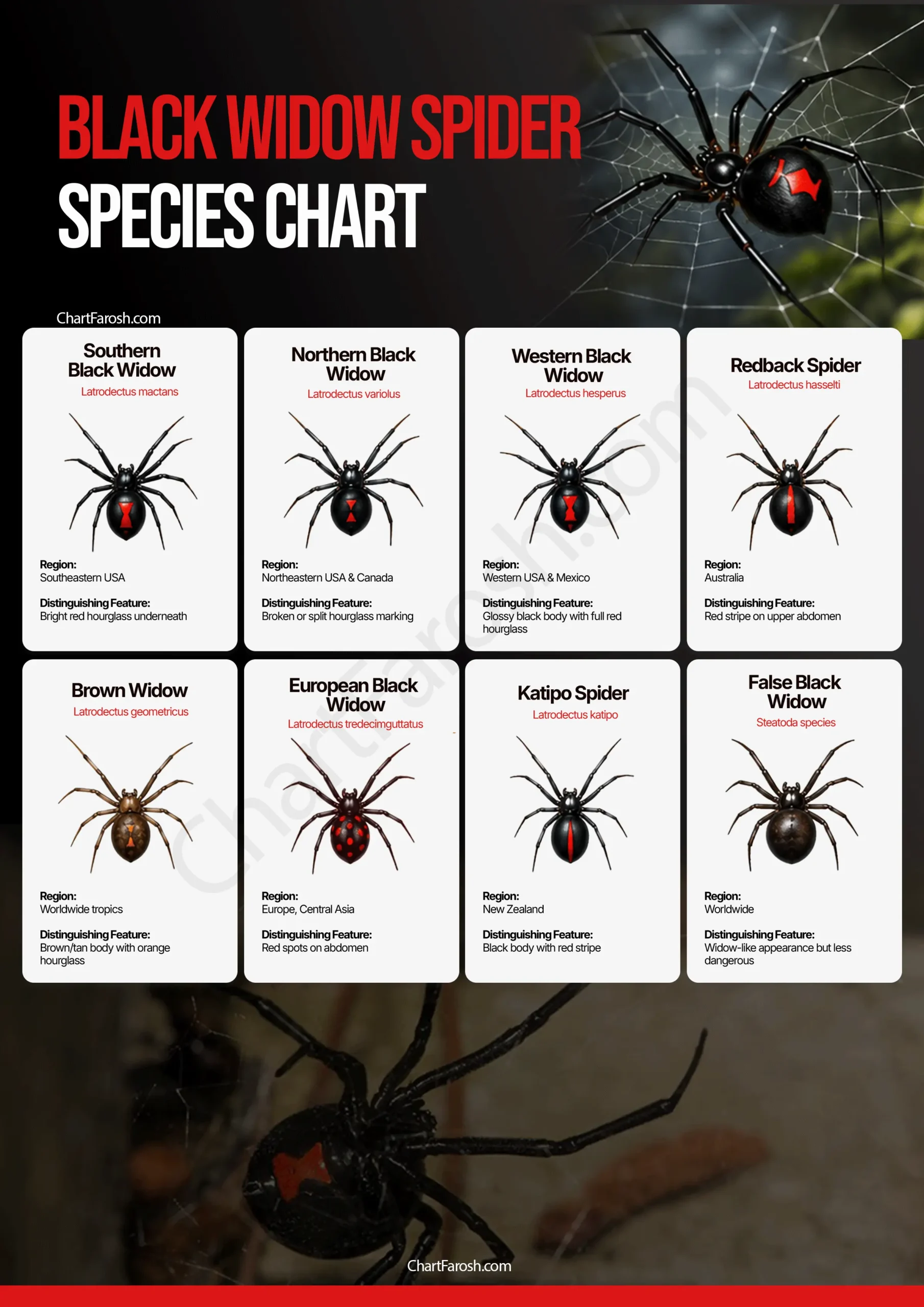
Table of Contents
How to Identify a Black Widow
The classic black widow is easy to picture. A shiny jet-black body the size of a small grape, with a red hourglass on the underside. The female is the one people fear. The male is tiny and rarely bites.
Here are the shared traits across the group.
| Feature | Details |
| Genus | Latrodectus (the true widows) |
| Body color | Usually glossy black; some brown or striped |
| Signature mark | Red hourglass on the underside of the abdomen |
| Female body size | About 8 to 15 mm |
| Which one bites | Only the female; males rarely break human skin |
| Venom type | Neurotoxic (latrotoxin) |
| Range | Worldwide, on every continent except Antarctica |
Not every widow fits the picture. Brown widows are tan. Redbacks and katipo wear a stripe on the back instead of an hourglass below. The red mark is the strongest clue, but it is not the only one.
Types of Black Widow Spiders (Identification Chart)
This chart compares 8 widow and widow-like spiders. The “Bite Risk” column rates the danger to humans, not the raw strength of the venom. Scientific names are in italics.
| Common Name | Scientific Name | Region | Female Size | Bite Risk | Distinguishing Feature |
| Southern Black Widow | Latrodectus mactans | Southeastern USA | 8–13 mm | High | Bright red hourglass underneath |
| Northern Black Widow | Latrodectus variolus | NE USA & Canada | 9–11 mm | High | Broken, split hourglass with a row of red spots |
| Western Black Widow | Latrodectus hesperus | Western USA & Mexico | 10–14 mm | High | Glossy black body, full red hourglass |
| Redback Spider | Latrodectus hasselti | Australia | 10 mm | High | Bright red stripe on the upper abdomen |
| Brown Widow | Latrodectus geometricus | Worldwide tropics | 7–10 mm | Moderate | Brown or tan body, orange hourglass |
| European Black Widow | Latrodectus tredecimguttatus | Europe, Central Asia | 7–15 mm | High | Red spots on the abdomen (thirteen-spot) |
| Katipo Spider | Latrodectus katipo | New Zealand | 8–11 mm | High | Black body with a red stripe |
| False Black Widow | Steatoda spp. | Worldwide | 7–14 mm | Mild–Moderate | Widow-like shape, no hourglass, milder bite |
Seven of these are true widows in the genus Latrodectus. The last one, the false widow, is a Steatoda. It looks the part but carries a much weaker bite. More on that below.
The Three North American Black Widows
North America has three well-known black widows. The southern black widow lives across the southeastern states and wears the bright, complete hourglass most people picture.
The northern black widow ranges through the northeastern states and into Canada. Its hourglass is split into two separate marks, and it often shows a row of red spots down the back. The western black widow covers the western states and northern Mexico, and it causes most of the widow bites reported in the West.
All three carry strong neurotoxic venom. All three bite only in defense. You can match local sightings against our spider identification chart for a wider set of common spiders.
Black Widows Around the World
Widows live far beyond the United States. Australia has the redback, a close relative with a vivid red stripe down its back. Redback bites are medically serious, though an antivenom exists and deaths are now very rare.
Europe and Central Asia have the European black widow, sometimes called the Mediterranean widow. Its name, tredecimguttatus, means thirteen spots, for the red marks on its abdomen. New Zealand has the katipo, a native widow with a red stripe. The katipo is now uncommon and protected, as its coastal dune habitat has shrunk.
The brown widow is the odd one out. It is tan rather than black, with an orange hourglass and a spiky egg sac. Its venom is potent drop for drop, but it injects little and rarely bites hard, so most brown widow bites stay mild. It has spread through warm regions worldwide.
True Widows vs False Widows
Plenty of harmless spiders get mistaken for widows. The main lookalikes are false widows in the genus Steatoda, also called cupboard spiders.
A false widow has the round body and dark color, but no red hourglass. The best-known one is the noble false widow, Steatoda nobilis, common in Europe. Its bite can sting and swell, yet it is far milder than a true widow bite. If a suspect spider has no hourglass and no bright stripe, it is probably a false widow. For other small dark spiders, our bug identification chart can help.
How Dangerous Is a Black Widow Bite?
Less dangerous than the reputation suggests, but not harmless. In the United States, people report about 2,600 widow bites a year. Deaths are very rare, especially with prompt care.
A bite often feels like a pinprick at first. Within a few hours it can bring intense muscle pain and cramping. Sweating and a rigid, painful abdomen often follow. Doctors call this syndrome latrodectism. Most people recover fully within a few days. Children, older adults, and anyone with heart problems face higher risk and should be seen quickly.
If a widow bites you, stay calm. Wash the area with soap and water. Put a cool compress on it. Do not cut the wound or try to suck out venom. Call your local poison center and seek medical care. In the United States, Poison Control is reachable at 1-800-222-1222. For the clinical detail, the NIH overview of black widow toxicity is a solid reference.
FAQs
Are black widow bites deadly?
Rarely. With modern medical care and antivenom, deaths are very uncommon. Most healthy adults recover within a few days. Young children and older adults face higher risk.
How can I tell a black widow from a false widow?
Look for the red hourglass on the underside. True widows have it. False widows in the genus Steatoda do not, and their bite is much milder.
Do male black widows bite?
Almost never. The male is small and usually cannot break human skin. The medically important bites come from the larger female.
Where do black widows live?
Across every continent except Antarctica. They like warm, sheltered spots close to the ground, such as woodpiles and quiet garage corners.
Is the brown widow as dangerous as the black widow?
No. The venom is potent, but the brown widow delivers a small dose and rarely bites hard. Its bites usually stay mild and local.
What should I do if a black widow bites me?
Wash the bite, apply a cool compress, and seek medical care. Call your poison center for advice. For help identifying spiders around your home, see our spider identification chart and the wider Animals Chart collection.
This article is for general identification and safety. It is not medical advice. If you are bitten and feel unwell, contact a doctor or your local poison center.