Types of Small Birds
Last spring I was on my balcony with a coffee. Something tiny shot past my face. It hovered near my potted basil for a second, wings a blur. Then it was gone.
I spent the next twenty minutes trying to work out what I’d seen. A bee? Too big. A hummingbird? Maybe. The whole thing lasted three seconds. All I had to go on was “small, fast, sort of blue.”
That’s when I started paying attention to small birds. They’re the ones you don’t really see. The chickadees stealing seeds from a feeder. The sparrows hopped under garden chairs. The warblers that flash through a hedge and vanish before you’ve focused.
This guide covers the small birds you’ll see in your garden or local park. Plus a few you won’t see unless you go looking.
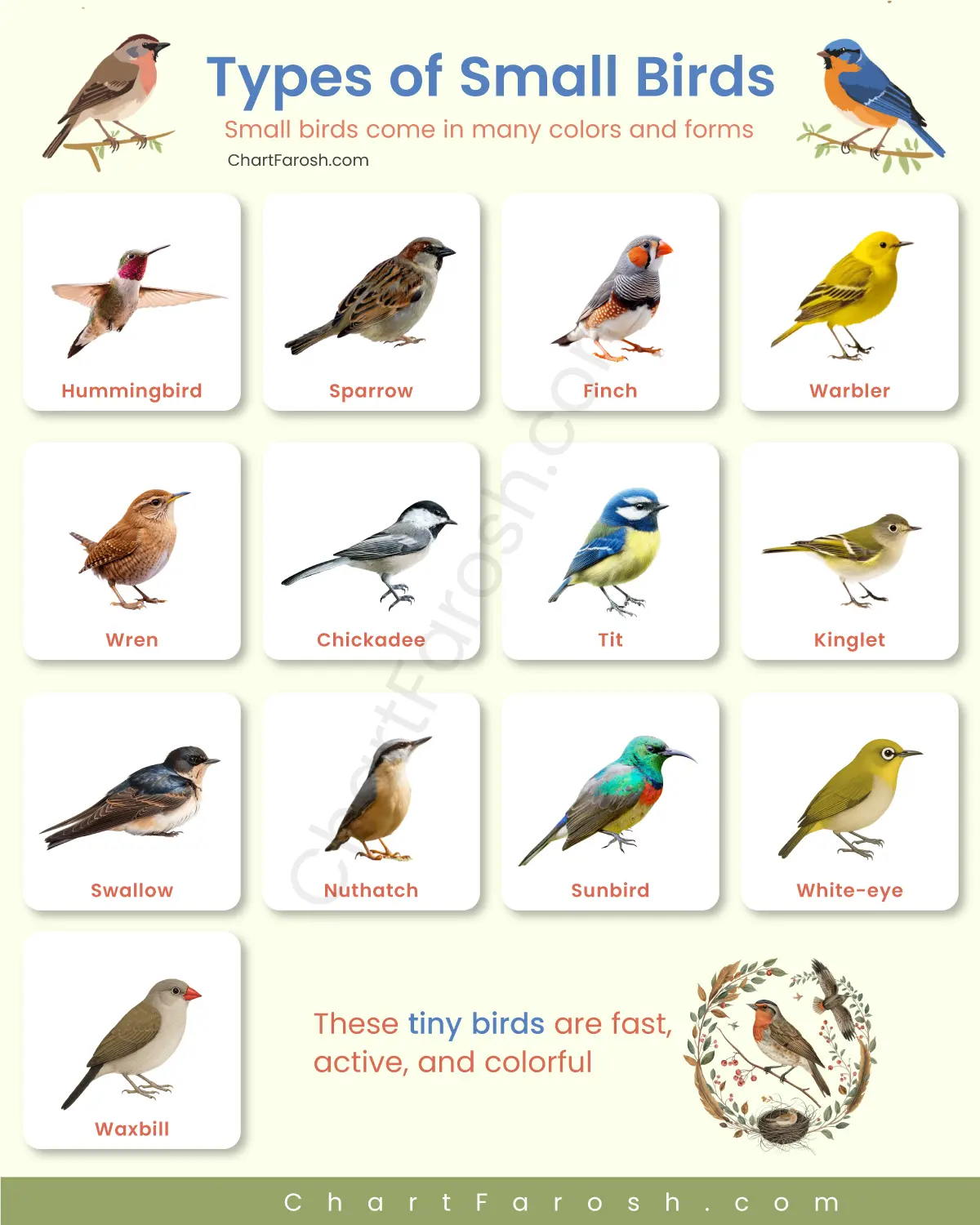
Table of Contents
Types of small birds with pictures
Small birds are species under 7 inches in length. That covers a wide range. The smallest is the Bee Hummingbird at around 2 inches. The largest, like the Barn Swallow, push close to 7 inches once you count the tail.
The table below lists 20 species for a broader overview that includes mid-sized and large species to make it easier to identify and differentiate them, making bird watching even more enjoyable.
| Bird Type | Name | Size (Avg) | Key Feature | Habitat |
| Hummingbird | Bee Hummingbird | 2–2.5 in | Smallest bird in the world | Cuba, forests |
| Hummingbird | Ruby-throated Hummingbird | 3–3.5 in | Bright red throat (male) | North America |
| Sparrow | House Sparrow | 5–6 in | Urban adaptable | Cities, farms |
| Sparrow | Song Sparrow | 5–7 in | Melodic song | Wetlands, gardens |
| Finch | American Goldfinch | 4–5 in | Bright yellow body | Meadows |
| Finch | House Finch | 5–6 in | Red head (male) | Urban areas |
| Warbler | Yellow Warbler | 4–5 in | Sweet singing | Forest edges |
| Warbler | Common Chiffchaff | 4–5 in | Repetitive ‘chiff-chaff’ call | Europe, Asia |
| Wren | Carolina Wren | 4–5 in | Loud voice | Woodlands |
| Wren | House Wren | 4–5 in | Active insect hunter | Gardens |
| Chickadee | Black-capped Chickadee | 5 in | Friendly and curious | North America |
| Tit | Blue Tit | 4–5 in | Blue and yellow plumage | Europe |
| Kinglet | Golden-crowned Kinglet | 3–4 in | Crown stripe | Conifer forests |
| Kinglet | Ruby-crowned Kinglet | 3–4 in | Red crown patch | North America |
| Swallow | Barn Swallow | 6–7 in | Forked tail | Fields, farms |
| Swallow | Tree Swallow | 5–6 in | Shiny blue-green back | Wetlands |
| Nuthatch | White-breasted Nuthatch | 5–6 in | Climbs headfirst | Forests |
| Sunbird | Purple Sunbird | 4 in | Metallic colors | Asia, Africa |
| White-eye | Silvereye | 4–5 in | White eye-ring | Australia |
| Waxbill | Common Waxbill | 4 in | Red beak, small body | Africa |
How to identify small birds
To accurately identify small birds, focus first on overall shape, silhouette, and beak structure rather than color alone, as plumage can vary by age, sex, and season.
Follow these core steps for effective small bird identification:
- Analyze size and silhouette: Compare the small bird to a familiar baseline reference (like a House Sparrow). Note structural proportions such as tail length (is it long and cocked upward like a wren, or short and neat?), plumpness, and posture.
- Inspect the bill shape: The beak is a permanent clue revealing a bird’s diet and family. Thick, conical bills indicate seed-eaters (like finches and sparrows), thin, needle-like bills point to insect-eaters (like warblers), and slightly curved or delicate bills suggest other foragers.
- Look for distinct field marks: Check for contrasting patterns rather than absolute colors. Scan the head for eye-lines, eye-rings, crown patches or eyebrow stripes, and look across the wings and tail for distinct wing bars or white outer feathers.
- Observe behavior and movement: Watch how the bird moves does it hop on the ground, cling vertically to tree trunks, pump its tail up and down, or flit rapidly among outer canopy branches?
- Listen to vocalizations: Small birds are often heard long before they are seen. Use sound-matching technology to capture distinct calls
Most common small birds in the world
The title of the most common small wild birds in the world belongs to the House Sparrow and the Red-billed Quelea, both of which boast individual global populations exceeding 1.5 billion.
A landmark global bird abundance study found that while the planet is home to roughly 50 billion wild birds, the vast majority of that total is made up of just a few highly successful, adaptable small species. Likewise, there are several remarkable birds in the world with different features and habitat mentioned in the table below
| Species | Avg Size | Where you’ll see it | How to spot it |
| House Sparrow | 5–6 in | Cities, towns, farms (every continent except Antarctica) | Brown back, grey crown, black throat (male) |
| European Starling | 7–8 in | Open fields, parking lots, lawns | Glossy black with white speckles in winter |
| Barn Swallow | 6–7 in | Open country, farms, near water | Deep forked tail, blue back, rust belly |
| Black-capped Chickadee | 5 in | Backyards across North America | Black cap, white cheeks, grey body |
| Blue Tit | 4–5 in | European gardens, parks, woodland | Yellow chest, blue cap and wings |
| Common Chiffchaff | 4–5 in | European and Asian woodlands | Olive-brown with pale belly, distinctive call |
.
Colorful small birds with bright feathers
Some small birds are dull. Sparrows and wrens lean brown for camouflage. The bright ones are bright for the opposite reason. They want to be seen, mostly by mates. The American Goldfinch’s yellow is one of the brightest displays of any small bird.
The color comes from carotenoid pigments in the seeds it eats. That’s why goldfinches in poor feeding territory look paler in summer. Sunbirds use a different mechanism. Their feathers have microscopic ridges that scatter light.
It’s the same effect that makes soap bubbles look rainbow-colored. The pigment isn’t there. The color is structural. If you are fond of birds, having a table below is a treat for you, don’t miss it!
| Species | Avg Size | Main color | Region |
| American Goldfinch | 4–5 in | Bright lemon yellow with black wings | North America |
| Purple Sunbird | 4 in | Iridescent purple-blue (male) | South Asia, Middle East |
| Painted Bunting | 5 in | Blue head, green back, red chest | Southern US, Mexico |
| Lilac-breasted Roller | 14 in (medium) | Lilac, turquoise, and green | Sub-Saharan Africa |
| Common Kingfisher | 6–7 in | Electric blue back, orange belly | Europe, Asia |
| Blue-bearded Helmetcrest | 4–5 in | Iridescent blue throat with crest | Colombian Andes |
Cute and rare small birds
“Cute” What most people refer to is round, fluffy, big-eyed, and small enough birds to fit in a teacup.
Here are some examples of cute and rare small birds:
- Spoon-billed Sandpiper (Calidris pygmaea) – ~14 cm (5.5 in) long.
This critically endangered wading bird looks like a tiny, fluffy cotton ball on stilts. Its most adorable feature is its unique spatulate bill that looks exactly like a miniature black spoon, which it uses to filter food from mudflats. Fewer than 500 individuals remain globally. [1] - Orange-bellied Parrot (Neophema chrysogaster) – ~20 cm (8 in) long.
One of the smallest parrot species, this vibrant bird features a bright grass-green coat, a vivid blue wing trim, and a bright neon-orange belly patch. With fewer than 50 left in the wild, this migratory Australian parrot is fiercely protected. [1, 2] - Pygmy Cupwing (Pnoepyga pusilla) – ~9 cm (3.5 in) long.
Found in the mountain forests of South Asia, this bird is frequently described by birders as “a tiny brown tennis ball supported by tiny chopsticks.” It has virtually no visible tail, giving it a completely round, fluffy silhouette. [1] - Blue-eyed Ground-Dove (Columbina cyanopis) – ~15 cm (6 in) long.
A miniature, rich-ruby-colored dove native to Brazil. It features striking, iridescent sapphire-blue spots on its wings and mesmerizing blue eyes. It was feared extinct for 75 years until a tiny population of just a few dozen birds was miraculously rediscovered in 2015. [1] - Honduran Emerald (Amazilia luciae) – ~9.5 cm (3.7 in) long.
A stunning, critically endangered hummingbird found only in the dry thorn-forests of Honduras. It sports a shimmering turquoise-green throat and a glittering emerald back, flitting like a literal flying gemstone
Small birds found in North America
North America hosts around 200 species classed as small birds. The most familiar ones cluster around feeders and gardens. Black-capped Chickadees are the iconic North American backyard bird.
They’re bold for a 5-inch species. They’ll land on an outstretched hand holding seed within a few visits. Tree Swallows and Barn Swallows are both agile aerial insectivores, but you can easily tell them apart by their belly color, throat markings, and tail shape.
Want to know more about the sizes and distinct features of these amazing birds, follow the table below.
| Species | Avg Size | Habitat | Identification tip |
| Black-capped Chickadee | 5 in | Forests, suburban yards | Black cap and bib, will land on a hand |
| Ruby-throated Hummingbird | 3–3.5 in | Eastern US gardens, edges | Iridescent red throat (male only) |
| American Goldfinch | 4–5 in | Meadows, weedy fields | Bright yellow body, black wings (summer) |
| House Wren | 4–5 in | Brushy yards, parks | Brown overall, upright tail, loud song |
| White-breasted Nuthatch | 5–6 in | Mature forests | Climbs down trees headfirst |
| Carolina Wren | 4–5 in | Southeast US woodlands | Rusty back, bold white eyebrow |
| Tree Swallow | 5–6 in | Wetlands, near water | Shiny blue-green back, white belly |
| Yellow Warbler | 4–5 in | Willows, wet thickets | All yellow with reddish chest streaks (male) |
Small birds in Europe
European small birds skew toward tits, finches, and warblers. The British Trust for Ornithology and the RSPB track populations across the continent. The Blue Tit is the most recognizable small bird in Europe. Its yellow chest and blue cap are unmistakable. It readily uses garden nest boxes.
The Common Chiffchaff is harder to see but easy to hear. Its name is its call, repeated through European woodlands from April to September. The complete guide to the different species of birds found in Europe is given below.
| Species | Avg Size | Habitat | Identification tip |
| Blue Tit | 4–5 in | Gardens, woodland | Yellow chest, blue cap and tail |
| Great Tit | 5–6 in | Gardens, parks, woodland | Black head, white cheeks, yellow belly |
| European Robin | 5 in | Gardens, hedgerows | Orange face and chest, brown above |
| Common Chiffchaff | 4–5 in | Woodland, scrub | Olive-brown, distinctive ‘chiff-chaff’ call |
| Goldcrest | 3–4 in | Conifer forests | Smallest European bird, yellow crown stripe |
| Eurasian Wren | 3–4 in | Hedges, gardens | Tiny round body, tail held upright |
| European Goldfinch | 4–5 in | Open country, gardens | Red face, black and yellow wings |
Small birds in Australia
Australia has unusual small-bird diversity. Long geographic isolation made many species endemic, found nowhere else on Earth. The Silvereye is the most widespread small bird in Australia. It has a distinctive white eye-ring. It travels in flocks of 20 to 100 birds, especially in winter.
Superb Fairywrens are the showstopper. Males turn bright cobalt blue during breeding season. They go dull brown the rest of the year. Females stay brown year-round. To help you know more about these lovely birds we have designed a table below.
| Species | Avg Size | Habitat | Identification tip |
| Silvereye | 4–5 in | Gardens, forest edges | Olive-grey with distinctive white eye-ring |
| Superb Fairywren | 4–5 in | Dense undergrowth | Cobalt-blue head (breeding males), held tail |
| Spotted Pardalote | 3–4 in | Eucalyptus forests | Black with bright white spots, yellow rump |
| Eastern Yellow Robin | 6 in | Wet forests, woodland | Yellow underparts, grey above |
| Brown Thornbill | 4 in | Brushy areas, gardens | Tiny, brown, with red eye |
| Red-browed Finch | 4–5 in | Grasslands, gardens | Red eyebrow stripe, olive body |
Small birds in Africa
African small birds include sunbirds, waxbills, and weavers. These three families produce some of the most distinctive small species on the continent. Sunbirds fill the role hummingbirds fill in the Americas. They hover at flowers, drink nectar, and have long curved beaks shaped for specific flowers.
The two groups don’t overlap. Sunbirds live in Africa and Asia. Hummingbirds live in the Americas. They evolved in parallel to solve the same problem. It’s one of the cleaner examples of convergent evolution in birds.
The Common Waxbill is the small African bird most likely to escape captivity and go wild elsewhere. Feral waxbill populations now live in Portugal, Brazil, and several Caribbean islands. Find out more about the small birds in Africa in the table below.
| Species | Avg Size | Habitat | Identification tip |
| Common Waxbill | 4 in | Grasslands, gardens | Red beak and eye-stripe, fine barring |
| Variable Sunbird | 4 in | Open woodland, gardens | Metallic green head, yellow belly (male) |
| Pin-tailed Whydah | 5 in (12 with tail) | Open country | Long black tail in breeding males |
| Beautiful Sunbird | 4 in | Savannas, scrubland | Iridescent green-blue head, red chest band |
| Speckled Mousebird | 6 in (with tail) | Bushy areas, gardens | Grey-brown with crest and long tail |
| Red-billed Firefinch | 4 in | Villages, dry savanna | Pinkish-red with white spots |
How small birds compare to larger species
When comparing small birds (like hummingbirds, wrens, and tits) to large species (like eagles, ostriches, and albatrosses), the differences go far beyond simple physical dimensions.
Small birds operate at an entirely different biological, metabolic, and evolutionary tempo than large birds, trading physical dominance for blistering speed and high-efficiency survival strategies.
The structural and physiological differences between small and large birds break down into several core areas:
| Features | Small Birds (e.g., Hummingbirds, Goldcrests) | Large Birds (e.g., Golden Eagles, Ostriches) |
| Average Weight | 2 to 20 grams | 4 to 100+ kilograms |
| Metabolic Rate | Staggeringly high; requires near-constant feeding | Slow and efficient; can go days without food |
| Heart Rate | 500 to 1,200+ beats per minute | 50 to 150 beats per minute |
| LIfespan | Short (typically 2 to 5 years) | Long (20 to 50+ years) |
| Flight Mechanics | Rapid, muscle-driven flapping and hovering | Energy-saving soaring, gliding, or completely flightless |
| Offspring Strategy | Large clutches, fast maturation (weeks) | Few eggs, incredibly slow maturation (months to years) |
FAQs
What is the smallest bird in the world?
The Bee Hummingbird of Cuba holds the record at 2 to 2.5 inches long. It weighs less than a US penny. It’s the only bird species you could mistake for an insect.
What is the difference between a finch and a sparrow?
Finches have thicker, cone-shaped beaks built for cracking seeds. Sparrows have similar beaks but are a bit larger and browner. The clearest difference is behavior. Finches feed in flocks at hanging feeders. Sparrows forage on the ground.
How small does a bird have to be to count as a small bird?
Most birders use under 7 inches as the cutoff. That includes chickadees, warblers, kinglets, wrens, finches, sparrows, and hummingbirds. It excludes robins, jays, and pigeons.
Where can I see hummingbirds?
Hummingbirds live only in the Americas. You won’t find native hummingbirds in Europe, Africa, Asia, or Australia. The visual replacement in those regions is the sunbird.
Do small birds migrate?
Most do. Warblers, swallows, and many sparrow species make long migrations every spring and fall. A few, like chickadees and house sparrows, stay put year-round and adapt to cold weather instead.
Why are some small birds so colorful?
Bright colors are a male trait used to attract mates. The cost is being more visible to predators. That’s why females in the same species often look duller. Sunbirds, hummingbirds, and finches show this pattern strongly.
How can I attract small birds to my garden?
Three things work for most species. A reliable seed source like sunflower or nyjer. A shallow water feature they can bathe in. Dense shrub cover to retreat into. A standard tube feeder will draw chickadees, finches, and sparrows within a week or two.