Types of Cuttlefish with Pictures
A few years ago I watched a cuttlefish at a public aquarium. I tapped the glass. The animal shifted from sandy brown to a rolling band of stripes in under a second. Then it went still and seemed to vanish against the rock.
I stood there for ten minutes. I had walked in thinking a cuttlefish was a kind of fish. It is not. It is a mollusk, closer to a snail than a salmon, with three hearts and blue-green blood.
There are many types of cuttlefish. Scientists count more than 120 species in the family Sepiidae. Some are the size of your thumb. One grows past a meter long. They live in warm and cool seas across Europe, Africa, Asia, and Australia. Oddly, not one is found off the Americas.
This guide covers the main cuttlefish species and how to tell them apart. You will see how big each one gets, where it lives, and what makes it strange. The key facts sit in clear charts so you can compare them fast.
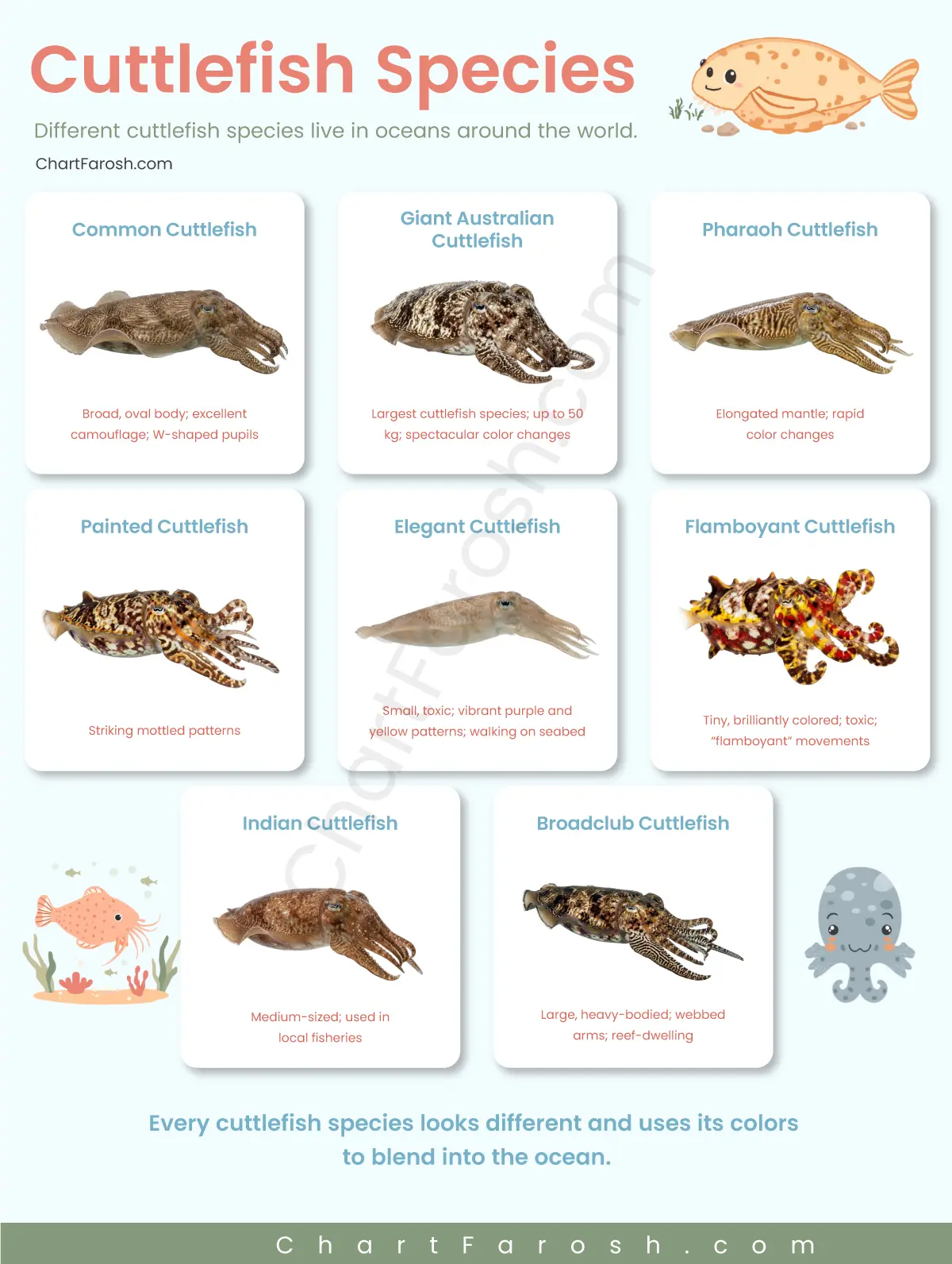
Table of Contents
How Many Species of Cuttlefish Are There?
There are more than 120 living species of cuttlefish. They all sit in one family, Sepiidae, inside the order Sepiida. Most belong to a single huge genus, Sepia. A few smaller genera hold the rest.
The count keeps shifting. A 2023 study used DNA to split many Sepia species into new genera, such as Ascarosepion and Acanthosepion. So the names change even when the animals do not. Below is a simple view of the main groups.
| Genus | Approx. species | Notable example |
| Sepia | 90+ | Common cuttlefish (Sepia officinalis) |
| Metasepia | 2 | Flamboyant cuttlefish (Metasepia pfefferi) |
| Sepiella | About 7 | Japanese spineless cuttlefish |
| Ascarosepion (2023 split) | 10+ | Giant Australian cuttlefish |
What Is a Cuttlefish?
A cuttlefish is a cephalopod, the same group as squid and octopus. It is not a fish. It has eight arms and two longer feeding tentacles that shoot out to grab prey. Its eyes carry a strange W-shaped pupil.
Inside its body sits a chalky internal shell called the cuttlebone. The animal pumps gas and liquid into tiny chambers in this bone to sink or rise. Above the cuttlebone lies skin packed with about 10 million color cells, which let the cuttlefish change shade, pattern, and even texture in a blink.
A cuttlefish also has three hearts and blue-green blood. The blood runs on copper, not iron, which gives it that color. Most species live only one to two years. They are carnivores and hunt crabs, shrimp, fish, and other cuttlefish.
| Feature | Detail |
| Class | Cephalopoda |
| Order | Sepiida |
| Family | Sepiidae |
| Arms and tentacles | 8 arms plus 2 feeding tentacles |
| Hearts | Three |
| Blood | Blue-green (copper-based hemocyanin) |
| Internal shell | Cuttlebone (controls buoyancy) |
| Lifespan | 1 to 2 years |
| Diet | Carnivore (crabs, shrimp, fish) |
Difference Between Cuttlefish, Squid, and Octopus
These three look alike to most people. They are cousins, not the same animal. The shell, the body shape, and the arms give them away.
| Trait | Cuttlefish | Squid | Octopus |
| Arms and tentacles | 8 arms + 2 tentacles | 8 arms + 2 tentacles | 8 arms, no tentacles |
| Internal shell | Cuttlebone, broad and chalky | Pen, thin and flexible | None |
| Body shape | Broad, flattened oval | Long, torpedo shape | Round, bag-like |
| Pupil shape | W-shaped | Round | Slot or dumbbell |
| Where it lives | Near the seabed, coastal | Open water | Reefs and dens |
| Hearts | Three | Three | Three |
All three can change color and squirt ink. The cuttlebone is the clearest sign of a cuttlefish. You may have seen one before, as pet shops sell dried cuttlebones for birds. For more sea-life charts, see the full Animals Chart section.
List of All Cuttlefish Species
Cuttlefish are hard to count because the family is large and the names keep changing. Here are well-known species with size, range, and conservation status. Status codes follow the IUCN Red List. Sizes show mantle length, the main body behind the eyes.
| Common Name | Scientific Name | Mantle Size | Region | Status |
| Common cuttlefish | Sepia officinalis | Up to 45 cm | E. Atlantic, Mediterranean | Least Concern |
| Pharaoh cuttlefish | Sepia pharaonis | Up to 43 cm | Red Sea, Indo-Pacific | Data Deficient |
| Giant Australian cuttlefish | Sepia apama | Up to 50 cm | Southern Australia | Near Threatened |
| Broadclub cuttlefish | Sepia latimanus | Up to 50 cm | Indo-Pacific reefs | Data Deficient |
| Golden cuttlefish | Sepia esculenta | About 18 cm | NW Pacific (Japan to Philippines) | Least Concern |
| Elegant cuttlefish | Sepia elegans | Up to 12 cm | E. Atlantic, Mediterranean | Data Deficient |
| Flamboyant cuttlefish | Metasepia pfefferi | Up to 8 cm | N. Australia, SE Asia | Data Deficient |
| Dwarf (stumpy) cuttlefish | Sepia bandensis | Up to 7 cm | Western Pacific | Data Deficient |
| Painted cuttlefish | Sepia picta | Small | Indian Ocean, W. Pacific | Data Deficient |
| Indian cuttlefish | Sepia brevimana | Medium | Indian Ocean, Red Sea | Data Deficient |
| Reaper cuttlefish | Sepia mestus | Up to 12 cm | Eastern Australia | Data Deficient |
| Mourning cuttlefish | Sepia plangon | About 12 cm | Eastern Australia | Data Deficient |
Common Cuttlefish: Most Widely Known European Cuttlefish
The common cuttlefish is the one most people picture. It lives along the eastern Atlantic, the North Sea, and the Mediterranean.
Adults reach about 45 centimeters in mantle length. It rests on sandy and muddy bottoms and is a master of camouflage, shifting color and pattern to match the seabed. It is also a major food species, sold fresh and dried across Europe and North Africa.
| Feature | Detail |
| Scientific name | Sepia officinalis |
| Mantle length | Up to 45 cm (18 in) |
| Habitat | Sandy and muddy seabeds, coastal |
| Range | Eastern Atlantic, North Sea, Mediterranean |
| Notable | Fast camouflage; W-shaped pupils |
| Conservation status | Least Concern |
Pharaoh Cuttlefish: Tropical Indo-Pacific Cuttlefish
The pharaoh cuttlefish is a large tropical species. Males can reach 43 centimeters in mantle length, a bit larger than females.
It ranges from the Red Sea across the Indian Ocean to Japan and Australia. It changes color and pattern almost instantly, both to hide and to confuse prey. It supports large fisheries and is now farmed in some countries.
| Feature | Detail |
| Scientific name | Sepia pharaonis |
| Mantle length | Up to 43 cm (males) |
| Habitat | Coastal waters, 1 to 130 m deep |
| Range | Red Sea, Indo-Pacific, to Japan and Australia |
| Notable | Important food fishery; near-instant color change |
| Conservation status | Data Deficient |
Giant Australian Cuttlefish: Largest Known Cuttlefish Species
The giant Australian cuttlefish is the largest cuttlefish in the world. Its mantle reaches 50 centimeters, and its total length can pass one meter. It weighs over 10.5 kilograms. Each winter, thousands gather to breed in the shallow waters of Spencer Gulf in South Australia, one of the few mass cuttlefish breeding events on Earth. The IUCN lists it as Near Threatened.
| Feature | Detail |
| Scientific name | Sepia apama |
| Mantle length | Up to 50 cm (20 in) |
| Total length | Up to 1 m (39 in) |
| Weight | Over 10.5 kg (23 lb) |
| Range | Southern Australia; Spencer Gulf breeding aggregation |
| Conservation status | Near Threatened |
Golden Cuttlefish: Distinctive Golden-Hued Species
The golden cuttlefish gets its name from the warm golden sheen along its body and fins. It is smaller than the giants, about 18 centimeters long. It lives in the northwest Pacific, from Russian seas and Japan down to Korea, China, and the Philippines. It is one of the most valuable cuttlefish in East Asian fisheries and is now raised in hatcheries.
| Feature | Detail |
| Scientific name | Sepia esculenta |
| Mantle length | About 18 cm (7 in) |
| Habitat | Sand and seagrass beds, 10 to 100 m |
| Range | NW Pacific: Japan, Korea, China, Philippines |
| Notable | Golden sheen; major East Asian fishery |
| Conservation status | Least Concern |
Broadclub Cuttlefish: Reef-Dwelling Indo-Pacific Species
The broadclub cuttlefish is the second largest cuttlefish, after the giant Australian. Its mantle reaches 50 centimeters and it weighs around 10 kilograms. It lives on coral reefs and lagoons across the Indo-Pacific. It has broad, webbed arms and a clever hunting trick. It flashes moving bands of color down its arms to dazzle and freeze a crab before striking.
| Feature | Detail |
| Scientific name | Sepia latimanus |
| Mantle length | Up to 50 cm (20 in) |
| Weight | Around 10 kg (22 lb) |
| Habitat | Coral reefs and lagoons |
| Range | Indo-Pacific |
| Notable | Broad webbed arms; hypnotic stripe display |
| Conservation status | Data Deficient |
Elegant Cuttlefish: Small Mediterranean Species
The elegant cuttlefish is a small species, with a mantle of about 12 centimeters. It lives in the eastern Atlantic, the Mediterranean, and the Black Sea. It prefers sandy and muddy bottoms offshore and can go as deep as 500 meters. In winter it moves to deeper water, then returns to the shallows in spring to spawn. It matters to some Mediterranean fisheries.
| Feature | Detail |
| Scientific name | Sepia elegans |
| Mantle length | Up to 12 cm (small) |
| Habitat | Sandy and muddy bottoms, offshore to 500 m |
| Range | Eastern Atlantic, Mediterranean, Black Sea |
| Notable | Seasonal depth migration; reddish-brown color |
| Conservation status | Data Deficient |
Flamboyant Cuttlefish: Tiny Toxic Indo-Pacific Species
The flamboyant cuttlefish is small but unforgettable. The mantle is only about 8 centimeters. It flashes bold red, yellow, and purple waves across its body when disturbed. Unlike most cuttlefish, it often walks along the seabed on its arms instead of swimming. Its flesh is toxic, which is rare among cuttlefish, so the bright display is a real warning.
| Feature | Detail |
| Scientific name | Metasepia pfefferi |
| Mantle length | Up to 8 cm (3 in) |
| Habitat | Sand and mud seafloor, shallow water |
| Range | Northern Australia, New Guinea, Southeast Asia |
| Notable | Toxic flesh; walks on the seabed; bright color flashes |
| Conservation status | Data Deficient |
Cuttlefish Habitat and Geographic Distribution
Cuttlefish live in oceans around much of the world, in both warm and cool water. Most stay near the seabed in shallow coastal zones, though some go down past 600 meters. They like sand, mud, seagrass, and reefs, where they can hide and ambush prey.
One gap stands out. There are no cuttlefish along the coasts of North or South America. Squid and octopus live there, but cuttlefish never crossed into those waters. The table below shows the main regions and a few species from each.
| Region | Typical Waters | Example Species |
| E. Atlantic and Mediterranean | Temperate, coastal | Common, elegant cuttlefish |
| Indo-Pacific | Tropical reefs and shallows | Pharaoh, broadclub, flamboyant |
| Southern Australia | Temperate reefs and gulfs | Giant Australian cuttlefish |
| NW Pacific (East Asia) | Coastal, sand and seagrass | Golden cuttlefish |
| The Americas | None present | No cuttlefish species |
FAQs
How many species of cuttlefish are there?
There are more than 120 living species in the family Sepiidae. Most belong to the genus Sepia, though recent DNA work has split many into new genera.
What is the largest cuttlefish?
The giant Australian cuttlefish (Sepia apama). Its mantle reaches 50 centimeters, its total length passes one meter, and it can weigh over 10.5 kilograms.
What is the smallest cuttlefish?
Among the smallest are the flamboyant and dwarf cuttlefish, with bodies only a few centimeters long. Some species mature at under two centimeters.
Is a cuttlefish a fish?
No. A cuttlefish is a cephalopod mollusk, related to squid and octopus. It has no backbone, no scales, and no fins like a true fish.
Are cuttlefish poisonous?
Most cuttlefish are harmless to handle and safe to eat. The flamboyant cuttlefish is the exception, since its flesh is toxic. Its bright color flashes act as a warning.
Where are cuttlefish found?
In oceans across Europe, Africa, Asia, and Australia, mostly in shallow coastal water. They are absent from the coasts of the Americas.
How long do cuttlefish live?
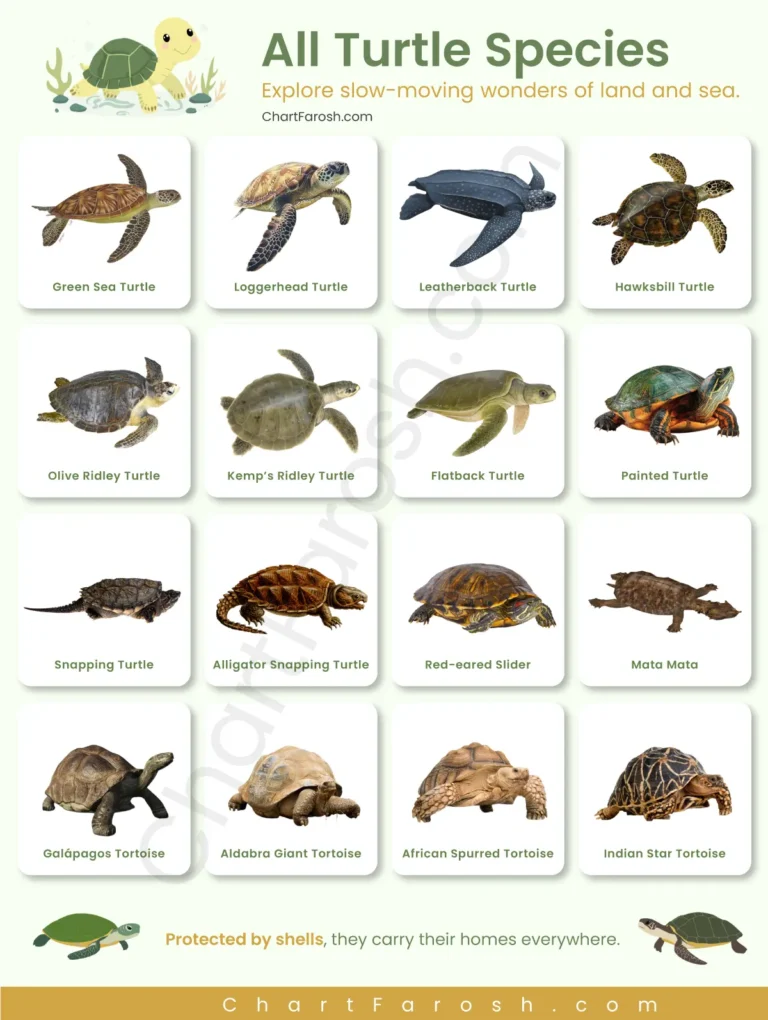
Most cuttlefish live only one to two years. They breed once near the end of life and then die. For more ocean and reptile charts, see our turtle species guide and the full Animals Chart section.