Types of Bugs
When I called everything in my garden a “bug,” my niece corrected me. She had learned at school that a spider is not an insect. She was right, and it sent me down a rabbit hole.
It turns out the word bug means two different things. In daily life, a bug is any small creepy-crawly. In science, only one group counts as a true bug. The rest are beetles, flies, bees, spiders, and more, each with its own family.
Below you will find the main types of bugs, what sets each one apart, and where they live. The charts sort them by group first, then by size, danger, and habitat. You can match a bug to its name in a few steps.
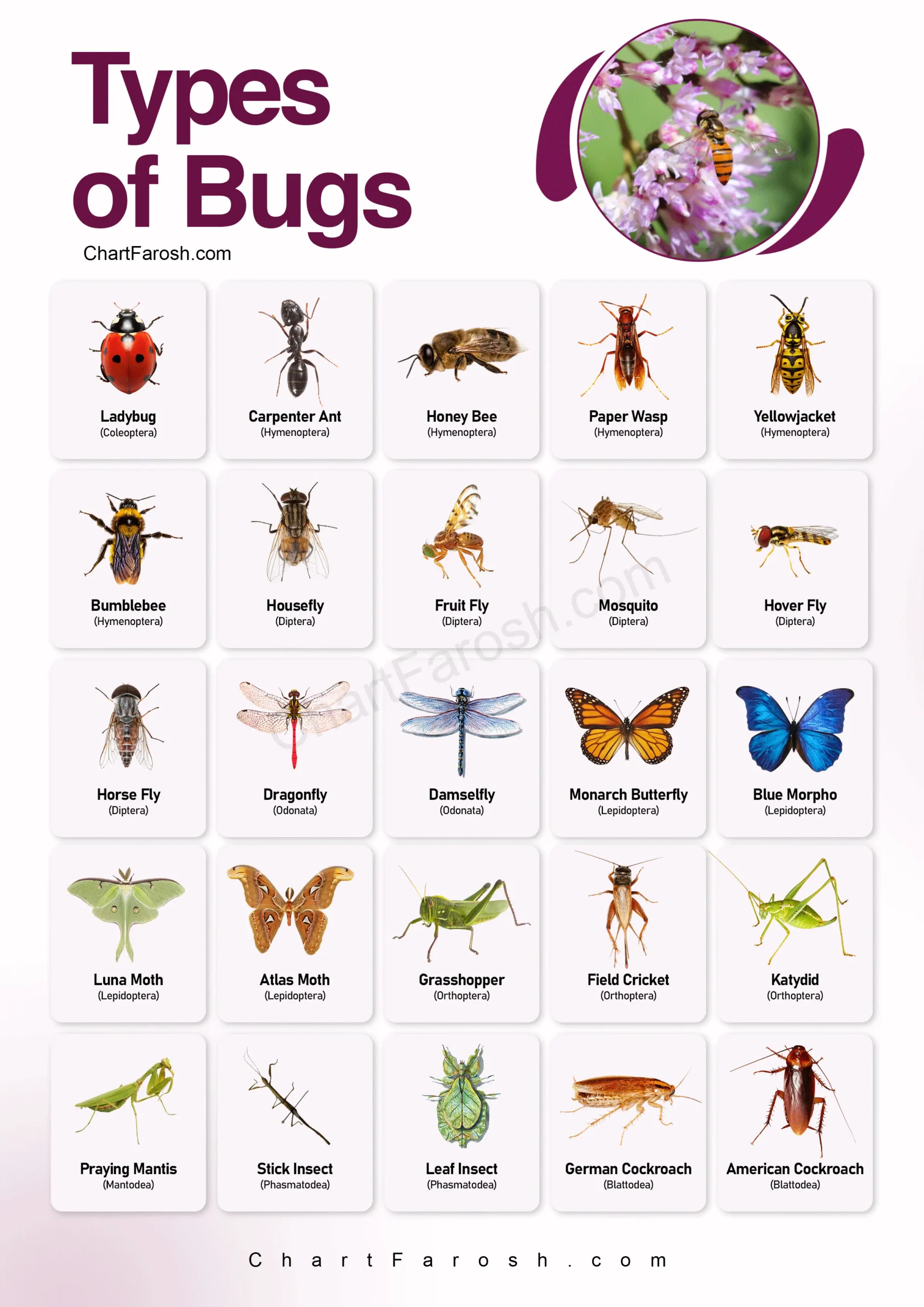
Table of Contents
Types of bugs and their names
Almost every bug is an arthropod. That means it has a hard outer shell, a body built in segments, and jointed legs. From there, the groups split apart fast, and the easiest way to tell them is to count the legs.
Insects have six legs and three body parts. Spiders and scorpions have eight legs. Centipedes and millipedes have many. The table below lays out the main groups so you can place a bug before you name it.
| Group | Scientific name | Legs | Quick tell |
| Beetles | Coleoptera | 6 | Hard wing cases fold over the back |
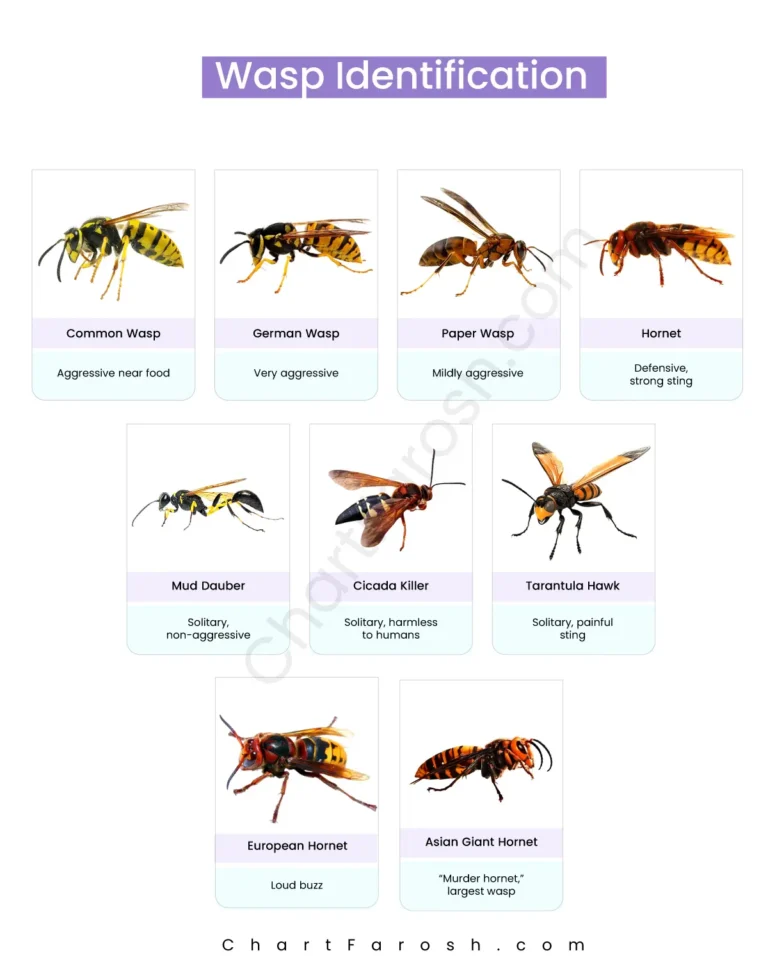
| Bees, ants & wasps | Hymenoptera | 6 | Narrow waist; many can sting |
| Flies | Diptera | 6 | Only one pair of wings |
| Dragonflies & damselflies | Odonata | 6 | Long body and four clear wings |
| Butterflies & moths | Lepidoptera | 6 | Large wings covered in scales |
| Grasshoppers & crickets | Orthoptera | 6 | Big back legs built for jumping |
| True bugs | Hemiptera | 6 | Straw-like mouth; the only real “bugs” |
| Roaches & termites | Blattodea | 6 | Flat bodies; termites live in colonies |
| Spiders & scorpions | Arachnida | 8 | Eight legs, no antennae; not insects |
| Ticks & mites | Arachnida | 8 | Tiny eight-legged parasites |
| Centipedes & millipedes | Myriapoda | Many | Many legs; not insects |
Within those groups sit thousands of species. The chart below lists common and well-known bugs, with the group each belongs to, its size and colors, and a feature that helps you tell it apart.
| Name | Group | Size | Main colors | Distinct feature | Habitat |
| Ladybug | Beetle | Small | Red, orange | Rounded spotted shell | Gardens |
| Carpenter ant | Ant | Medium | Black, red | Nests in wood | Forests & homes |
| Honey bee | Bee | Medium | Yellow & black | Makes honey and wax | Hives |
| Paper wasp | Wasp | Medium | Yellow, brown | Paper-like nests | Roofs & trees |
| Yellowjacket | Wasp | Small–medium | Yellow & black | Quick to sting | Underground nests |
| Bumblebee | Bee | Large | Black & yellow | Fuzzy pollinator | Meadows |
| Housefly | Fly | Small | Gray | Common indoor fly | Homes |
| Fruit fly | Fly | Tiny | Tan | Drawn to fruit | Kitchens |
| Mosquito | Fly | Small | Gray, brown | Females feed on blood | Wet areas |
| Hover fly | Fly | Small | Yellow & black | Mimics bees | Flower gardens |
| Horse fly | Fly | Large | Brown, black | Painful bite | Farms |
| Dragonfly | Dragonfly | Large | Blue, green | Strong flying predator | Near water |
| Damselfly | Damselfly | Small | Blue, metallic | Thin body, folded wings | Ponds |
| Monarch butterfly | Butterfly | Medium | Orange & black | Long migration | Meadows |
| Blue morpho | Butterfly | Large | Bright blue | Iridescent wings | Rainforests |
| Luna moth | Moth | Large | Pale green | Long tail-like wings | Forests |
| Atlas moth | Moth | Very large | Brown, orange | Giant wingspan | Tropical forests |
| Grasshopper | Grasshopper | Medium | Green, brown | Strong jumping legs | Grasslands |
| Field cricket | Cricket | Small | Black | Chirping song | Fields |
| Katydid | Cricket relative | Medium | Green | Leaf-like wings | Bushes |
| Praying mantis | Mantis | Large | Green, brown | Grasping front legs | Gardens |
| Stick insect | Stick insect | Large | Brown, green | Twig camouflage | Forests |
| Leaf insect | Leaf insect | Medium | Green | Leaf mimicry | Tropical forests |
| German cockroach | Cockroach | Medium | Light brown | Fast household pest | Kitchens |
| American cockroach | Cockroach | Large | Reddish-brown | Large indoor roach | Basements |
| Termite | Termite | Tiny | Pale white | Eats wood | Underground colonies |
| Bed bug | True bug | Tiny | Reddish-brown | Blood-feeding parasite | Mattresses |
| Stink bug | True bug | Medium | Green, brown | Gives off a strong odor | Crops & gardens |
| Assassin bug | True bug | Medium | Brown, black | Predatory bite | Plants |
| Aphid | True bug | Tiny | Green | Feeds on plant sap | Leaves |
| Cicada | True bug | Large | Black & orange | Loud buzzing call | Trees |
| Water strider | True bug | Small | Brown | Walks on water | Ponds |
| Giant water bug | True bug | Large | Brown | Aquatic predator | Freshwater |
| Firefly | Beetle | Small | Black & yellow | Gives off light | Forest edges |
| Hercules beetle | Beetle | Very large | Olive, black | Huge horn | Rainforests |
| Stag beetle | Beetle | Large | Dark brown | Antler-like jaws | Woodlands |
| Weevil | Beetle | Small | Brown | Long snout | Grain stores |
| Scarab beetle | Beetle | Medium | Metallic green | Heavy body | Deserts & forests |
| Jumping spider | Spider | Tiny | Black, colorful | Sharp eyesight | Walls & plants |
| Black widow | Spider | Medium | Black & red | Venomous bite | Dark corners |
| Scorpion | Scorpion | Medium | Yellow, black | Venomous tail | Deserts |
| Tick | Tick / mite | Tiny | Brown | Blood-feeding parasite | Grasslands |
| Dust mite | Tick / mite | Microscopic | White | Eats skin flakes | Bedding |
| House centipede | Centipede | Medium | Gray-brown | Many long legs | Homes |
| Giant millipede | Millipede | Large | Black | Two leg pairs per segment | Forest floors |
| Silverfish | Bristletail | Small | Silver-gray | Wingless household pest | Bathrooms |
| Earwig | Earwig | Small | Brown | Pincers on the tail | Gardens |
| Cat flea | Flea | Tiny | Dark brown | Jumping parasite | Pets |
| Head louse | Louse | Tiny | Gray | Scalp parasite | Hair |
| Mayfly | Mayfly | Small | Pale brown | Very short adult life | Rivers |
| Dobsonfly | Dobsonfly | Large | Brown | Huge jaws in males | Streams |
| *Many creatures we call “bugs” are not bugs in the strict sense. Scientists use “true bug” only for the order Hemiptera, such as the bed bug, stink bug, aphid, and cicada. Spiders, scorpions, ticks, and mites are arachnids with eight legs. Centipedes and millipedes are myriapods. None of these are insects. |
What counts as a true bug?
A true bug belongs to the order Hemiptera. The clue is the mouth. True bugs have a sharp, straw-like beak that pierces and sucks, whether from a plant stem or, in the case of the bed bug, from skin.
Aphids, cicadas, stink bugs, and water striders all share that beak. A beetle does not, and neither does an ant. So the next time someone calls a beetle a bug, you will know the difference, even if the everyday word covers both.
Largest bugs in the world
Size records cross several groups, so the giants are not all insects. The Hercules beetle is the longest insect at about 19 cm, and over half of that is its horn. The giant African millipede can be longer overall, but it is a myriapod, not an insect.
The table below ranks the largest bugs by size and names the group each belongs to. Wingspan, body length, and leg span all measure different things, so a spider can span a dinner plate while weighing very little.
| Bug | Group | Size | Where found |
| Hercules beetle | Beetle (Coleoptera) | Up to ~19 cm long | Central & South America |
| Atlas moth | Moth (Lepidoptera) | Wingspan up to ~24 cm | Asia |
| Giant water bug | True bug (Hemiptera) | Up to ~12 cm long | Freshwater, Americas & Asia |
| Goliath birdeater | Spider (Arachnida) | Leg span up to ~30 cm | South America |
| Giant African millipede | Millipede (Myriapoda) | Up to ~33 cm long | West Africa |
Smallest bugs
The tiniest bugs hide in plain sight. Aphids cluster on leaf tips, dust mites live in bedding, and fairy wasps are smaller than a grain of salt. Many are barely visible without a lens.
Small does not mean harmless or useless. Aphids can ruin a crop, dust mites trigger allergies, and tiny parasitic wasps protect gardens by attacking pest eggs. The smallest bugs often have the biggest effect on the spaces we share with them.
Dangerous vs harmless bugs
Most bugs cannot hurt you at all. A small number bite, sting, or carry disease, and those are worth knowing. The risk often depends on where you live, so a bug that is harmless in one place can be a concern in another.
The table below sorts well-known bugs by the risk they pose. For most people, the bigger worry is an itchy bite or a painful sting rather than real danger. Allergies and local disease are the cases that call for more care.
| Bug | Risk to people | What to know |
| Black widow, scorpion | Venomous | A bite or sting can need medical care. Deaths are rare with prompt treatment. |
| Tick | Bites; disease risk | Can pass on Lyme disease and other illnesses through its bite. |
| Mosquito | Bites; disease risk | Females can spread malaria, dengue, and more, depending on the region. |
| Bee, wasp, yellowjacket | Stings | A sting hurts and can be serious for people with allergies. |
| Bed bug, flea, louse | Bites, no venom | Itchy and a nuisance. For most people they do not spread disease. |
| Ladybug, butterfly, dragonfly | Harmless | No bite or sting. Many are useful in the garden. |
Helpful bugs you should welcome
Plenty of bugs work in your favor. Bees, butterflies, and hover flies pollinate the plants we eat. Without them, gardens and farms would struggle to produce fruit and seed.
Other bugs control pests for free. Ladybugs and lacewings eat aphids, mantises hunt larger insects, and dragonflies clear out mosquitoes. Dung beetles and millipedes recycle waste and feed the soil, which keeps the whole system running.
Common bugs around the home
A few bugs turn up indoors more than the rest. Cockroaches and ants come for food and water. Silverfish and house centipedes prefer damp corners, while fruit flies gather near ripe produce.
Most indoor problems trace back to moisture, food, or clutter. Seal gaps, fix leaks, and store food well, and the numbers usually drop. Bed bugs are the hard exception, since they hide in seams and often need professional treatment.
Types of bugs by habitat
Where you are shapes the bugs you see. Kitchens draw roaches and flies, gardens fill with bees and beetles, and ponds hum with dragonflies. The table below pairs each habitat with the bugs you are most likely to find there.
| Habitat | Bugs you’ll find there |
| Homes & kitchens | Cockroach, ant, housefly, fruit fly, silverfish, bed bug, house centipede |
| Gardens & crops | Ladybug, aphid, stink bug, grasshopper, praying mantis, bumblebee |
| Water & wetlands | Dragonfly, damselfly, mosquito, water strider, giant water bug, mayfly |
| Forests & woodlands | Stag beetle, stick insect, luna moth, carpenter ant, dobsonfly |
| Deserts & dry areas | Scorpion, scarab beetle, some grasshoppers |
FAQs
What is a bug?
In everyday speech, a bug is any small crawling or flying creature. In science, a “true bug” means only the order Hemiptera, such as the bed bug, stink bug, aphid, and cicada.
Are spiders bugs or insects?
Neither. Spiders are arachnids. They have eight legs and two body parts, while insects have six legs and three body parts.
What is the largest bug?
The Hercules beetle is the longest insect by total length, at about 19 cm. The giant African millipede can stretch even longer at around 33 cm, though it is a myriapod, not an insect.
What is the difference between an insect and a bug?
All true bugs are insects, but not all insects are bugs. A true bug belongs to the order Hemiptera and feeds through a straw-like mouth.
Which bugs are dangerous to people?
Black widows and scorpions are venomous, ticks and mosquitoes can carry disease, and bee or wasp stings can be serious for people with allergies. Most other bugs are harmless.
Which bugs are helpful?
Bees and butterflies pollinate plants. Ladybugs, mantises, and dragonflies eat pests. Dung beetles and millipedes break down waste and enrich the soil.
How can I identify a bug?
Start by counting the legs. Six legs and three body parts point to an insect, eight legs to an arachnid, and many legs to a centipede or millipede. Then check the wings, color, and size against a chart.