Types of Butterflies
The first butterfly I learned to name was a monarch, mostly because my mother kept pointing at the orange ones in the garden. It took me years to notice the rest. Once you start looking, the variety is hard to ignore, and the names start to make sense.
There are around 17,500 butterfly species in the world, spread across six main families. Each family shares a few traits you can learn to spot. Size, wing shape, color, and even flight style all give you clues.
Below you will find the main types of butterflies, what sets each one apart, and where they live. The charts group them by family first, then by size, rarity, and region, so you can match a butterfly to its name in a few steps.
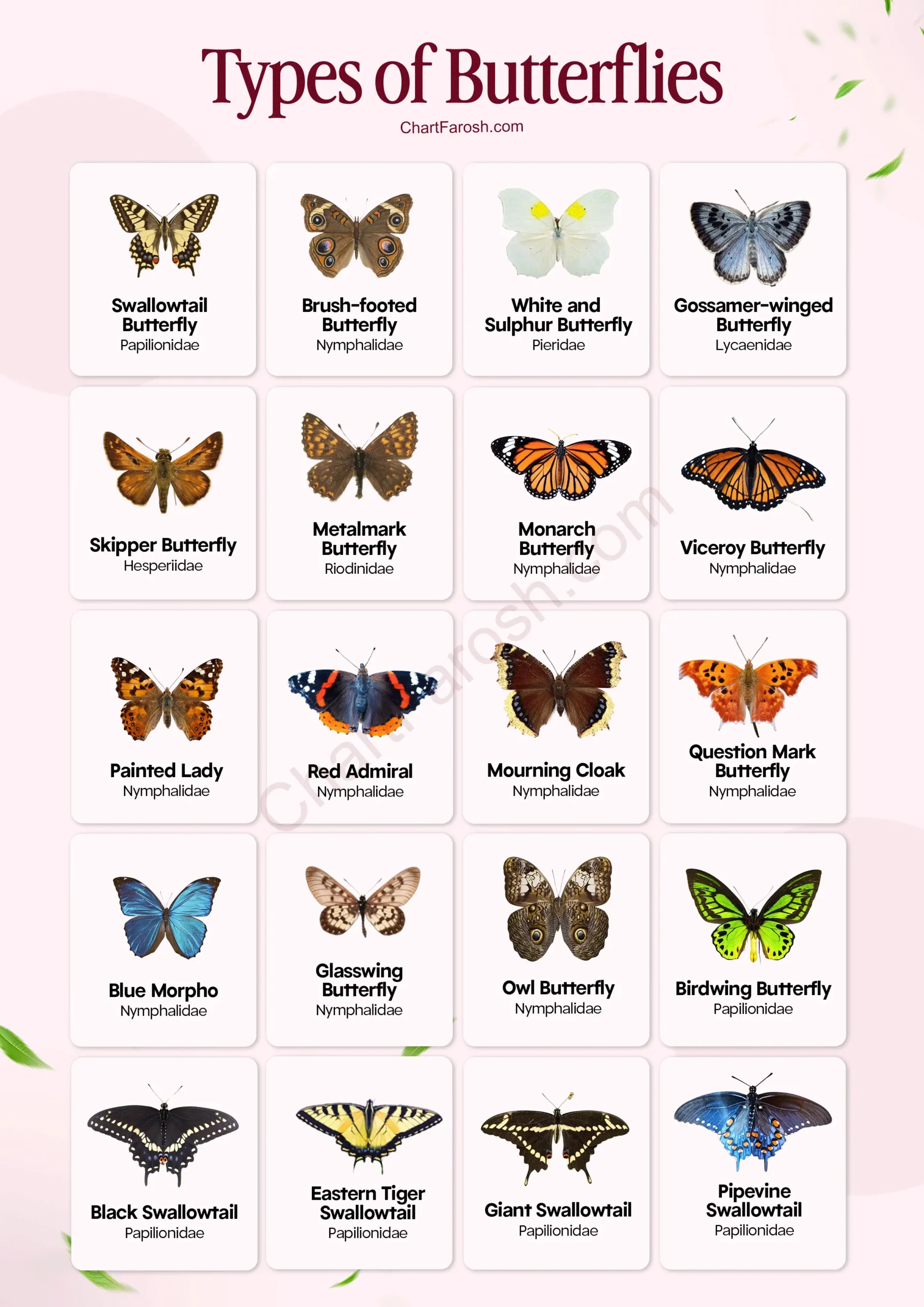
Table of Contents
Types of butterflies and their names
Butterflies belong to the order Lepidoptera, which they share with moths. Scientists sort them into families based on wing structure, leg shape, and life cycle. Six families cover almost every butterfly you are likely to see in a garden, field, or forest.
The largest and most colorful tend to be swallowtails and brush-footed butterflies. Small flashes of blue or copper in a meadow are usually gossamer-winged butterflies. A fast brown blur near the grass is often a skipper. The table below sorts the six families by their main traits.
| Family | Scientific family | Size | Main colors | Distinctive feature | Examples |
| Swallowtails | Papilionidae | Large | Yellow, black, blue | Tail-like extensions on hindwings | Tiger swallowtail, birdwing |
| Brush-footed | Nymphalidae | Medium to large | Orange, brown, black | Reduced, brush-like front legs | Monarch, painted lady, peacock |
| Whites & sulphurs | Pieridae | Small to medium | White, yellow | Plain garden butterflies | Cabbage white, clouded sulphur |
| Gossamer-winged | Lycaenidae | Small | Blue, copper | Tiny, delicate wings | Common blue, American copper |
| Skippers | Hesperiidae | Small to medium | Brown, orange | Fast, darting flight | Fiery skipper, silver-spotted skipper |
| Metalmarks | Riodinidae | Small | Metallic orange/brown | Metallic spots on the wings | Jungle metalmarks |
Within those families sit thousands of species. The chart below lists common and notable butterflies, with the family each belongs to, its size and colors, and a feature that helps you tell it apart.
| Common type | Family | Size | Main colors | Distinct feature | Where found |
| Monarch | Nymphalidae | Medium–large | Orange & black | Long migration; toxic to predators | North America |
| Viceroy | Nymphalidae | Medium | Orange, black | Mimics the monarch | Wetlands |
| Painted lady | Nymphalidae | Medium | Orange, brown | Found on almost every continent | Fields & gardens |
| Red admiral | Nymphalidae | Medium | Black with red bands | Territorial, lands on people | Temperate regions |
| Mourning cloak | Nymphalidae | Large | Dark maroon | Pale wing borders | Forests |
| Question mark | Nymphalidae | Medium | Orange-brown | Silver “?” mark under the wing | Woodlands |
| Blue morpho | Nymphalidae | Large | Bright blue | Iridescent upper wings | Tropical rainforest |
| Glasswing | Nymphalidae | Medium | Transparent | Clear, see-through wings | Central America |
| Owl butterfly | Nymphalidae | Very large | Brown, eye spots | Owl-like eye patterns | South America |
| Zebra longwing | Nymphalidae | Medium | Black & yellow stripes | Slow, gliding flight | Tropical forest |
| Julia | Nymphalidae | Medium | Bright orange | Long, narrow wings | Tropical habitats |
| Peacock | Nymphalidae | Medium | Red with eye spots | Flashes eyespots to startle birds | Europe & Asia |
| Common buckeye | Nymphalidae | Medium | Brown, eye spots | Several “eyes” on the wings | Open sunny areas |
| Malachite | Nymphalidae | Large | Green & black | Bright green wing bands | Tropical forest |
| Black swallowtail | Papilionidae | Large | Black & yellow | Blue and orange spots | Meadows |
| Eastern tiger swallowtail | Papilionidae | Large | Yellow & black | Bold tiger stripes | Eastern forests |
| Giant swallowtail | Papilionidae | Very large | Black & yellow | Largest U.S. swallowtail | Citrus groves |
| Pipevine swallowtail | Papilionidae | Large | Black, blue sheen | Toxic; many species mimic it | Woodland edges |
| Apollo | Papilionidae | Medium–large | White with red spots | Mountain and alpine species | Alpine meadows |
| Common Mormon | Papilionidae | Large | Black | Females take several mimic forms | Asia |
| Birdwing | Papilionidae | Very large | Green, black, gold | Among the largest butterflies | Southeast Asia |
| Cabbage white | Pieridae | Small | White | Common garden and crop pest | Gardens |
| Clouded sulphur | Pieridae | Small–medium | Yellow | Fast, low flight | Grasslands |
| Orange sulphur | Pieridae | Small–medium | Orange-yellow | Common over farm fields | Farms |
| Common Jezebel | Pieridae | Medium | Yellow, red, black | Bright underside colors | South Asia |
| Common blue | Lycaenidae | Small | Blue | Widespread European blue | Meadows |
| Karner blue | Lycaenidae | Small | Silvery blue | Endangered in the U.S. | Sandy pine barrens |
| American copper | Lycaenidae | Small | Copper-orange | Metallic shine | Open fields |
| Hairstreak | Lycaenidae | Small | Brown, blue | Hair-like tails on the wings | Shrublands |
| Silver-spotted skipper | Hesperiidae | Medium | Brown, silver spots | Powerful, fast flight | Woodland edges |
| Fiery skipper | Hesperiidae | Small | Orange-brown | Rapid, jerky movement | Lawns |
| Long-tailed skipper | Hesperiidae | Medium | Brown, blue-green | Long tails on the hindwings | Tropical gardens |
| Atlas moth* | Saturniidae (moth) | Very large | Brown, orange | A moth, not a butterfly | Southeast Asia |
| *The Atlas moth is not a butterfly. It belongs to the moth family Saturniidae and appears here only because people often mistake it for one. You can tell by its feathery antennae and the way it rests with wings spread flat. |
Largest butterfly species
Size is the easiest way to start grouping butterflies. The giants almost all come from the swallowtail and brush-footed families, and most of them live in the tropics. The record-holder is Queen Alexandra’s birdwing, found only in Papua New Guinea.
The table below ranks the largest butterflies by wingspan. The Atlas moth makes the list by size, though it remains a moth, not a butterfly.
| Species | Family | Wingspan | Where found |
| Queen Alexandra’s birdwing | Papilionidae | Up to ~25–28 cm | Papua New Guinea |
| Goliath birdwing | Papilionidae | Up to ~20 cm | New Guinea, Indonesia |
| Atlas moth* | Saturniidae (moth) | Up to ~24–30 cm | Southeast Asia |
| Owl butterfly | Nymphalidae | Up to ~16–20 cm | Central & South America |
| Giant swallowtail | Papilionidae | Up to ~14–18 cm | North America |
Smallest butterfly species
At the other end sit the gossamer-winged butterflies, the blues, coppers, and hairstreaks. Many are smaller than a coin. The western pygmy blue is one of the smallest in the world, with a wingspan near 1.2 to 2 cm.
Small butterflies are easy to miss, but they reward a close look. Their wings often carry fine spots, hair-like tails, or a metallic shine that only shows in good light. Slow down near low flowers and you will start to find them.
Rarest butterflies in the world
Rarity usually comes down to a small range or a fussy host plant. Queen Alexandra’s birdwing is rare because it lives in one corner of Papua New Guinea and depends on a single vine. The Palos Verdes blue, found near Los Angeles, was once thought extinct before a tiny colony turned up again.
The Karner blue is another example. Its caterpillars eat only wild lupine, so the butterfly vanishes wherever that plant disappears. Protecting these butterflies means protecting the exact plants and patches of land they need.
Common and popular butterfly species
Some butterflies turn up almost anywhere. The painted lady lives on nearly every continent and travels long distances each year. The cabbage white is the small white butterfly you see over vegetable beds, and the monarch is the famous orange traveler of North America.
In Europe and the UK, the peacock and the red admiral are the ones most people recognize. The peacock flashes the eye spots on its wings to scare off birds. The red admiral is bold and will sometimes land on your hand.
Toxic vs harmless butterflies
No butterfly can hurt a person. The “toxic” label only matters to the birds and lizards that try to eat them. A few species store poisons from the plants they ate as caterpillars, which makes them taste bad and keeps predators away.
This is where mimicry comes in. The viceroy looks almost exactly like the toxic monarch, so birds avoid both. Many harmless butterflies survive by copying a toxic neighbor. The table below compares a few well-known examples.
| Butterfly | Toxic or harmless? | How it protects itself |
| Monarch | Toxic to predators | Stores toxins from milkweed it eats as a caterpillar. Birds learn to avoid it. |
| Pipevine swallowtail | Toxic to predators | Takes up toxins from pipevine plants. Several other species copy its look. |
| Viceroy | Mildly distasteful | Looks like the monarch, so birds avoid both. The two share their defense. |
| Cabbage white | Harmless | No chemical defense. Relies on numbers and quick flight to survive. |
| Painted lady | Harmless | No toxins. Survives through wide range and constant movement. |
Endangered butterfly species
Butterfly numbers have fallen in many regions, and a few species now carry official protection. The migratory monarch was listed as Endangered on the IUCN Red List in 2021, then reassessed to Vulnerable in late 2023. In the United States, wildlife officials proposed listing the monarch as threatened in December 2024, though that listing was not yet final at the time of writing.
Other butterflies face the same pressures on a smaller scale. The table below shows the main protected species and what threatens each one. Habitat loss and pesticides drive most of the decline, so saving host plants is the clearest way to help.
| Species | Status | Region | Main threat |
| Migratory monarch | IUCN: Vulnerable | North America | Habitat loss, pesticides, climate change |
| Karner blue | U.S.: Endangered | Northern U.S. | Loss of wild lupine, its host plant |
| Apollo | CITES Appendix II | Europe, Central Asia | Climate change in mountain habitats |
| Palos Verdes blue | U.S.: Endangered | California | Urban development; one of the rarest |
Types of butterflies by region
Where you live shapes the butterflies you see. North America has its swallowtails, monarchs, and skippers. Europe and the UK have peacocks, red admirals, and blues. The tropics hold the showiest species, including the blue morpho and the glasswing.
The table below pairs each region with the butterflies you are most likely to meet there. Use it as a starting point for a local walk, then check a field chart to confirm what you find.
| Region | Common butterflies you’ll see |
| North America | Monarch, eastern tiger swallowtail, painted lady, cabbage white, common buckeye, fiery skipper |
| Europe & the UK | Peacock, red admiral, common blue, painted lady, Apollo, cabbage white |
| Tropics (Asia, Central & South America) | Blue morpho, glasswing, owl butterfly, malachite, common Mormon, birdwing |
FAQs
How many types of butterflies are there?
There are around 17,500 butterfly species worldwide. They sit within six main families, so most butterflies you meet belong to one of those groups.
What are the main butterfly families?
The six families are swallowtails, brush-footed butterflies, whites and sulphurs, gossamer-winged butterflies, skippers, and metalmarks. Wing shape, leg structure, and size set them apart.
What is the largest type of butterfly?
Queen Alexandra’s birdwing is the largest, with a wingspan up to about 25 to 28 cm. It lives only in a small part of Papua New Guinea.
What is the smallest butterfly?
The western pygmy blue is one of the smallest, with a wingspan near 1.2 to 2 cm. Most of the tiniest butterflies belong to the gossamer-winged family.
How do I tell a butterfly from a moth?
Butterflies have thin antennae with a small club at the tip, and they rest with wings held up. Most moths have feathery antennae, fly at night, and rest with wings flat.
Which butterflies are endangered?
The migratory monarch is listed as Vulnerable on the IUCN Red List, and the Karner blue is endangered in the United States. Habitat loss and pesticides drive most of these declines.
Are any butterflies dangerous to humans?
No butterfly is dangerous to people. Some, like the monarch and pipevine swallowtail, are toxic to the birds that try to eat them, but they cannot harm you.