Types of Moths
Last summer I left the porch light on by mistake. By morning the screen door was covered in moths. Big ones. Tiny ones. One had wings the color of a faded leaf. Another looked like it was wearing a fur coat.
I had always filed moths away as the dull cousins of butterflies. That night changed my mind. I started reading, and one number stopped me cold. There are around 160,000 known moth species. Butterflies make up fewer than 20,000.
So I went looking for a way to sort them out. The different types of moths fall into a handful of clear families. Once you learn the families, identification gets much easier. Size, color, and a single standout feature are usually enough to place one.
Below you will find every moth from the chart, grouped by family, with size, color, and the one feature that earns each its name. You will meet the giant Atlas moth, the silk-spinning silkworm, and a plain gray moth that taught scientists how evolution works. Some are harmless night visitors. A few will happily eat your sweaters.
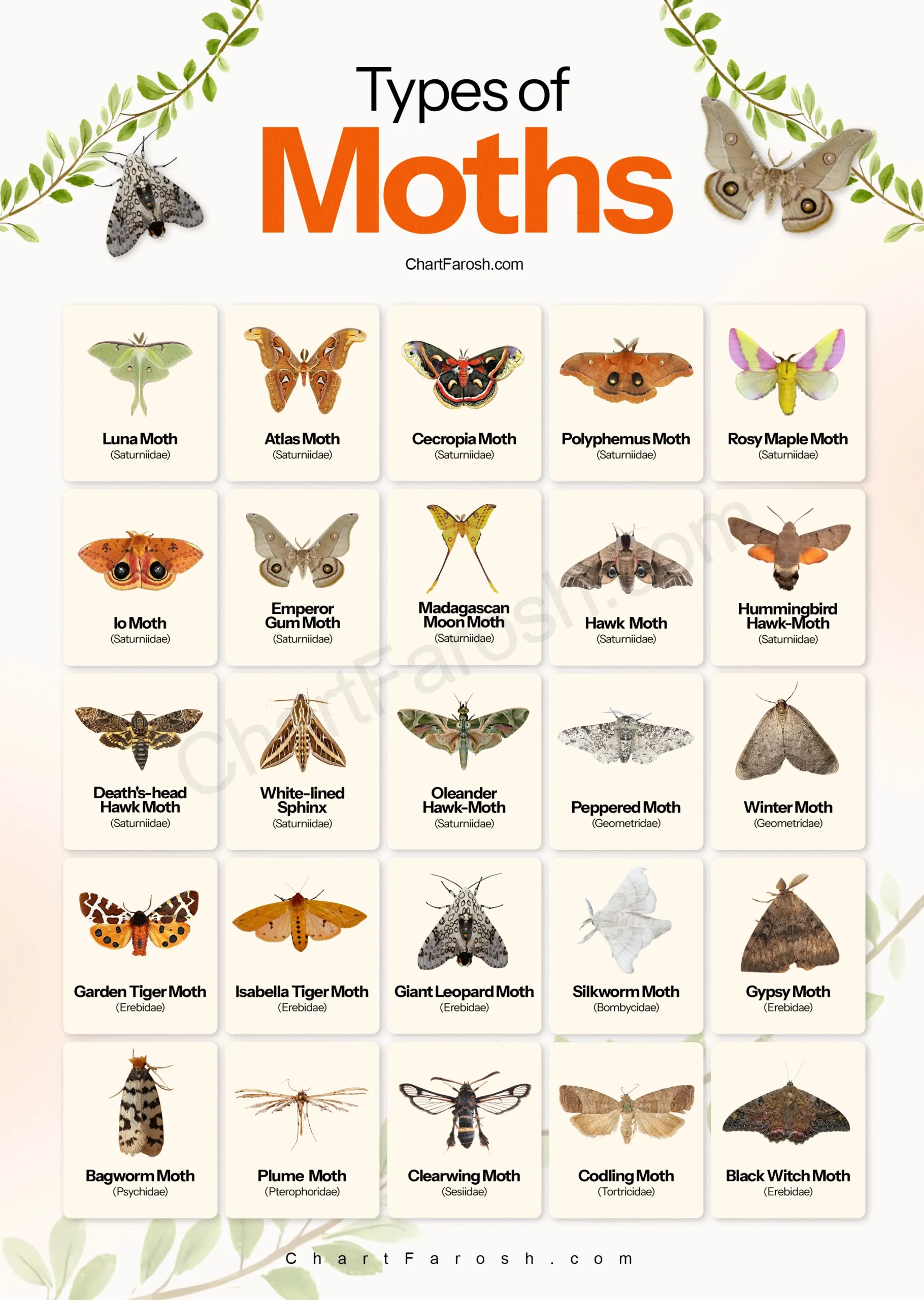
Table of Contents
Moth Identification Chart (All 37 Types)
This chart lists all 37 moth species covered here. Each row gives the family, rough size, main colors, and the single feature that sets the moth apart. Use it to scan fast, then read the family sections below for the full story.
| Moth | Family | Size | Main Colors | Standout Feature |
| Luna Moth | Saturniidae | Large | Pale green | Long tail-like hindwings |
| Atlas Moth | Saturniidae | Very large | Brown, orange | Largest wing area of any moth |
| Cecropia Moth | Saturniidae | Very large | Brown, red, white | Largest native North American moth |
| Polyphemus Moth | Saturniidae | Large | Brown | Large eyespots on the hindwings |
| Rosy Maple Moth | Saturniidae | Medium | Pink and yellow | Cotton-candy coloring |
| Io Moth | Saturniidae | Medium | Yellow, brown | Bold hindwing eyespots |
| Emperor Gum Moth | Saturniidae | Large | Brown, pink | Giant Australian silk moth |
| Comet Moth (Madagascan Moon Moth) | Saturniidae | Very large | Yellow | Extremely long hindwing tails |
| African Moon Moth | Saturniidae | Large | Green | Long tails, found in East Africa |
| Promethea Moth | Saturniidae | Medium-large | Black, reddish-brown | Strong male-female color difference |
| Imperial Moth | Saturniidae | Large | Yellow with brown spots | Heavy-bodied giant |
| Spanish Moon Moth | Saturniidae | Large | Green | Long tails, native to European pine forests |
| Elephant Hawk-Moth | Sphingidae | Medium-large | Pink and olive | Bright pink and green stripes |
| Hummingbird Hawk-Moth | Sphingidae | Medium | Brown and orange | Hovers while it feeds |
| Death’s-head Hawk Moth | Sphingidae | Large | Brown, yellow | Skull-like mark on the thorax |
| White-lined Sphinx | Sphingidae | Medium | Brown with white stripes | Strong migratory flyer |
| Oleander Hawk-Moth | Sphingidae | Large | Green camouflage | Leaf-like wing pattern |
| Peppered Moth | Geometridae | Medium | White, black | Famous example of evolution |
| Canary-shouldered Thorn | Geometridae | Medium | Yellow and brown | Leaf-shaped wings |
| Winter Moth | Geometridae | Small | Brown | Females are nearly wingless |
| Tiger Moth | Erebidae | Medium | Orange, black | Bold warning colors |
| Garden Tiger Moth | Erebidae | Medium | Brown, orange, blue | Hairy caterpillar stage |
| Isabella Tiger Moth | Erebidae | Medium | Yellow-orange | Woolly bear caterpillar |
| Giant Leopard Moth | Erebidae | Large | White with black spots | Leopard-like ring pattern |
| Spongy Moth (formerly gypsy moth) | Erebidae | Medium | Brown, cream | Serious forest pest |
| Black Witch Moth | Erebidae | Very large | Dark brown | One of the largest moths in the Americas |
| Miller Moth | Noctuidae | Medium | Gray | Drawn to lights in large numbers |
| Owlet Moth | Noctuidae | Small-large | Brown, gray | Mostly nocturnal, the largest moth family |
| Codling Moth | Tortricidae | Small | Gray-brown | Major apple pest |
| Clothes Moth | Tineidae | Tiny | Golden tan | Larvae damage fabrics |
| Indianmeal Moth | Pyralidae | Small | Brown and copper | Common pantry pest |
| Bagworm Moth | Psychidae | Small | Brown | Caterpillars build protective bags |
| Silkworm Moth | Bombycidae | Medium | White, cream | Source of commercial silk |
| Yucca Moth | Prodoxidae | Small | White | Pollinates yucca plants |
| Clearwing Moth | Sesiidae | Medium | Black and yellow | Mimics wasps and bees |
| Plume Moth | Pterophoridae | Small | Brown, white | Feather-like split wings |
| Puss Moth | Notodontidae | Medium | Gray and white | Unusual defensive caterpillar |
Sizes are general. “Tiny” means a wingspan near 1 cm. “Very large” means 15 cm or more across the wings. For help matching the larvae you find in the garden, see the caterpillar identification chart.
Giant Silk Moths (Saturniidae)
Saturniidae holds the giants. These are the moths people photograph and frame. Adults of most species have no working mouth and never eat. They live a week or less, mate, lay eggs, and die.
The Atlas moth (Attacus atlas) is the headline act. Its wings can stretch past 24 cm, and it carries the largest wing area of any moth. The wingtips look like a snake’s head, which scares off birds. The Atlas moth is native to the forests of Southeast Asia.
North America has its own record holder. The Cecropia moth is the largest native moth on the continent, with a wingspan up to 18 cm. The Luna moth is the famous one, pale green with long sweeping tails. The Polyphemus and Io moths both flash big eyespots when threatened.
Color runs wild in this family. The Rosy maple moth looks dipped in pink and yellow cotton candy. The imperial moth is heavy and yellow with brown blotches. The promethea moth shows a sharp split, with dark males and lighter, more patterned females.
The long-tailed moon moths are the most elegant. The comet moth, also called the Madagascan moon moth, has tails up to 15 cm long and is one of the largest silk moths alive.
The Natural History Museum notes that the adult Madagascan moon moth cannot feed and lives only about a week. Its close relative the African moon moth (Argema mimosae) carries shorter tails across East Africa. Europe answers with the green Spanish moon moth, and Australia with the large, pink-tinged emperor gum moth.
Hawk Moths and Sphinx Moths (Sphingidae)
Hawk moths are the athletes. Narrow wings, thick bodies, and fast, direct flight. Many hover at flowers like tiny helicopters.
The hummingbird hawk-moth is the one people mistake for a real hummingbird. It hovers in daylight and sips nectar through a long tongue. The elephant hawk-moth trades speed for color, with bright pink and olive stripes that look almost tropical.
Others lean strange. The death’s-head hawk moth wears a skull-shaped mark on its back and can squeak when disturbed. The oleander hawk-moth is green and smooth, like a folded leaf. The white-lined sphinx is a strong migrant and turns up far from where it started.
Geometer Moths (Geometridae)
Geometer moths are usually small and flat-winged. Their caterpillars are the loopers, or inchworms, that arch their backs as they walk.
The peppered moth is the star here, even though it is plain. During the Industrial Revolution, soot darkened tree bark in England. Dark peppered moths suddenly hid better than pale ones, so the dark form spread. When the air cleaned up, the pale form returned. It remains one of the clearest field examples of natural selection.
The canary-shouldered thorn holds its wings like a dead leaf, which makes it hard to spot. The winter moth breaks the usual rule. Females have only stubby wings and cannot fly, so they crawl up tree trunks to lay eggs in cold weather.
Tiger, Tussock and Witch Moths (Erebidae)
Erebidae is a huge, mixed family. It holds bright tiger moths, furry-caterpillar tussock moths, and some of the largest dark-winged moths.
Tiger moths use bold colors as a warning. The garden tiger moth pairs a brown forewing with orange and blue hindwings, and tastes foul to predators. The Isabella tiger moth is better known by its larva, the woolly bear caterpillar that curls into a fuzzy ball when touched. The giant leopard moth is white with hollow black rings.
Two members stand out for size and reputation. The black witch moth is one of the largest moths in the Americas, dark and bat-like in flight.
The spongy moth (formerly gypsy moth) is the troublemaker. Its caterpillars strip leaves from forest trees across North America and Eurasia. The Entomological Society of America renamed the spongy moth in 2022, replacing a name that was an ethnic slur.
Owlet and Miller Moths (Noctuidae)
Noctuidae, the owlet moths, is the largest moth family of all. Most are brown or gray and active at night. They are the moths you barely notice until a swarm shows up at the porch light.
The miller moth is the adult of the army cutworm. In some years they move through towns in huge numbers and pile up around doors and windows. The name owlet moth covers thousands of species, so it works as a family label more than a single insect. If you find an unfamiliar brown moth indoors, an owlet is a safe first guess. Our bug identification chart can help you rule out beetles and true bugs.
Pest and Household Moths
Some moths share your home or your harvest. These are small, drab, and easy to miss until the damage shows.
The clothes moth is the closet villain. Its larvae eat wool, fur, and silk, leaving holes in stored clothes. The Indianmeal moth is its kitchen cousin. The larvae get into flour, cereal, and dried fruit, and spin fine webbing in the package.
Outside, the codling moth is the reason for the worm in the apple. Its larva tunnels straight to the core. The bagworm moth is stranger. The caterpillar builds a tough silk case studded with leaves and twigs, then drags it around like a portable tent.
Specialist and Mimic Moths
A few moths earn their place through one remarkable trick.
The silkworm moth (Bombyx mori) gave us silk. It has been farmed for thousands of years and no longer survives in the wild. The yucca moth runs an exclusive deal with yucca plants. It is the only insect that pollinates them, and the plant feeds its larvae in return. You can read about more of these partners in the beneficial insects chart.
Others survive by pretending. The clearwing moth has see-through wings and a black-and-yellow body, so it passes for a wasp. The plume moth looks like a tiny flying T, with wings split into feathery plumes. The puss moth is mild as an adult, but its caterpillar rears up, shows a red face, and waves two whip-like tails to scare off attackers.
Helpful Moths vs Harmful Moths
Moths get a bad name from a few pests. Most are harmless, and several are useful. This table sorts the well-known ones by what they do.
| Moth | Helpful or Harmful | What it does | Where you find it |
| Silkworm Moth | Helpful | Spins the cocoon used for commercial silk | Domestic, reared on mulberry |
| Yucca Moth | Helpful | Pollinates yucca plants, no other insect does the job | Deserts of the Americas |
| Hummingbird Hawk-Moth | Helpful | Pollinates flowers while hovering | Gardens and meadows |
| Spongy Moth | Harmful | Caterpillars strip leaves from forest trees | Woodlands, North America and Eurasia |
| Codling Moth | Harmful | Larvae bore into apples and pears | Orchards worldwide |
| Clothes Moth | Harmful | Larvae eat wool, fur, and silk | Inside homes |
| Indianmeal Moth | Harmful | Larvae infest flour, grains, and dried food | Kitchens and pantries |
The lesson is simple. A moth at your light is almost never a threat. The damage comes from a short list of larvae, not from the adults flying around the yard.
Moths vs Butterflies: How to Tell Them Apart
Moths and butterflies share an order, Lepidoptera, so they overlap. A few habits still split them apart most of the time.
Moths usually fly at night and rest with their wings spread flat or folded over the body. Butterflies fly by day and often hold their wings up. Look at the antennae for the clearest tell.
Moth antennae are feathery or thread-like. Butterfly antennae are thin with a small club on the end. For the daytime side of the family, see the butterfly identification chart and the British butterflies chart.
FAQs
What is the largest moth in the world?
By wing area, the Atlas moth wins. Its wings can pass 24 cm across. By raw wingspan, the white witch moth of the Americas edges ahead at around 28 cm.
Are moths harmful to humans?
No. Adult moths do not bite or sting. The only damage comes from a few species whose larvae eat crops, fabric, or stored food.
Why are moths attracted to light?
Moths navigate by keeping a steady angle to the moon. An artificial light tricks that system, so they spiral toward bulbs instead of flying straight.
What is the difference between a moth and a butterfly?
Most moths fly at night and have feathery or thread-like antennae. Butterflies fly by day and have thin antennae with a club at the tip.
Which moths damage clothes and food?
The clothes moth eats wool, fur, and silk in closets. The Indianmeal moth infests flour, grain, and dried food in the pantry.
Do moths turn into caterpillars?
It is the other way around. A caterpillar is the larval stage that hatches first, then forms a cocoon and emerges as an adult moth. To match the larvae you find, use the caterpillar identification chart, and browse more species on the Animals Chart hub.