Types of House Spiders
Last autumn I reached into the back of my closet for a jacket. A pale spider with long thin legs shot across my hand. I yelped, dropped the jacket, and spent ten minutes sure I had a brown recluse problem.
I didn’t. It was a harmless cellar spider, the kind that lives in almost every garage and basement on the planet.
That little panic sent me down a rabbit hole. I had always lumped every eight-legged thing in the house into one mental box marked “spider, probably bad.” It turns out the spiders sharing your walls fall into very different groups. Most are harmless. A few can give a painful nip. Only two in North America are worth real caution.
So I started keeping notes. Which ones spin webs in the corners. Which ones hunt on the floor at night. Which ones you can scoop into a cup and which ones you leave well alone.
What follows is the result: every common house spider, what it looks like, where it hides, and exactly how worried you should be.
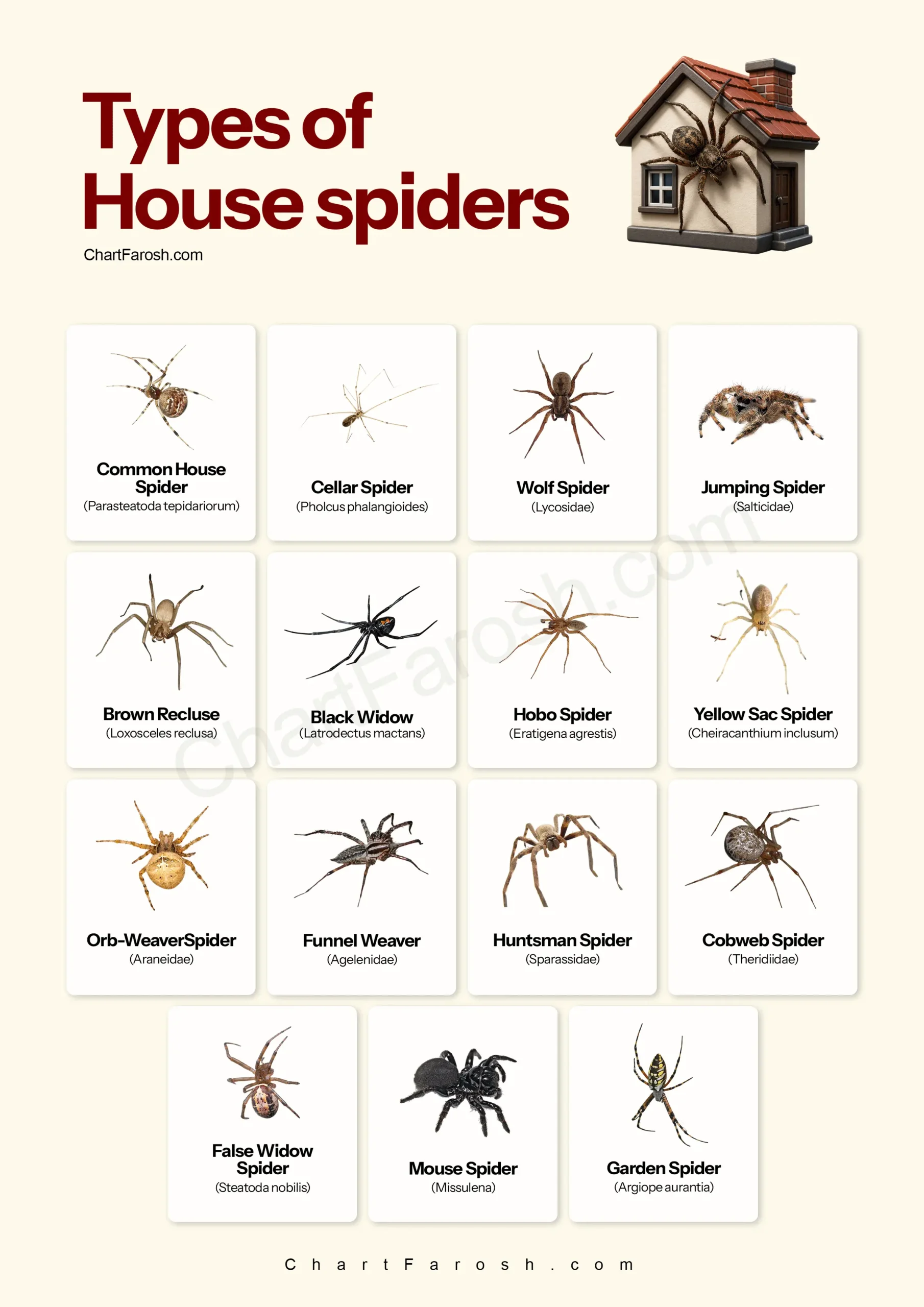
Table of Contents
House spider identification chart
Fifteen spiders turn up indoors more than any others. Some build webs. Some hunt on foot. The chart below sorts them by name, look, favorite hiding spot, and how much their bite actually matters.
| # | Spider Type | Scientific Name | Appearance | Common Place in House | Bite Danger |
| 1 | Common House Spider | Parasteatoda tepidariorum | Small brown spider with long legs | Corners, ceilings | Low |
| 2 | Cellar Spider | Pholcus phalangioides | Very long thin legs, pale body | Basements, garages | Harmless |
| 3 | Wolf Spider | Lycosidae (family) | Hairy brown hunting spider | Floors, under furniture | Mild |
| 4 | Jumping Spider | Salticidae (family) | Small fuzzy spider with large eyes | Windows, walls | Harmless |
| 5 | Brown Recluse | Loxosceles reclusa | Light brown body with violin mark | Closets, storage boxes | Potentially dangerous |
| 6 | Black Widow | Latrodectus mactans | Shiny black spider, red hourglass | Garages, dark corners | Dangerous |
| 7 | Hobo Spider | Eratigena agrestis | Brown fast-running spider | Basements | Low |
| 8 | Yellow Sac Spider | Cheiracanthium inclusum | Pale yellow-beige spider | Walls, ceilings | Mild |
| 9 | Orb-Weaver Spider | Araneidae (family) | Round abdomen, wheel-shaped web | Windows, gardens | Harmless |
| 10 | Funnel Weaver | Agelenidae (family) | Brown spider making funnel webs | Corners, basements | Low |
| 11 | Huntsman Spider | Sparassidae (family) | Large flat fast spider | Walls, sheds | Mild |
| 12 | Cobweb Spider | Theridiidae (family) | Small tangled-web spider | Ceilings, storage rooms | Low |
| 13 | False Widow Spider | Steatoda nobilis | Dark glossy spider, no hourglass | Indoor corners | Mild to moderate |
| 14 | Giant House Spider | Eratigena atrica | Large, fast, long-legged brown spider | Basements, floors, sheds | Harmless |
| 15 | Garden Spider | Argiope aurantia | Yellow and black patterned body | Near windows and plants | Harmless |
Read the last column first. Most of these spiders score low or harmless. That matches what entomologists find. Of the hundreds of spider species that wander into North American homes, only the black widow and the brown recluse carry venom that needs medical attention. Everything else is, at worst, a sting that fades within a day.
If you would rather match a spider to a photo than to a description, the spider identification chart pairs each species with close-up images.
The harmless house spiders you can leave alone
Most spiders in your house are working for you. They eat flies, mosquitoes, ants, and other spiders. The common house spider, cellar spider, jumping spider, orb-weaver, garden spider, cobweb spider, funnel weaver, and giant house spider all sit in this group. None has venom strong enough to hurt a healthy adult.
The cellar spider (Pholcus phalangioides) is the pale, long-legged one that hangs upside down in basements. People call it a daddy longlegs. The story that its venom is the deadliest of any spider but its fangs are too short to bite is a myth, on both counts.
The jumping spider (family Salticidae) is the small fuzzy one with two large front eyes. It builds no web. It stalks prey and pounces, and it often swivels to look at you, which is curiosity rather than threat.
The giant house spider (Eratigena atrica) looks alarming because of its speed and a leg span that can reach two inches (50 mm). It is harmless and reluctant to bite. You see males racing across the floor in late summer, when they wander indoors looking for mates.
The orb-weaver and garden spider spin the classic wheel-shaped webs near windows and plants. They mostly stay outside and rarely come in. Spiders like these do far more good than harm, which is why many of the beneficial insects around a home are actually spiders.
| Spider | Body Length | Builds a Web? | Where You’ll See It |
| Common House Spider | 5-8 mm (0.2-0.3 in) | Yes, tangled | Ceiling and wall corners |
| Cellar Spider | 7-10 mm (0.3-0.4 in) | Yes, loose | Basements, garages |
| Jumping Spider | 4-15 mm (0.2-0.6 in) | No, it hunts | Windows, sunny walls |
| Orb-Weaver Spider | 6-20 mm (0.2-0.8 in) | Yes, wheel-shaped | Window frames, eaves |
| Garden Spider | 19-28 mm (0.8-1.1 in) | Yes, large outdoor | Gardens, near windows |
| Cobweb Spider | 3-10 mm (0.1-0.4 in) | Yes, tangled | Ceilings, storage rooms |
| Funnel Weaver | 10-20 mm (0.4-0.8 in) | Yes, funnel | Corners, basements |
| Giant House Spider | 12-18 mm (0.5-0.7 in) | Yes, sheet web | Basements, floors, sheds |
House spiders with a mild bite
A few house spiders can bite if you trap them against your skin, but the result is closer to a bee sting than an emergency. The wolf spider, hobo spider, yellow sac spider, huntsman, and false widow belong here.
The wolf spider (family Lycosidae) is a fast, hairy ground hunter that spins no snare web. Its bite stings and may swell, then settles within a day.
The hobo spider (Eratigena agrestis) carried a bad reputation for years. It was once blamed for flesh-eating wounds. That link has not held up. The U.S. Centers for Disease Control and Prevention removed the hobo spider from its list of venomous spiders in 2017, and lab studies found no evidence its venom causes necrosis. Treat it as a mild biter, not a threat.
The yellow sac spider (Cheiracanthium inclusum) is the small pale spider that tucks a silk sac into wall and ceiling corners. Its bite can leave a sharp sting and a small red welt.
The false widow (Steatoda nobilis) is the one people most often mistake for a black widow. It is glossy and dark but lacks the red hourglass. A bite usually feels like a wasp sting and fades within a day, though a small number of cases involve longer swelling or infection, so clean any bite well. A side-by-side look at the common household bugs you find alongside spiders can help you rule out other culprits.
Dangerous house spiders: black widow and brown recluse
Two spiders in North American homes carry venom that can need medical care. Both are shy. Both bite only when pressed against skin. Knowing them on sight is the single most useful thing in this whole list.
The black widow (Latrodectus mactans) is a shiny black spider with a red hourglass on the underside of its abdomen. Only the female bites; the male is too small to break skin.
The venom attacks nerve endings and can cause severe muscle pain and cramping, though it is rarely fatal to a healthy adult. People report around 2,600 widow bites to U.S. poison centers each year. You find them in garages, woodpiles, and dark corners that nobody disturbs.
The brown recluse (Loxosceles reclusa) is a light tan or brown spider with a violin-shaped mark behind its eyes. It lives in the south-central and Midwestern United States and is rare outside that range. Most bites heal on their own, but a minority turn into a slow, necrotic wound that needs treatment. The bite is often painless at first, so people miss it for hours. It hides in closets, storage boxes, attics, and shoes left undisturbed.
One word on identification. Necrotic skin wounds get blamed on brown recluses far more often than recluses cause them. Entomologists at the University of Kentucky point out that outside the spider’s range a recluse bite is highly unlikely, and that bacterial infections such as MRSA cause many look-alike sores.
| Feature | Black Widow | Brown Recluse | False Widow |
| Scientific name | Latrodectus mactans | Loxosceles reclusa | Steatoda nobilis |
| Key marking | Red hourglass underneath | Violin shape behind eyes | No hourglass, faint cream marks |
| Body color | Shiny black | Light tan to brown | Glossy dark brown |
| Where it lives | Garages, woodpiles, corners | Closets, boxes, attics | Indoor corners, sheds |
| Region | Across North America | South-central, Midwest US | UK, Ireland, spreading |
| Bite feel | Sharp, then muscle cramps | Often painless at first | Like a wasp sting |
| Risk level | Dangerous, rarely fatal | Can cause slow-healing wound | Mild to moderate |
| What to do | Seek medical advice | See a doctor if it worsens | Clean it, watch for infection |
Where house spiders hide in your home
Spiders pick their spots by how they hunt. Web-builders want still air and an anchor point. Hunters want floor level and cover. Match the room to the likely spider and you know what you are dealing with before you get close.
| Area of the Home | Spiders You’ll Likely Find | Why They Pick It |
| Basements and garages | Cellar, hobo, funnel weaver, black widow | Cool, dark, undisturbed, ground level |
| Ceiling and wall corners | Common house, cobweb, yellow sac | High anchor points for webs |
| Closets and storage boxes | Brown recluse | Quiet, rarely opened, full of folds |
| Windows and door frames | Jumping, orb-weaver, garden | Light draws in the insects they hunt |
| Floors and under furniture | Wolf, huntsman, giant house spider | Open ground for hunting at night |
What to do if a house spider bites you
Most spider bites need nothing more than soap, water, and a cold pack. The trouble is that people panic about the wrong ones.
Wash the area. Put something cold on it to bring down swelling. Take an over-the-counter painkiller if it stings. Watch the spot for a day or two.
Call a doctor or poison control if you saw a black widow or brown recluse, if the pain spreads or turns severe, if you get muscle cramps, fever, or nausea, or if the wound starts to break down and will not heal. In the United States, Poison Control runs a free, confidential helpline and an online tool. Children, older adults, and anyone with a weak immune system should be checked sooner.
If you live in Australia and find a thick black spider at ground level, you may be looking at a mouse spider or a funnel-web rather than a house spider. Those are a different conversation, and the Australian Museum keeps current first-aid advice for them.
How to keep house spiders out
You will never make a home fully spider-free, and you would not want to, since they eat pests. But you can bring the numbers down.
Seal gaps around doors, windows, vents, and pipes, and fix torn screens. Spiders follow insects indoors, so a tight house gives them less reason to come in.
Cut the clutter in basements, garages, and closets. Boxes and piles are the quiet folds that recluses and widows like best. Store things in sealed plastic bins instead of cardboard.
Reduce the insects spiders feed on. Switch outdoor bulbs to yellow or sodium lights that draw fewer bugs, and sweep away webs and egg sacs when you spot them. Working out which pests share the space helps too, so an ant identification chart can point you at the food source a spider is tracking.
FAQs
What is the most common house spider?
The common house spider (Parasteatoda tepidariorum) is the one most people meet. It is small and brown with long legs and builds tangled webs in ceiling and wall corners. The cellar spider runs a close second in basements and garages.
Which house spiders are dangerous?
In North America, only two. The black widow and the brown recluse have venom that can need medical care. Every other spider on this list is harmless or gives a bite no worse than a bee sting.
How can I tell a black widow from a false widow?
The black widow has a bright red hourglass on the underside of its abdomen. The false widow is glossy and dark but has no hourglass, sometimes only faint cream markings. When in doubt, do not handle it.
Are daddy longlegs venomous?
The cellar spider, often called a daddy longlegs, is harmless to people. The popular claim that it has the deadliest venom of any spider but fangs too short to bite is false on both counts.
Why do I suddenly have more spiders in autumn?
Late summer and early fall is mating season for many house spiders. Males leave their hiding spots to wander in search of females, which is why you see large, fast spiders crossing the floor at that time of year.
Do house spiders mean my home is dirty?
No. Spiders come indoors for shelter and for the insects they eat, not for mess. A spotless home with small gaps around the windows will still get spiders. For more help telling species apart, see the spider identification chart, and browse the wider Animals Chart collection for more identification guides.