Grasshopper Lifespan Chart
Two summers ago I watched a grasshopper sit on the same fence post in my yard for most of August. Same spot, every morning. I figured it was old and would be gone in a week.
I was half right. The adult grasshopper does live only a few months. But the insect itself runs a longer clock. The eggs sit in the soil through winter. They hatch in spring. The nymphs grow all summer. The adult I kept seeing was the last stage, near the end of a cycle that had already taken most of a year.
That is the key to grasshopper lifespan. The bug you see hopping in late summer is short-lived. The species survives underground, in the egg, waiting for warm weather.
Locusts break this pattern. In hot climates they can run several short generations in one year, which is part of why swarms build so fast. Below are 15 common grasshoppers and locusts. For each one I give the adult lifespan, the full life cycle, and where it lives. Start with the master chart.
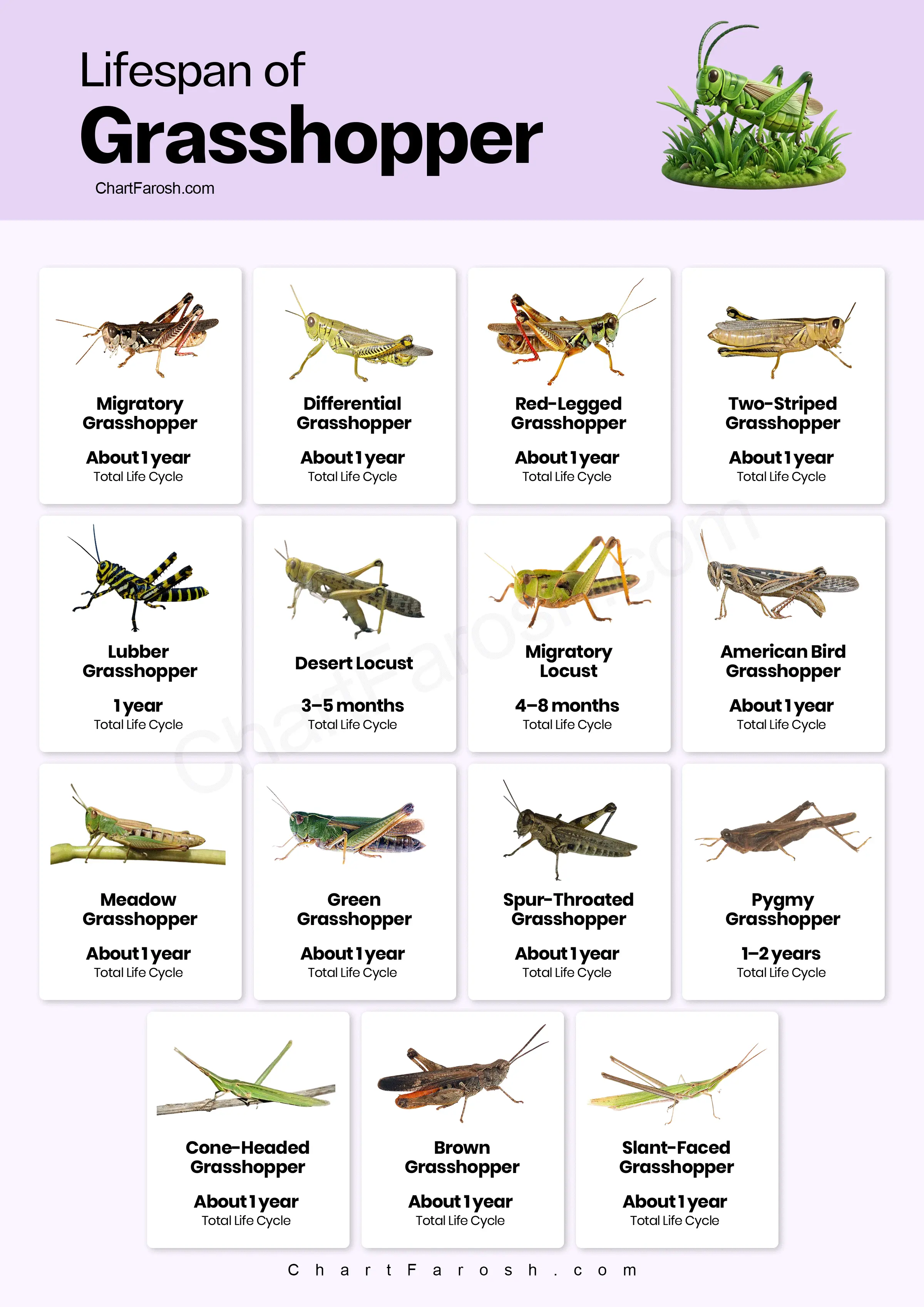
Table of Contents
Grasshopper Lifespan Chart: All 15 Types at a Glance
Adult lifespan and full life cycle are two different numbers. The adult is the winged stage you see in summer. The full cycle counts the egg, the nymph, and the pupa-free path to adult. Read both columns together.
| Grasshopper Type | Scientific Name | Adult Lifespan | Full Life Cycle | Main Region |
| Migratory Grasshopper | Melanoplus sanguinipes | 2–3 months | About 1 year | North America |
| Differential Grasshopper | Melanoplus differentialis | 2–3 months | About 1 year | North America |
| Red-Legged Grasshopper | Melanoplus femurrubrum | 2–4 months | About 1 year | North America |
| Two-Striped Grasshopper | Melanoplus bivittatus | 2–4 months | About 1 year | North America |
| Lubber Grasshopper | Romalea microptera | 4–6 months | 1 year | Southeast US |
| Desert Locust | Schistocerca gregaria | 2–5 months | 3–5 months | Africa, Asia |
| Migratory Locust | Locusta migratoria | 2–5 months | 4–8 months | Africa, Asia, Australia |
| American Bird Grasshopper | Schistocerca americana | 3–5 months | About 1 year | North America |
| Meadow Grasshopper | Chorthippus parallelus | 2–3 months | About 1 year | Europe |
| Green Grasshopper | Omocestus viridulus | 2–3 months | About 1 year | Europe |
| Spur-Throated Grasshopper | Melanoplus spp. | 2–4 months | About 1 year | North America |
| Pygmy Grasshopper | Tetrix spp. | 3–6 months | 1–2 years | Worldwide |
| Cone-Headed Grasshopper | Acrida spp. | 2–4 months | About 1 year | Africa, Asia, Europe |
| Brown Grasshopper | Chorthippus brunneus | 2–3 months | About 1 year | Europe |
| Slant-Faced Grasshopper | Gomphocerinae spp. | 2–4 months | About 1 year | Worldwide |
Spur-Throated Grasshoppers
The spur-throated grasshoppers are the common field grasshoppers across North America. The name comes from a small spur between the front legs. As a group they sit in the genus Melanoplus.
Four of the rows here are Melanoplus species. The Migratory grasshopper, Melanoplus sanguinipes, is the worst crop pest of the bunch. The Differential and Two-Striped are large and easy to spot. The Red-Legged is the one with bright red hind legs. The fifth row, Spur-Throated Grasshopper, is the genus itself, the umbrella the other four sit under.
The pattern holds across all of them. The adult lives 2 to 4 months in late summer and fall. The full cycle runs about a year, with the eggs waiting out the winter in the soil.
| Grasshopper Type | Scientific Name | Adult Lifespan | Full Life Cycle |
| Migratory Grasshopper | Melanoplus sanguinipes | 2–3 months | About 1 year |
| Differential Grasshopper | Melanoplus differentialis | 2–3 months | About 1 year |
| Red-Legged Grasshopper | Melanoplus femurrubrum | 2–4 months | About 1 year |
| Two-Striped Grasshopper | Melanoplus bivittatus | 2–4 months | About 1 year |
| Spur-Throated Grasshopper | Melanoplus spp. | 2–4 months | About 1 year |
Locusts and Bird Grasshoppers
Locusts are grasshoppers that change behavior when they crowd together. They shift color, gather, and fly in swarms. The Desert Locust is the famous one. The UN tracks it through the FAO Locust Watch service because a single swarm can strip a field in hours.
Here the life cycle is shorter, not longer. In warm climates the Desert Locust, Schistocerca gregaria, can finish a cycle in 3 to 5 months and start another. The Migratory Locust does the same across Africa, Asia, and Australia. The American Bird Grasshopper is a strong flier from the same broad group and lives in the southern US.
Adults live a few months, but the short cycle is what lets numbers explode.
| Grasshopper Type | Scientific Name | Adult Lifespan | Full Life Cycle |
| Desert Locust | Schistocerca gregaria | 2–5 months | 3–5 months |
| Migratory Locust | Locusta migratoria | 2–5 months | 4–8 months |
| American Bird Grasshopper | Schistocerca americana | 3–5 months | About 1 year |
Slant-Faced Grasshoppers
Slant-faced grasshoppers have a sloped, wedge-shaped head. Most of the common European grasshoppers fall here, in the subfamily Gomphocerinae. They can be hard to tell from other small flyers, so the flying insect identification guide helps.
The Meadow grasshopper is the one you hear ticking in long grass on a warm day. The Green grasshopper sings a long buzzing song. The Brown grasshopper, Chorthippus brunneus, also called the common field grasshopper, is the one you flush from dry paths. The fourth row, Slant-Faced Grasshopper, is the subfamily these three belong to.
Adults live 2 to 3 months through the summer. The eggs carry the species through winter, so the full cycle is about a year.
| Grasshopper Type | Scientific Name | Adult Lifespan | Full Life Cycle |
| Meadow Grasshopper | Chorthippus parallelus | 2–3 months | About 1 year |
| Green Grasshopper | Omocestus viridulus | 2–3 months | About 1 year |
| Brown Grasshopper | Chorthippus brunneus | 2–3 months | About 1 year |
| Slant-Faced Grasshopper | Gomphocerinae spp. | 2–4 months | About 1 year |
Big, Small, and Odd-Shaped Grasshoppers
The last group covers the grasshoppers people remember for how they look.
The Lubber is huge, slow, and brightly colored as a warning. It lives longest as an adult, 4 to 6 months. University of Florida’s lubber profile covers its life cycle in detail. The Cone-Headed grasshopper, Acrida, has a pointed head and looks like a blade of grass; it is a slant-faced type too.
The Pygmy grasshopper, Tetrix, is tiny and breaks the yearly rule. It can overwinter as an adult and stretch its full cycle to two years.
So the extremes sit in this group. The longest adult life and the longest full cycle both live here.
| Grasshopper Type | Scientific Name | Adult Lifespan | Full Life Cycle |
| Lubber Grasshopper | Romalea microptera | 4–6 months | 1 year |
| Cone-Headed Grasshopper | Acrida spp. | 2–4 months | About 1 year |
| Pygmy Grasshopper | Tetrix spp. | 3–6 months | 1–2 years |
Shortest and Longest Grasshopper Lifespans Compared
Adult life and full cycle pull in different directions. A locust lives a few months but races through its whole cycle in three. A pygmy grasshopper can drag its cycle across two years. Here are the extremes side by side.
| Grasshopper Type | Adult Lifespan | Full Life Cycle | Note |
| Desert Locust | 2–5 months | 3–5 months | Shortest full cycle; breeds again fast |
| Migratory Locust | 2–5 months | 4–8 months | Several generations in warm years |
| Migratory Grasshopper | 2–3 months | About 1 year | Typical temperate pattern |
| Lubber Grasshopper | 4–6 months | 1 year | Longest adult life |
| Pygmy Grasshopper | 3–6 months | 1–2 years | Longest full cycle; overwinters as adult |
FAQs
How long do grasshoppers live?
Most adult grasshoppers live 2 to 4 months, usually through summer and into fall. The full life cycle, from egg to adult, takes about a year for temperate species because the eggs sit in the soil all winter.
What is the longest-living grasshopper?
The Pygmy grasshopper has the longest full cycle, sometimes two years, because it can overwinter as an adult. For adult life alone, the Lubber grasshopper leads at 4 to 6 months.
Do locusts live longer than grasshoppers?
No, they run shorter cycles. A Desert Locust can finish its whole cycle in 3 to 5 months and start another, while a temperate grasshopper runs one yearly generation. The fast turnover is why locust swarms grow so quickly.
How long do grasshoppers live as adults?
The adult stage lasts a few months at most. Cold weather, predators, and the end of the breeding season finish them off in fall. The eggs they lay carry the next generation.
Where do grasshoppers go in winter?
In most species the adults die in fall and the eggs survive underground until spring. A few, like some pygmy grasshoppers, can overwinter as adults in mild areas.
Do grasshoppers bite or harm people?
Grasshoppers do not bite people in a harmful way, though a large one can pinch. The real damage is to crops, which is why migratory grasshoppers and locusts are tracked as pests.
How can I tell grasshoppers apart?
Look at size, head shape, and leg color first. A sloped head points to a slant-faced type, and a spur between the front legs to a spur-throated type. For more help, see the bug identification chart and browse the Animals Chart hub or the related gnat lifespan chart.