Insects With the Longest Lifespan
Most insects live fast and die young. A housefly gets a month, a mayfly barely a day. So the first time I read that a termite queen can rule a nest for fifty years, I had to read it twice. Some insects are not sprinters at all.
The pattern behind the long-lived ones is clear once you see it. Almost all of them are either egg-laying colony queens or insects that spend years tucked underground as grubs and nymphs. The buzzing, flying adult is usually still the short part. The long life happens out of sight.
This article ranks 30 insects by how long they can live, from the fifty-year termite queen down to the moths that barely last a season. It also explains why queens and cicadas top the list, and clears up a common mix-up about what insect lifespan really means.

Table of Contents
The 30 Longest-Living Insects, Ranked
The table is ranked by maximum recorded lifespan. For many entries that number counts the whole life, including the long larval or nymph stage, not just the adult. For a wider view of how these compare with shorter-lived species, see our bug lifespan chart.
| Rank | Insect | Maximum Lifespan | Why It Lives So Long |
| 1 | Queen termite | 20–50 years | Colony queen; can outlive the whole nest |
| 2 | Queen ant | 15–30 years | Record near 28 years for a black garden ant |
| 3 | Periodical cicada (Magicicada) | 13–17 years | Most of it underground as a nymph |
| 4 | Giant burrowing cockroach | 5–10 years | Long-lived Australian burrower |
| 5 | Carpenter ant (worker) | Up to 7 years | Workers last years; queens far longer |
| 6 | Stag beetle | 3–7 years | Years as a grub in rotting wood |
| 7 | Dragonfly (large species) | 1–6 years | Mostly an aquatic nymph |
| 8 | Honey bee queen | 2–5 years | Lays eggs for years; workers last weeks |
| 9 | Madagascar hissing cockroach | 2–5 years | Hardy and slow; a common pet |
| 10 | Dobsonfly | 2–5 years | Years as an aquatic hellgrammite larva |
| 11 | Hercules beetle | 2–5 years | Long grub stage in rotting wood |
| 12 | Elephant beetle | 2–5 years | Long larval stage underground |
| 13 | Rhinoceros beetle | 2–4 years | Long larval stage |
| 14 | Ground beetle (large species) | 2–4 years | Long-lived ground predator |
| 15 | Giant weta | 2–3 years | Large, slow New Zealand native |
| 16 | Jerusalem cricket | 2–3 years | Slow-growing burrower |
| 17 | Death’s-head hawkmoth | 1–3 years | Counts the long larval and pupal stages |
| 18 | Darkling beetle | 1–3 years | Hardy; mealworm beetles belong here |
| 19 | Firefly | 1–3 years | Mostly a glowing larva |
| 20 | Mole cricket | 1–3 years | Lives years in underground burrows |
| 21 | Walking stick insect | 1–3 years | Slow grower; longer in captivity |
| 22 | Dubia roach (Blaptica dubia) | 1.5–2.5 years | Popular feeder cockroach |
| 23 | Tarantula hawk wasp | Up to 2 years | Counts the larva; adults live months |
| 24 | Giant water bug | 1–2 years | Large aquatic predator |
| 25 | American cockroach | 1–2 years | Long for a household roach |
| 26 | Oriental cockroach | 1–2 years | Damp-loving household roach |
| 27 | Praying mantis (large species) | 1–2 years | Adults live a single season |
| 28 | Cicada killer wasp | 1–2 years | Mostly the larval stage |
| 29 | Bess beetle | 1–2 years | Subsocial beetle of rotting logs |
| 30 | Atlas moth | A few months | Often miscredited; adults live 1–2 weeks |
The Top Three: Queens and a Patient Cicada
The two longest-lived insects are both colony royalty. A queen termite can live 20 to 50 years, and a queen ant can reach 15 to 30, with a black garden ant recorded at 28. BBC Science Focus notes these queens hold the longest documented adult lifespans of any insect. Each lives a protected life of nothing but egg-laying inside the nest.
Third place goes to the periodical cicada, which lives 13 or 17 years on a prime-numbered clock. It spends almost all of that underground as a nymph, feeding on tree roots, before a short adult summer above ground, as the Library of Congress describes. You can meet the queens up close in our ant identification chart.
Why Some Insects Live So Long
Three things explain almost every name on the list. The biggest is being a colony queen. In a social, or eusocial, insect, the queen can outlive her workers by decades. Research on termite queens links this to unusually strong defenses against cell damage.
The second is a long, slow youth. Stag beetles, cicadas, dragonflies, and dobsonflies spend years as grubs or nymphs before a brief adult stage. The growing takes the time, not the flying. The third is shelter, whether a deep burrow, a rotting log, or a warm tank in captivity, all of which keep predators and weather at bay.
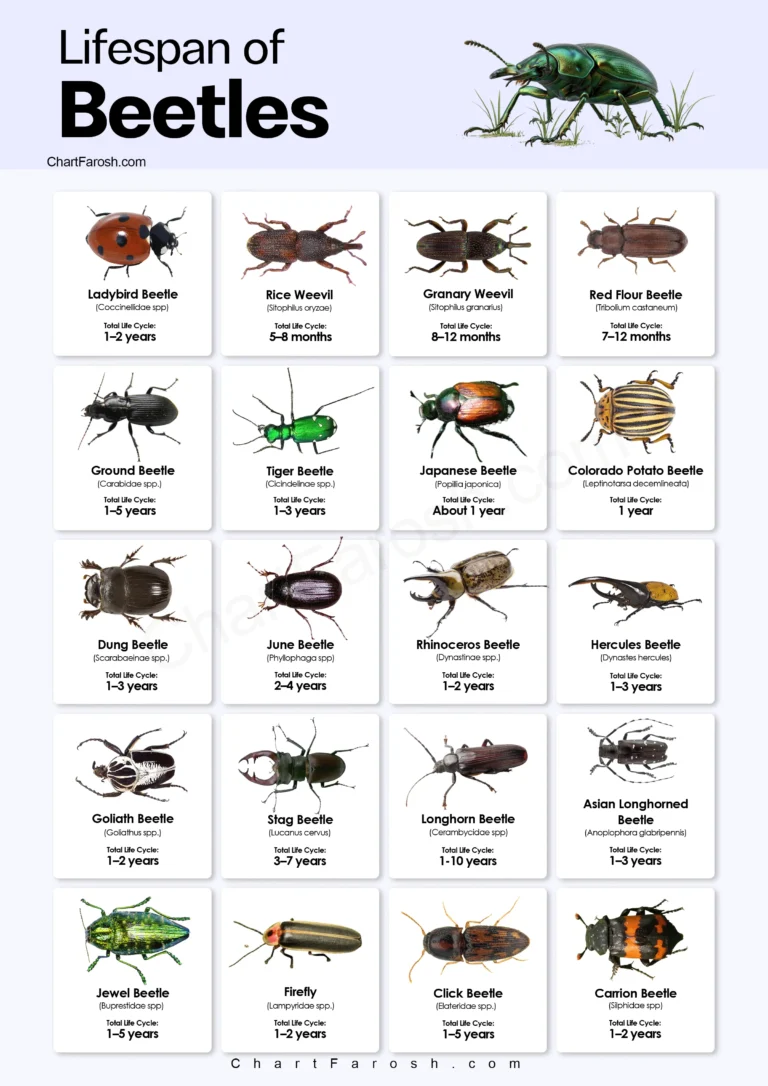
This is why so many of the beetles in our beetle lifespan chart and the burrowing crickets in our cricket lifespan chart rank well here. Slow developers that hide underground get more time.
Longevity Champions by Group
Sorting the winners by group shows where the real records sit. Social insects dominate, but one beetle quietly beats nearly everything on the main list.
| Category | Longest-Lived Example | Maximum Lifespan |
| Social insect | Queen termite | Up to 50 years |
| True bug relative | Periodical cicada | 13–17 years |
| Cockroach | Giant burrowing cockroach | Up to 10 years |
| Beetle (common) | Stag beetle | Up to 7 years |
| Beetle (record) | Jewel / splendour beetle | Up to ~47–51 years |
| Cricket relative | Giant weta or Jerusalem cricket | 2–3 years |
Adult Life vs Total Life: A Common Mix-Up
Most lists of long-lived insects quietly mix two different numbers. One is how long the adult lives. The other is how long the whole life lasts, from egg to death. For the insects near the top here, those numbers are close, because a queen lives her long life as an adult. For the beetles and cicadas, they are not, because the years are spent as a grub or nymph.
That mix-up explains a few entries people expect to see. The atlas moth often appears on these lists because it is huge. But its adult life is only one to two weeks, and its whole cycle runs a few months. It does not really belong among the long-lived at all. The true record-holder among beetles is not on most lists either: a jewel, or splendour, beetle once emerged from timber after about 47 years as a larva, the longest life of any insect on record.
Need a custom insect lifespan or longevity chart for your classroom, museum, or pest-control business? Our Animal Chart Designing Service builds clean, branded charts and printable PDFs to your exact spec.
FAQs
What insect has the longest lifespan?
The queen termite. Some species live 20 to 50 years inside the nest, longer than any other insect.
How long do queen ants live?
Queen ants commonly live 15 to 30 years. A black garden ant queen was recorded living about 28 years in a lab colony.
How long do cicadas live?
Periodical cicadas live 13 or 17 years, but almost all of that is spent underground as nymphs. The adults live only a few weeks.
Why do queen insects live so long?
Colony queens lead protected lives devoted to laying eggs, and they have strong defenses against cell damage. Their workers, by contrast, live only weeks or months.
Do any beetles live for decades?
Yes. A jewel, or splendour, beetle once emerged from wood after about 47 years as a larva, the longest life ever recorded for an insect.
Which insect lives the shortest life?
The adult mayfly, which can live less than a day. It is the opposite extreme from the queens on this list.
Do these insects live that long as adults?
Not usually. For most of them the years are spent as larvae or nymphs. The main exceptions are the colony queens, who live their long lives as adults.