All Antelope Species List with Pictures
I remember the first time I saw an antelope in the wild, it was early morning, the sun just peeking over the horizon, and I was trekking through a savannah in Kenya.
I’d always been fascinated by wildlife, but seeing an antelope leap effortlessly across the grasslands made me realize how graceful and adaptable these animals truly are.
I wanted to know more: why there are so many types of antelope, what makes some species rare, and how they survive in such diverse environments.
That curiosity turned into a mini obsession. I started reading field guides, talking to rangers, and even spending hours in wildlife sanctuaries observing antelopes.
Over time, I learned that antelopes aren’t just one kind of animal, they’re a diverse family of species, each uniquely adapted to its habitat, from forests and deserts to grasslands and mountains.
Understanding them gives you a deeper appreciation of Africa’s incredible ecosystems.
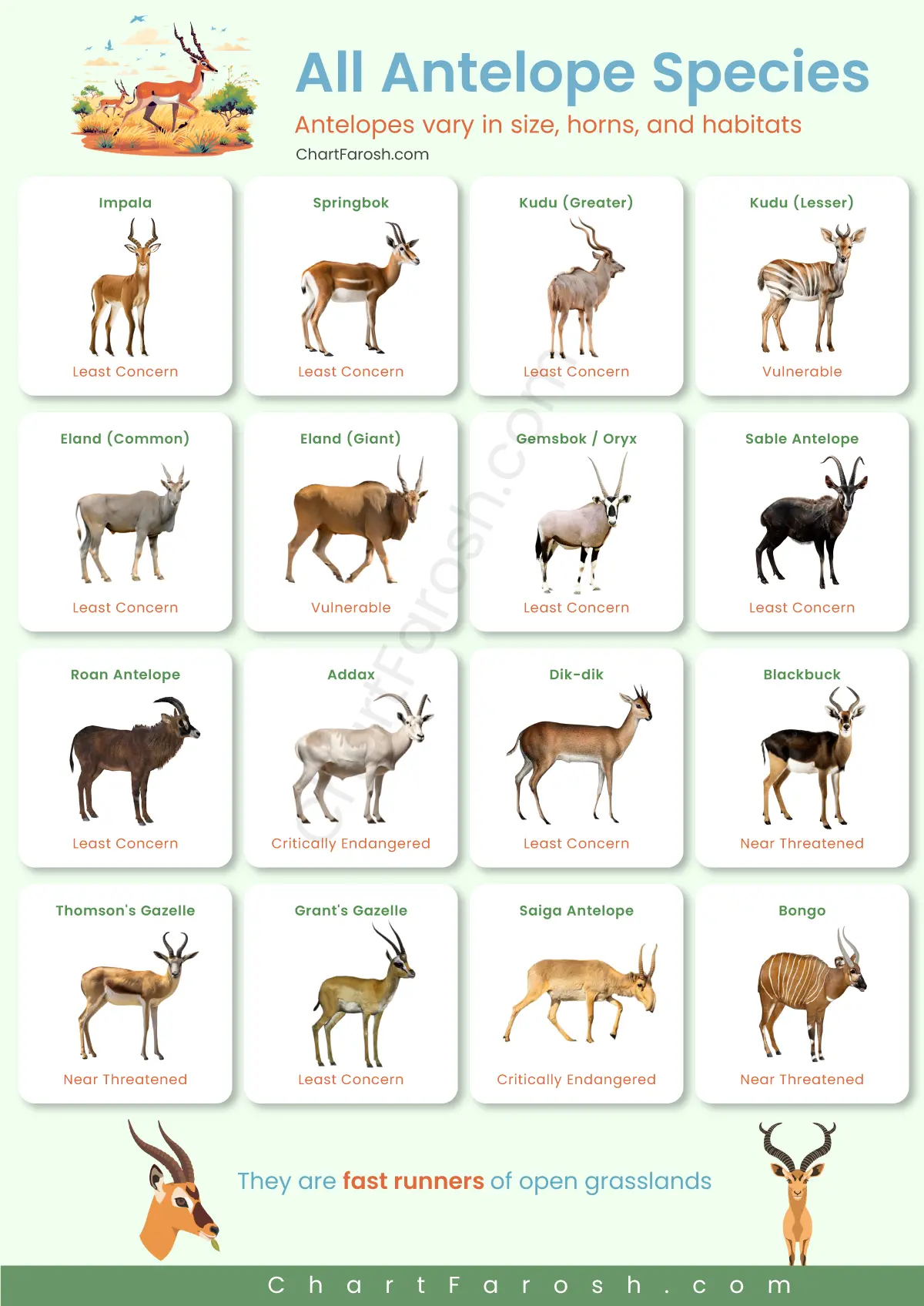
Table of Contents
Types of Antelope
Antelopes are a diverse group of herbivorous mammals found across Africa, Asia, and even parts of the Americas.
There are over 90 recognized species, ranging from tiny duikers that dart through forests to massive elands that roam open grasslands.
Each type of antelope has unique adaptations for its environment: some are built for speed, others for camouflage, and some have specialized horns for defense or display.
They play a vital role in their ecosystems, serving as prey for large carnivores while also helping with seed dispersal and vegetation control.
Understanding the types of antelope is essential for both wildlife enthusiasts and conservationists, as it highlights the ecological diversity and challenges each species faces.
Observing these animals reveals fascinating behaviors, from their social structures and mating rituals to their incredible agility and survival strategies.
| Antelope Species | Scientific Name | Region | Key Feature | Conservation Status |
| Impala | Aepyceros melampus | Eastern & Southern Africa | Graceful jumper, curved horns | Least Concern |
| Springbok | Antidorcas marsupialis | Southern Africa | Pronking behavior | Least Concern |
| Kudu (Greater) | Tragelaphus strepsiceros | Eastern & Southern Africa | Spiral horns | Least Concern |
| Kudu (Lesser) | Tragelaphus imberbis | Eastern Africa | Smaller spiral horns | Vulnerable |
| Eland (Common) | Taurotragus oryx | Southern Africa | Largest antelope, twisted horns | Least Concern |
| Eland (Giant) | Taurotragus derbianus | Central & East Africa | Largest African antelope | Vulnerable |
| Gemsbok / Oryx | Oryx gazella | Southern Africa | Long straight horns, desert-adapted | Least Concern |
| Sable Antelope | Hippotragus niger | Eastern & Southern Africa | Black coat, curved horns | Least Concern |
| Roan Antelope | Hippotragus equinus | West & Central Africa | Reddish-brown coat | Least Concern |
| Addax | Addax nasomaculatus | Sahara Desert | Spiral horns, desert-adapted | Critically Endangered ⚠️ |
| Dik-dik | Madoqua spp. | Eastern & Southern Africa | Tiny antelope, large eyes | Least Concern |
| Blackbuck | Antilope cervicapra | India | Slender, ringed horns | Near Threatened |
| Thomson’s Gazelle | Eudorcas thomsonii | East Africa | Small, fast, white rump | Near Threatened |
| Grant’s Gazelle | Nanger granti | East Africa | Long horns, white underbelly | Least Concern |
| Saiga Antelope | Saiga tatarica | Central Asia | Distinct bulbous nose | Critically Endangered ⚠️ |
| Bongo | Tragelaphus eurycerus | Central Africa | Striking striped coat | Near Threatened |
| Nyala | Tragelaphus angasii | Southern Africa | Males dark brown with stripes | Least Concern |
| Klipspringer | Oreotragus oreotragus | Southern & Eastern Africa | Tiny, rock-dwelling | Least Concern |
| Impala (Black-faced) | Aepyceros melampus petersi | Southern Africa | Distinct black facial markings | Least Concern |
African Antelope Species Overview
Africa is the natural home to most antelope species, each adapted to a specific region or habitat.
From the dense forests of Central Africa to the open savannahs of the Serengeti, African antelopes are found in a wide range of environments.
Some species, like the impala, are highly social and form large herds, while others, like the elusive sitatunga, prefer solitary lives in swamps and reed beds.
African antelope species vary widely in size, diet, and behavior. While most are herbivorous, feeding on grasses, leaves, and shoots, their foraging patterns often reflect the season and availability of food.
Studying African antelope species also gives insights into predator-prey dynamics, ecosystem health, and the impact of human activities such as hunting and habitat encroachment.
Conserving these species ensures that Africa’s landscapes remain balanced and biologically rich.
Antelope Species List by Size
Antelopes can be categorized into small, medium, and large species, each adapted to survive in its unique habitat.
Size affects their social behavior, predator avoidance strategies, and even their feeding habits. Small antelopes, such as dik-diks and duikers, often rely on camouflage and agility to avoid predators.
Medium-sized antelopes like impalas and gazelles combine speed and herd dynamics to stay safe.
Large antelopes, including elands and kudu, depend on size and strength, often forming smaller family units with dominant males leading the group.
This size-based classification helps researchers, conservationists, and wildlife enthusiasts understand behavioral patterns, ecological roles, and conservation needs.
Recognizing antelope species by size also helps in planning protected areas, ensuring that each species has enough resources and space to thrive.
Small Antelope Species
Small antelopes are true masters of stealth and agility, relying on their compact size, keen senses, and quick reflexes to move effortlessly through forests, grasslands, and scrublands.
Despite being among the smallest members of the antelope family, they play a surprisingly important role in their ecosystems.
Their constant foraging helps disperse seeds and contributes to the regeneration of plants, which benefits other herbivores and maintains habitat diversity.
Small antelopes are also a vital food source for a variety of predators, including leopards, eagles, and wild dogs, making them key players in the food chain.
Many species are highly alert and use camouflage, silent movements, and quick bursts of speed to avoid detection.
- Dik-dik: Tiny, alert, and fast, often found in East African bushlands.
- Duiker: Forest-dwelling, shy, and excellent at hiding.
- Steenbok: Prefers open grasslands, known for quick bursts of speed.
- Oribi: Small, delicate antelope, grazing in short grass areas.
- Royal antelope: One of the smallest antelopes in the world, inhabiting West African forests.
Medium-Sized Antelopes
Medium-sized antelopes strike a balance between agility and strength. Species like impalas and gazelles are known for their remarkable speed and ability to make long leaps when escaping predators.
These antelopes often form herds, which increases their chances of survival and provides complex social interactions.
Their diet typically consists of grasses and leaves, and they play a crucial role in maintaining the balance of their habitats.
Predators such as lions, leopards, and hyenas often target medium-sized antelopes, making their alertness and group strategies essential.
Observing them offers insights into herd dynamics, territorial behavior, and survival instincts that have evolved over millennia.
Largest Antelope Species in the World
The largest antelope species are impressive not only in size but also in presence and ecological influence. Adult males, such as elands and greater kudus, can weigh over 1,000 pounds in some cases.
Their large size helps them defend against predators, navigate diverse terrains, and maintain dominance within their herds.
These antelopes tend to have slower speeds compared to smaller species but compensate with strength and endurance.
Larger species often feed on a mix of grasses, leaves, and shrubs, depending on seasonal availability.
Their social structures are fascinating, with dominant males leading smaller groups or harems of females. Observing large antelopes in the wild is awe-inspiring, showcasing both power and adaptability.
They are vital to ecosystem health, controlling vegetation growth and supporting predator-prey dynamics across their ranges.
Fastest Antelope Species
Some antelopes are built for speed, making them the ultimate sprinters of the savannah. These species rely on quick bursts of energy to escape predators such as lions, cheetahs, and hyenas.
Their slender, muscular bodies, long legs, and keen eyesight allow them to detect danger from a distance and react instantly.
Fast antelopes often live in open grasslands, where visibility is high and speed is a key survival tool.
Herd behavior also helps; many species run together in coordinated groups, confusing predators and increasing survival odds.
Their diet remains herbivorous, mainly grasses and shoots, which provide the energy needed for their high-speed lifestyle.
Observing these antelopes is a spectacle of agility, coordination, and instinct, a reminder that survival in the wild is as much about speed as it is about strength.
- Thomson’s gazelle: Known for incredible bursts of speed up to 50 mph.
- Springbok: Capable of high jumps and fast sprints in open plains.
- Impala: Agile and quick, often evading predators with sudden leaps.
- Grant’s gazelle: Fast and enduring, often covering long distances.
- Topi: Built for speed and stamina, thriving in East African savannahs.
Rare Antelope Species
Some antelope species are rarely seen due to limited populations, specific habitats, or elusive behavior
These rare antelopes often live in remote forests, mountains, or swamps, making encounters with humans uncommon.
Rarity can result from natural habitat constraints, poaching, or environmental changes.
Despite being lesser-known, rare antelopes are ecologically important, contributing to biodiversity and maintaining the balance of their ecosystems.
Studying rare species provides valuable insight into their adaptations, survival strategies, and reproductive behavior.
Conservation programs often prioritize these species because their small populations are highly vulnerable to extinction.
Observing a rare antelope in its natural habitat is a thrilling experience and a reminder of the richness and fragility of wildlife.
Protecting rare species helps ensure the survival of entire ecosystems and the many other creatures that rely on them.
Endangered Antelope Species
Endangered antelopes face high risks of extinction due to habitat loss, hunting, and climate change.
Species such as the saola and giant sable antelope are critically endangered, with populations numbering only in the hundreds.
These antelopes require specific habitats, often deep forests or remote highlands, making them highly sensitive to human activity.
Conservation programs, including protected areas, anti-poaching measures, and breeding initiatives, are vital for their survival.
Endangered antelopes play essential roles in their ecosystems, including seed dispersal and maintaining vegetation balance.
Awareness and education are also critical, as many communities share landscapes with these species.
Protecting endangered antelopes ensures biodiversity, ecosystem health, and the survival of some of the planet’s most extraordinary and unique animals.
Desert Antelope Species
Desert antelopes have evolved remarkable adaptations to survive harsh, arid environments with scarce water and extreme temperatures.
Their diet often includes drought-resistant plants, and they are highly efficient at conserving water.
These antelopes are agile, able to move quickly across open sandy plains to escape predators or find food.
Many species live in small herds, which reduces competition for limited resources and allows for coordinated predator detection.
Observing desert antelopes reveals the incredible resilience of wildlife to extreme conditions.
- Addax: Can survive long periods without water, inhabiting Saharan deserts.
- Dibatag: Agile and adapted to arid regions of East Africa.
- Arabian oryx: Known for white coats reflecting heat and long migrations.
- Dorcas gazelle: Small, nimble, and highly drought-resistant.
- Sand gazelle: Adapted to desert plains, able to cover long distances.
Forest-Dwelling Antelopes
Forest-dwelling antelopes are masters of camouflage, using their muted colors and quiet movements to survive in dense woodlands.
These antelopes are typically smaller, allowing them to move through thick underbrush with ease.
They feed on leaves, shoots, and fruits, often playing a critical role in seed dispersal and forest regeneration. Many forest antelopes are solitary or form small groups, reducing detection by predators.
These species are often elusive, making wildlife observation both challenging and rewarding.
Forest antelopes are crucial to maintaining ecosystem balance and biodiversity, supporting other species indirectly through their ecological roles.
Protecting forest habitats ensures the survival of these species and the countless plants and animals that rely on them.
Grassland Antelope Species
Grassland antelopes are built for open spaces, where speed, herd coordination, and vigilance are essential for survival.
These species feed primarily on grasses and short vegetation, often moving seasonally to follow food availability.
Herd behavior provides protection, with many eyes watching for predators like lions, cheetahs, and wild dogs.
Grassland antelopes play an important ecological role by maintaining grass height, which supports other herbivores and reduces wildfire risk.
Observing these species showcases fascinating behaviors such as synchronized running, competitive displays, and social bonding.
Their adaptations, long legs, sharp senses, and alert instincts, highlight the incredible ways evolution equips wildlife for survival in vast, open habitats.
Antelopes with Spiral Horns
Spiral-horned antelopes are some of the most striking species, with horns that twist in elegant curves. These horns are often used in displays of dominance, mating rituals, or defending against predators.
The spiral shape is not just for show, it allows males to spar safely without causing serious injury.
Spiral-horned antelopes live in a variety of habitats, from woodlands to grasslands, depending on the species.
Observing them in the wild is a fascinating experience, as these horns make each individual unique and instantly recognizable.
- Greater kudu: Famous for long, impressive spirals.
- Lesser kudu: Smaller than the greater kudu, but equally elegant.
- Nyala: Twisted horns and striking coat patterns.
- Eland: Massive, spiraled horns on the largest antelope species.
- Sitatunga: Spiral horns, semi-aquatic lifestyle in swampy forests.
Antelopes with Straight Horns
Straight-horned antelopes may have a simpler horn design compared to their spiral-horned relatives, but their horns are just as functional and essential for survival.
These straight horns are used for defense against predators, marking territories, and asserting dominance during fights with rivals.
Straight-horned antelopes are highly alert, relying not only on their horns but also on remarkable speed, agility, and keen senses to stay safe in their habitats.
They are commonly found across grasslands and savannahs, where visibility is high and their straight horns make it easier to identify individuals within herds.
Horn length and thickness can vary based on age, sex, and species, serving as a visual cue of maturity and strength.
Observing straight-horned antelopes in the wild provides insight into their social hierarchies, mating behaviors, and survival strategies.
Differences Between Antelopes and Deer
Antelopes and deer are often confused because both are hoofed herbivores, but they have key differences.
Antelopes are mostly native to Africa and parts of Asia, while deer are found worldwide, including Europe, the Americas, and Asia.
Antelope horns are permanent and can be straight or spiral, whereas deer grow and shed antlers annually.
Behaviorally, antelopes often live in open herds for predator protection, while deer may prefer forested or temperate habitats.
Antelopes are generally faster runners and adapted to open savannahs, while deer exhibit more climbing and forest navigation abilities.
These differences are essential for understanding species ecology, predator-prey dynamics, and conservation approaches.
Antelope Species in Africa
Africa is home to the majority of antelope species, ranging from tiny, elusive duikers that dart through dense forests to massive elands roaming open savannahs.
These antelopes occupy a wide variety of habitats, including deserts, grasslands, wetlands, and tropical forests, each species uniquely adapted to its environment.
African antelopes play a critical role in maintaining ecosystem balance.
They serve as a primary food source for large predators such as lions, leopards, cheetahs, and hyenas, while their grazing habits help control vegetation and support plant diversity.
Herding species, like impalas and gazelles, also aid in seed dispersal, contributing to forest regeneration and grassland health.
The behavior, social structures, and movements of African antelopes are fascinating to observe, from seasonal migrations across hundreds of miles to intricate interactions within herds.
- Impala: Widely distributed, social and agile.
- Kudu: Recognizable for spiral horns.
- Eland: The largest African antelope species.
- Dik-dik: Small, alert, and forest-dwelling.
- Springbok: Desert and savannah habitats, known for leaping displays.
Antelope Species in Kenya
Kenya’s diverse landscapes, ranging from sweeping savannahs to lush forests, are home to a remarkable variety of antelope species.
Among the most commonly seen are impalas, gazelles, and dik-diks, each adapted to specific habitats and ecological niches.
Many of these antelopes can be observed in world-famous national parks such as Maasai Mara, Amboseli, and Tsavo, where they form an essential part of the ecosystem.
Kenyan antelopes not only contribute to the balance of their habitats by grazing and dispersing seeds but also play a vital role in supporting tourism.
Seasonal migrations are a common sight, as antelopes move to follow the availability of food and water, often creating breathtaking scenes for wildlife photographers and enthusiasts.
Antelope Species in America
Although less diverse than Africa, North and South America have a few antelope species, primarily the pronghorn.
Pronghorns are adapted to open plains and desert environments, with exceptional speed to evade predators.
Unlike African antelopes, they have unique horns that combine characteristics of antlers and horns.
American antelopes play a crucial role in grassland ecosystems by grazing selectively, which helps maintain plant diversity.
Observing them in national parks and wildlife reserves shows how antelopes outside Africa have evolved differently while still maintaining core survival traits such as herd behavior, alertness, and agility.
Antelope Species in India
India is home to a fascinating range of antelope species, each uniquely adapted to the country’s diverse ecosystems, from open grasslands and scrublands to dense forests and semi-arid regions.
These antelopes are not only an integral part of the landscape but also play a critical role in maintaining vegetation balance, supporting biodiversity, and sustaining predator populations such as tigers, leopards, and wolves.
Indian antelopes vary widely in size, horn structure, and behavior, which reflects their adaptation to different habitats.
Some, like the blackbuck, thrive in open plains and are known for their incredible speed and agility, while species such as the four-horned antelope prefer secluded forested areas where stealth is key to survival.
- Blackbuck: Recognizable for curved horns and agile movements.
- Nilgai: Largest Indian antelope, found in open plains.
- Chinkara: Small, desert-adapted species.
- Four-horned antelope: Rare, forest-dwelling species.
- Indian gazelle (Goa): Agile and alert, inhabiting grasslands.
FAQs
What is the fastest antelope in the world?
The pronghorn and Thomson’s gazelle are among the fastest, capable of reaching speeds over 50 mph.
How many species of antelope exist?
There are over 90 recognized antelope species worldwide, with most found in Africa.
Are all antelopes endangered?
Not all, but several species l are critically endangered.
Can antelopes survive in deserts?
Yes,some species are adapted to arid conditions.
How can I identify antelopes by horns?
Spiral horns are common in species like kudu and nyala, while straight horns are found in species like impalas and topis. Horn shape, size, and pattern often indicate species, age, and gender.