Types of Mantises
A bright green mantis once sat on my window screen for a whole afternoon, swiveling its head to watch me type. It looked calm and a little alien. I kept wondering how many kinds there were and whether the pink, flower-shaped ones I saw online were real.
They are real, and there are far more than I expected. Mantises come shaped like leaves, flowers, sticks, and bark, plus a few that look like nothing else alive. The disguise is the whole point, since a hidden hunter eats better than a visible one.
Scientists count more than 2,400 mantis species worldwide. The chart below covers the ones people raise, garden with, and search for most, with size, color, range, and the trick that sets each one apart. It also sorts out the names that get mixed up with other flying insects.
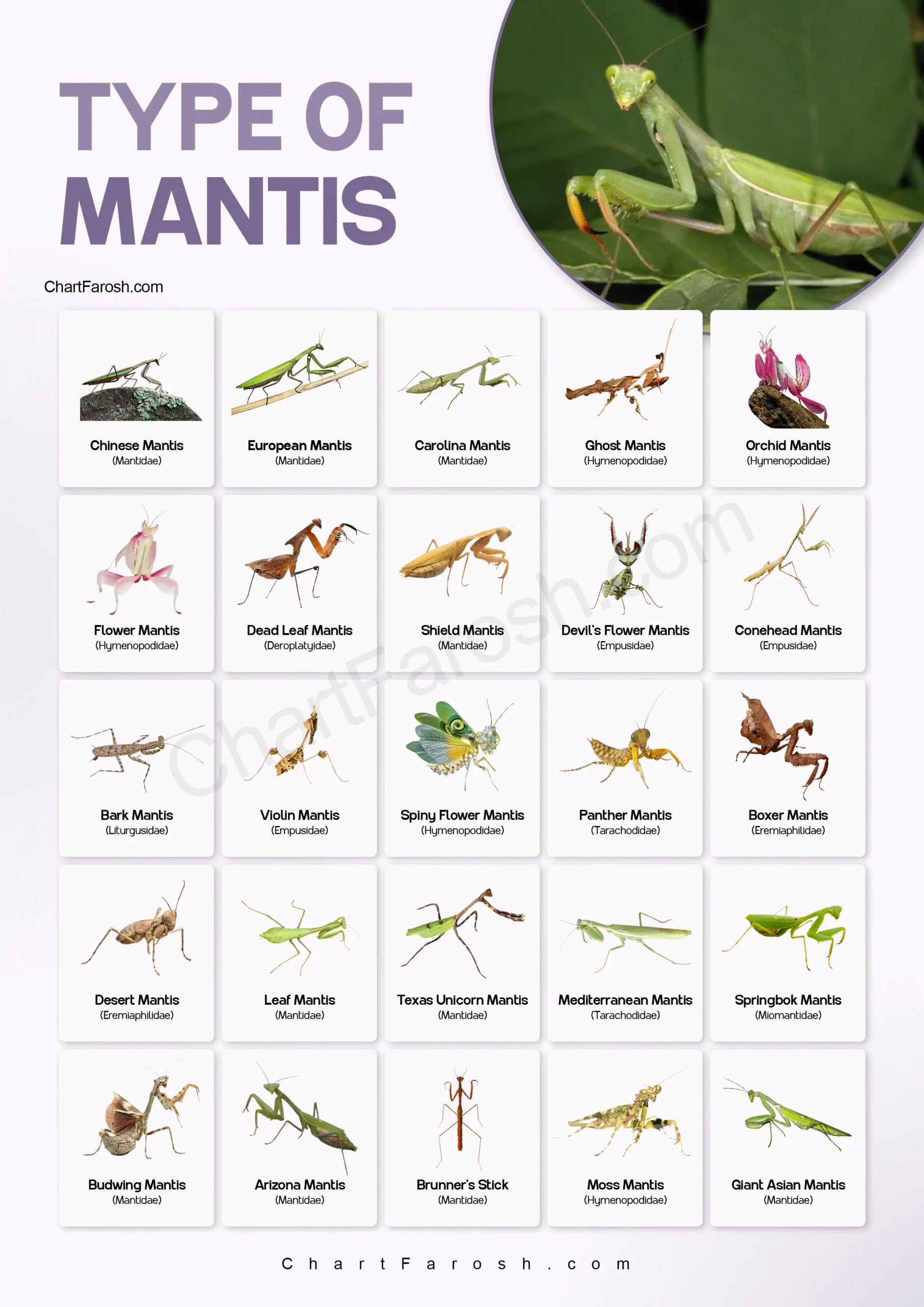
Table of Contents
Mantis species and their names
All mantises belong to the order Mantodea, and most of the familiar ones sit in the family Mantidae. They share the same body plan: a triangular head, a long neck, and folding front legs lined with spines. Those raptorial legs snap shut on prey in a fraction of a second.
The table lists 26 widely kept and widely searched species. The family-level classification of mantises was reworked in 2019, so the chart uses stable scientific species names rather than shifting family labels. Where a common name is shared by several species, the note explains it below the table.
| Common name | Scientific name | Size | Main colors | Distinctive feature | Native region |
|---|---|---|---|---|---|
| Chinese mantis | Tenodera sinensis | Large, to 11 cm | Green, brown | One of the largest mantises; introduced to the US | East Asia |
| European mantis | Mantis religiosa | Medium-large | Green, brown | Bull’s-eye spot inside the foreleg | Europe, Asia, Africa |
| Carolina mantis | Stagmomantis carolina | Medium | Gray, green, brown | Common North American native | North America |
| Ghost mantis | Phyllocrania paradoxa | Small-medium | Brown, green | Dead-leaf body with a head crest | Africa, Madagascar |
| Orchid mantis | Hymenopus coronatus | Medium | White, pink | Petal-shaped legs that mimic a flower | SE Asia |
| Spiny flower mantis | Pseudocreobotra wahlbergii | Small | White, green, yellow | Spiral eye-spots on the wings | Sub-Saharan Africa |
| Dead leaf mantis | Deroplatys desiccata | Large | Brown | Flat, leaf-shaped body | SE Asia |
| Giant Asian mantis | Hierodula membranacea | Large | Green | Bulky build; popular as a pet | Tropical Asia |
| Giant shield mantis | Rhombodera basalis | Large | Bright green | Wide, shield-shaped thorax | SE Asia |
| African mantis | Sphodromantis viridis | Large | Green | Hardy; common beginner pet | Africa |
| Devil’s flower mantis | Idolomantis diabolica | Very large, to 13 cm | Green, white, red | Largest flower-mimicking mantis | East Africa |
| Conehead mantis | Empusa pennata | Medium-large | Green, brown | Cone-shaped crest on the head | Mediterranean |
| Violin mantis | Gongylus gongylodes | Large | Brown | Thin body with leaf-like limb lobes | India, Sri Lanka |
| Budwing mantis | Parasphendale affinis | Medium | Brown | Short wing buds in females | East Africa |
| Springbok mantis | Miomantis caffra | Medium | Green | Invasive in New Zealand and beyond | Southern Africa |
| Mediterranean mantis | Iris oratoria | Medium | Green, brown | Bright eye-spot on the hindwings | Mediterranean; intro. to US |
| Arizona mantis | Stagmomantis limbata | Medium | Green, tan | Bordered mantis of the US Southwest | SW North America |
| Texas unicorn mantis | Phyllovates chlorophaea | Medium | Green, brown | Two-part horn on the head | S US to South America |
| Brunner’s stick mantis | Brunneria borealis | Large | Green | Stick-like; all-female, parthenogenetic | Southern US |
| Cryptic mantis | Acanthops falcata | Medium | Brown | Curled dead-leaf mimic | South America |
| Bark mantis | Liturgusa species | Small-medium | Gray, brown | Fast runner on tree trunks | American tropics |
| Ant mantis | Odontomantis species | Small | Black | Nymphs mimic ants | Asia |
| Boxer mantis | Otomantis species | Small | Brown, mottled | Raises forelegs in a boxing pose | East Africa |
| Desert mantis | Eremiaphila species | Small-medium | Tan, sandy | Built for bare desert ground | N Africa, Middle East |
| Twig mantis | Popa spurca | Medium | Brown | Stick-like camouflage | Africa |
| Peacock mantis | Pseudempusa pinnapavonis | Medium | Brown, green | Colorful hindwings flashed in display | SE Asia |
These 26 are a small slice of the order. They are the species you are most likely to meet, keep, or look up, not the full count of 2,400-plus.
Largest mantis species
The biggest mantises are heavy, slow, and hard to miss. The Chinese mantis (Tenodera sinensis) can reach about 11 centimeters and is the largest mantis living wild in North America after its introduction from Asia. The giant Asian mantis and the African mantis are nearly as bulky and are favorites in the pet trade.
The Devil’s flower mantis (Idolomantis diabolica) is the giant of the flower mimics and can stretch past 13 centimeters with its wings spread. Large mantises take large prey, and the biggest will grab moths, bees, and even the odd caterpillar that wanders within reach.
Smallest mantis species
Plenty of mantises are tiny. Ground and bark species like the bark mantis and the boxer mantis stay small and flat, which helps them vanish against tree trunks and stones. Some of the smallest mantises measure under 2 centimeters as adults.
The ant mantis is a strange case. Its black nymphs look and move like ants, which keeps predators away while the young mantis grows. By adulthood it loses the disguise and looks like a small, ordinary mantis.
Rarest and most unusual mantises
Some mantises are prized because they are hard to find or hard to mistake. The orchid mantis (Hymenopus coronatus) is the most famous, with legs shaped like flower petals that lure pollinators straight into its grasp. The spiny flower mantis flashes a pair of spiral eye-spots when threatened.
Brunner’s stick mantis (Brunneria borealis) breaks a basic rule of biology. The species is made up entirely of females and reproduces without males, a process called parthenogenesis. Every egg case it lays hatches into more females.
Common and popular mantises
A handful of species turn up again and again, in gardens, classrooms, and the pet trade. The European mantis (Mantis religiosa) ranges across Europe, Asia, and Africa and was introduced to North America over a century ago. The Carolina mantis is the common native across much of the southern United States.
Keepers favor the African mantis and the giant Asian mantis because both are tough and easy to feed. The orchid mantis stays popular for its looks, even though it can be tricky to raise. In a garden, a mantis works as one of the beneficial insects that quietly thin out pests.
Mantis vs look-alike insects
People often mix mantises up with other long-bodied insects. The fastest way to be sure is to look at the front legs and the way the animal feeds. Mantises are the only common insects in this group that hold their prey in spiked, folding arms.
| Insect | Front legs | Diet | Quick tell |
|---|---|---|---|
| Praying mantis | Spiked, grasping (raptorial) | Live insects (predator) | Triangular head that swivels |
| Stick insect | Plain walking legs | Leaves (herbivore) | Long twig body, no grasping legs |
| Grasshopper | Big jumping hind legs | Plants (herbivore) | Jumps and often sings |
| Assassin bug | Folding front legs, long beak | Live insects (predator) | Narrow head with a curved beak |
Are mantises dangerous?
Mantises are not dangerous to people. They have no venom and no sting, and the worst a large one can do is pinch with its spined forelegs. The old name praying mantis comes from the folded-arm pose, not from any threat to humans.
They are dangerous to other insects, though, and even to each other. Females sometimes eat males during mating, especially in captivity, where the male cannot escape. As ambush hunters they sit alongside garden spiders near the top of the small-creature food chain.
Mantises by region
Europe has only a few native mantises, led by the European mantis and the conehead mantis in the warm south. Both prefer dry grassland and scrub. The European mantis has since spread widely and now lives across much of the United States.
Africa and tropical Asia hold the greatest variety. The flower mimics, the giant predators, and the strangest leaf and stick forms nearly all come from these warm regions. Madagascar alone hosts the ghost mantis and several relatives found nowhere else.
The Americas have their own line of mantises, from the Carolina and Arizona mantises in the north to the dead-leaf Acanthops species in South America. North America has no giant native mantis, so the largest ones there arrived from overseas.
Mantis names that overlap or get mixed up
Common names for mantises are loose, and several point to more than one insect. The orchid mantis and the so-called Malaysian orchid mantis are the same species, Hymenopus coronatus. The Devil’s flower mantis and the giant Devil’s flower mantis also refer to one insect, Idolomantis diabolica.
Other labels describe a look rather than a species. Flower mantis, leaf mantis, twig mantis, moss mantis, and dragon mantis are shapes that several unrelated mantises share, not single entries. Bark mantis and boxer mantis are each used for more than one species across different regions.
A few names are simply confused. The true toad mantis is a South American insect, not the sand-colored desert mantis the name is sometimes pinned on. When you meet a vague name, it usually traces back to one of the recognized species in the chart above.
How to identify a mantis
A few traits give a mantis away, even when its camouflage is good.
- Front legs: spined and folded, built to grab and hold prey.
- Head: triangular and able to turn almost all the way around.
- Posture: it waits and ambushes rather than chasing.
- Body: long and slender, often shaped like a leaf, flower, stick, or bark.
- Eggs: females lay a foamy case called an ootheca, which you can match in an insect egg identification reference.
- Hunting: it targets live prey, including the bees and flies that visit nearby flowers.
FAQs
How many types of praying mantis are there?
More than 2,400 species exist across roughly 30 families. Only a few dozen are common in gardens, classrooms, or the pet trade.
What is the largest praying mantis?
The Chinese mantis and the Devil’s flower mantis are among the largest, reaching about 11 to 13 centimeters.
What is the smallest praying mantis?
Some ground and bark mantises are tiny, with adults measuring under 2 centimeters.
Is the orchid mantis a real species?
Yes. The orchid mantis (Hymenopus coronatus) mimics a flower to ambush the pollinators that land near it.
Are praying mantises dangerous to humans?
No. They have no venom or sting. A large one can deliver a sharp pinch, but it poses no real threat to people.
What is the difference between a mantis and a stick insect?
A mantis has grasping front legs and hunts live prey. A stick insect has plain legs and eats plants.
Where do most mantises live?
Most live in tropical and subtropical parts of Asia, Africa, and the Americas, with a few in temperate Europe and North America.