Beetle Lifespan Chart
I used to think a beetle lived for one summer and then was gone. Then I found a fat white grub in a rotting log and learned it had been there for years before the adult ever crawled out. That gap between what we see and what happens underground is the real story of how long beetles live.
Most beetles spend the bulk of their lives as larvae, hidden in soil, wood, or stored grain. The adult we recognise is often the shortest chapter. A Japanese beetle may buzz around your roses for a month, while its grub chewed on roots for the better part of a year.
This chart breaks down the average lifespan of 20 common beetle types. It also shows what makes some last for years and others for weeks, and which species hold the longevity records. Use it to compare, to plan pest control, or to settle a backyard argument.
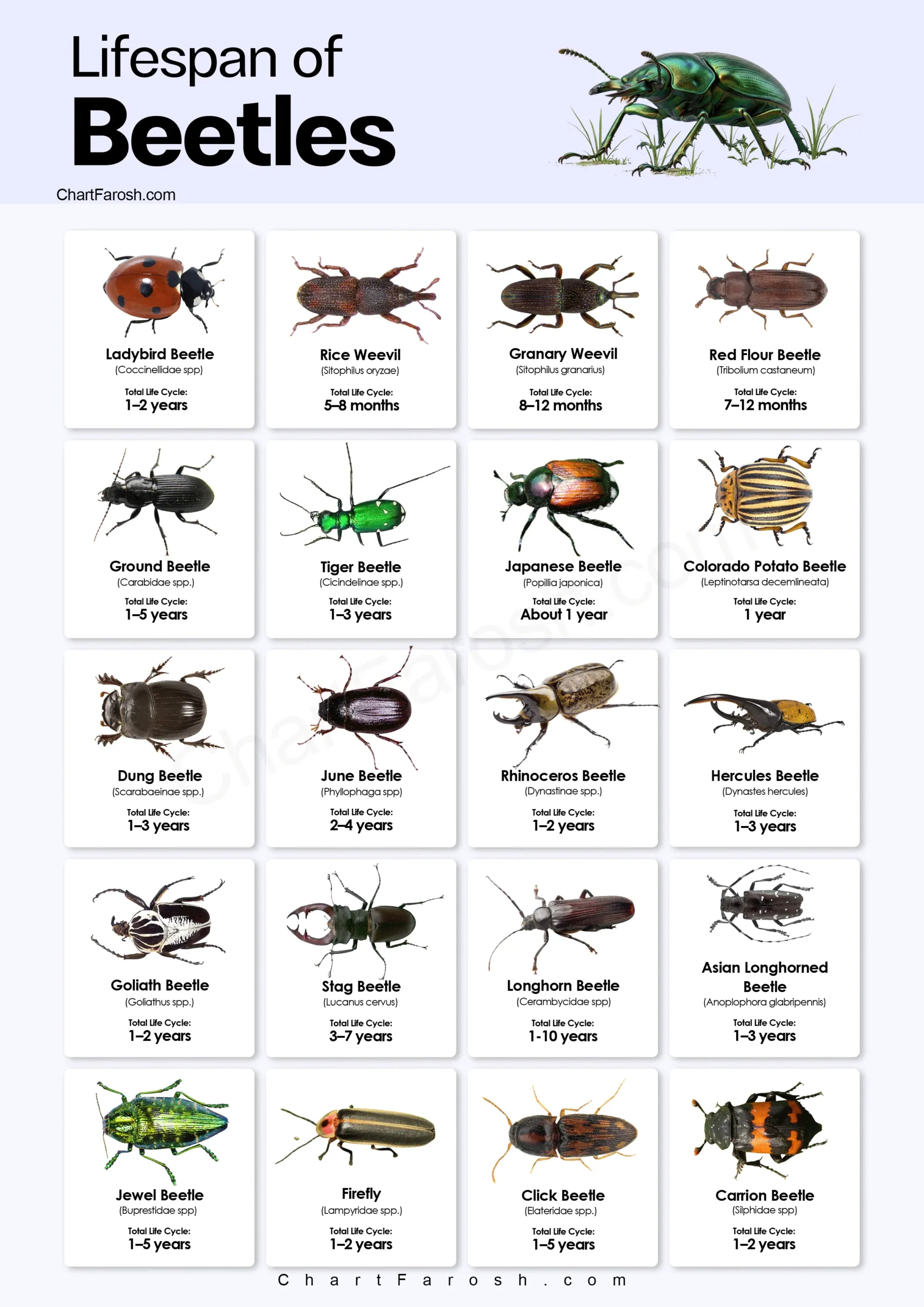
Table of Contents
Beetle Lifespan Chart
Beetle lifespans run from a few weeks to several years, and the number you want depends on what you mean by life. The table below gives the average adult lifespan and the total life cycle for each type. The total covers the egg, larva, and pupa stages, which is where most of the time is spent.
You will notice the two columns often disagree. A June beetle lives less than a year as an adult but takes two to four years to finish its full cycle. If you want to know which beetle you are looking at first, our beetle identification chart pairs well with this one.
| Beetle Type | Scientific Name (Example) | Average Adult Lifespan | Total Life Cycle |
| Ladybird Beetle | Coccinellidae spp. | 1–2 years | 1–2 years |
| Rice Weevil | Sitophilus oryzae | 4–8 months | 5–8 months |
| Granary Weevil | Sitophilus granarius | 7–12 months | 8–12 months |
| Red Flour Beetle | Tribolium castaneum | 6–12 months | 7–12 months |
| Ground Beetle | Carabidae spp. | 1–4 years | 1–5 years |
| Tiger Beetle | Cicindelinae spp. | 6–12 months | 1–3 years |
| Japanese Beetle | Popillia japonica | 30–45 days | About 1 year |
| Colorado Potato Beetle | Leptinotarsa decemlineata | 1–3 months | 1 year |
| Dung Beetle | Scarabaeinae spp. | 3–12 months | 1–3 years |
| June Beetle | Phyllophaga spp. | Less than 1 year | 2–4 years |
| Rhinoceros Beetle | Dynastinae spp. | 3–6 months | 1–2 years |
| Hercules Beetle | Dynastes hercules | 3–6 months | 1–3 years |
| Goliath Beetle | Goliathus spp. | 3–6 months | 1–2 years |
| Stag Beetle | Lucanus cervus | 3–12 months | 3–7 years |
| Longhorn Beetle | Cerambycidae spp. | 1–3 months | 1–10 years |
| Asian Longhorned Beetle | Anoplophora glabripennis | 1–2 months | 1–3 years |
| Jewel Beetle | Buprestidae spp. | Several weeks–1 year | 1–5 years (rarely far longer) |
| Firefly | Lampyridae spp. | 2–8 weeks | 1–2 years |
| Click Beetle | Elateridae spp. | 2–12 months | 1–5 years |
| Carrion Beetle | Silphidae spp. | 2–12 months | 1–2 years |
Which Beetles Live the Longest?
Ground beetles top the list among common species, with some adults reaching one to four years and a total cycle of up to five. Stag beetles run longer still once you count the larval stage, which can last three to seven years in rotting wood. Even the small ladybird beetle in your garden often reaches one to two years, which is a long run for an insect that size.
Wood-borers like longhorn and jewel beetles can stretch their total cycle out for a decade or more. Those long larval stages are also where the all-time records live, which I cover further down. For the egg side of the story, see our insect egg identification chart.
Which Beetles Have the Shortest Lifespan?
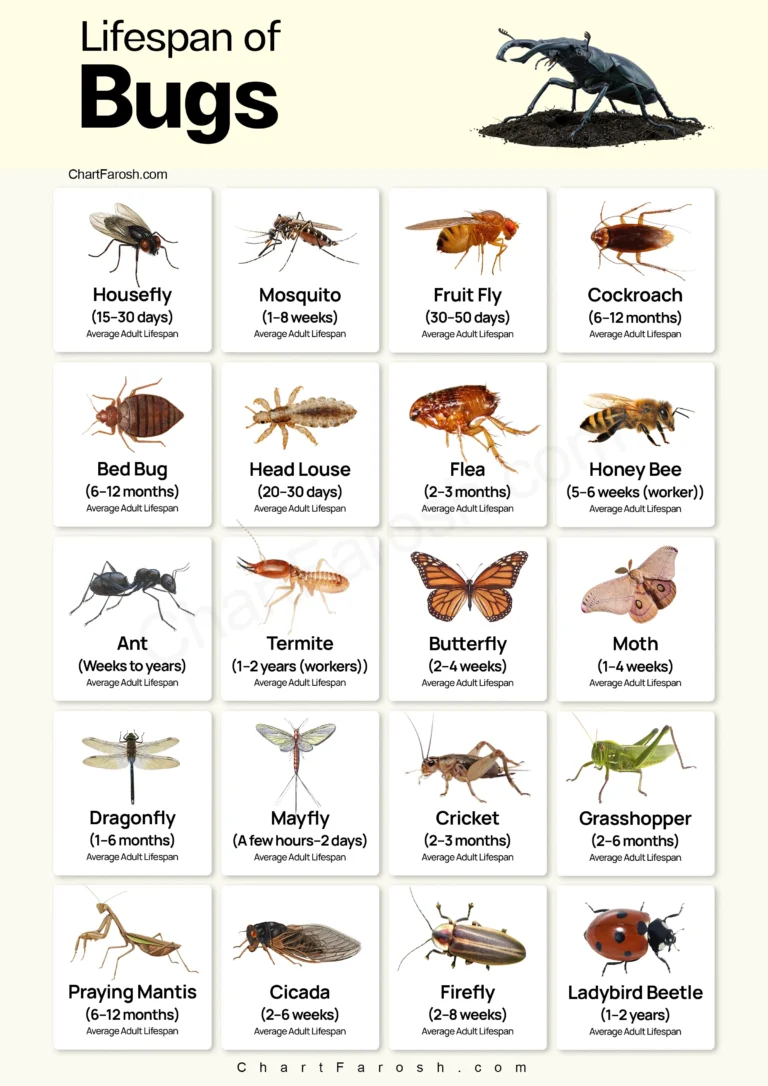
Fireflies sit at the short end as adults, glowing for just two to eight weeks before they are done. Asian longhorned beetles last one to two months, and Japanese beetles manage about 30 to 45 days. The pattern holds across the order: the adult phase is brief, and the real time goes into growing up.
The Beetle Life Cycle: Egg, Larva, Pupa, Adult
Beetles belong to the order Coleoptera, the largest group of animals on Earth. Like butterflies and flies, they go through complete metamorphosis, sometimes called holometabolous development. That means four clear stages: egg, larva, pupa, and adult.
The larva does most of the living. Beetle grubs moult through several growth stages, called instars, as they feed and swell. When a grub is ready, it forms a pupa and rebuilds its body into the hard-shelled adult, complete with the wing covers known as elytra. The same four-stage path shows up in other insects too, which is why a caterpillar identification chart looks so different from the moth it becomes.
For most species the adult has one job, which is to mate and, for females, to lay eggs. That is why the adult stage tends to be so short. The beetle has already done its growing. Many garden species in our beneficial insects chart follow exactly this rhythm: a long, hungry youth and a quick adult life.
Factors That Affect Beetle Lifespan
Two beetles of the same species can live very different lengths of time. A handful of factors explain most of the gap.
- Species and size: larger beetles and wood-borers take longer to develop, which stretches the total life cycle.
- Temperature and climate: warm weather speeds up development, while cold winters slow it down or push the beetle into dormancy.
- Food and habitat: a grub feeding on rich roots grows faster than one stuck in dry, dead wood.
- Predators and pesticides: birds, frogs, spiders, and insecticides cut many adult beetles short.
- Captivity: kept safe and well fed, some beetles outlive their wild cousins by years.
How Beetle Lifespan Compares to Other Insects
Beetles are not unusual among insects in spending most of their lives out of sight. Here is how their lifespans stack up against other common bugs.
| Insect | Typical Adult Lifespan | Total Life Cycle | Where the Time Goes |
| Beetle (varies by type) | Weeks to a few years | 1 year on average; up to 4–5 years | Mostly the larval (grub) stage |
| Butterfly | 2–4 weeks | A few weeks to a year | Egg, caterpillar, and chrysalis stages |
| Honey bee (worker) | About 6 weeks in summer | 6 weeks; queens 2–5 years | Short adult life; queens last years |
| Ant (worker) | Weeks to a few months | Queens can live many years | Queens far outlive workers |
| Housefly | About 28 days | 2–4 weeks | Fast egg-to-adult turnaround |
| Dragonfly | Weeks to a few months | Up to several years | Mostly the aquatic nymph stage |
The lesson is the same across the board. Adult insects are built for one short, busy season, and the long, slow work happens earlier. If you want the other end of the lifespan scale, our cat lifespan chart covers how household pets compare.
Record-Holders: The Longest-Lived Beetles
The longevity records belong to wood-boring beetles, and the numbers are hard to believe. The official record goes to a golden jewel beetle (Buprestis aurulenta) that emerged from staircase timber in an English home in 1983, after at least 47 years as a larva. Guinness World Records lists it as the longest-lived insect on record.
Other wood-borers come close. Some longhorn beetles have emerged from furniture after decades, and a few reports put certain larval stages near 51 years. The trick is a strategy called delayed emergence. When the wood is poor in nutrients, the larva takes its time, sometimes for decades, before it becomes an adult.
This is also why the one to five years you often see quoted for jewel beetles undersells the extremes. Most never come close. A few wait out half a century inside seasoned timber, which is why I added the note in the chart above.
Are Fireflies Beetles?
Yes. Fireflies are beetles in the family Lampyridae, not flies and not true bugs. They go through the same four life stages as every other beetle, and they spend most of their one to two year cycle as glowing larvae underground.
The Xerces Society notes that the adults most of us photograph on summer nights live only a few weeks. For a wider breakdown of how entomologists group these stages, Oklahoma State University Extension has a clear guide to holometabolous development.
FAQs
How long do beetles live on average?
Most beetles complete their whole life cycle in about a year. Many of them spend most of that time as larvae and only a few weeks or months as adults.
What is the longest-living beetle?
A golden jewel beetle holds the record. It emerged as an adult after at least 47 years as a larva inside a wooden staircase, which makes it the longest-lived insect on record.
Why do beetles live longer as larvae than as adults?
The larva is the feeding and growing stage. Once a beetle becomes an adult, its main job is to mate and lay eggs, so the adult stage is usually short.
Are fireflies really beetles?
Yes. Fireflies belong to the beetle family Lampyridae, and they pass through the same egg, larva, pupa, and adult stages as other beetles.
What affects a beetle’s lifespan the most?
Species and temperature matter most. Larger, wood-boring beetles develop slowly, and cold weather can stretch the larval stage by months or even years.
How long does a stag beetle live?
Adult stag beetles live only a few months. The larva, though, can spend three to seven years underground before it emerges to breed.
Which beetle has the shortest adult life?
Adult fireflies are among the shortest. They glow for only about two to eight weeks before they die, even though their full life cycle runs one to two years.