Types of Caterpillars
I found my first hornworm on a tomato plant, and I nearly missed it. It was as thick as my finger and bright green, the exact shade of the stem. Then it lifted its head and I jumped. It had been eating my plants for days, hidden in plain sight.
That is the thing about caterpillars. They are everywhere in summer, and most of us walk right past them. Some are future monarchs. Some are pests. A few can give you a sting you will not forget.
There are tens of thousands of caterpillar species, and each one is the larva of a moth or a butterfly. Learn the types of caterpillars by family, host plant, and body shape, and identification gets much easier.
The chart below covers 38 caterpillars, grouped by family. You will meet the giant hickory horned devil, the furry puss caterpillar that hides venom under soft hair, and the monarch that turns milkweed into a defense. Some you can hold. A few you should never touch.
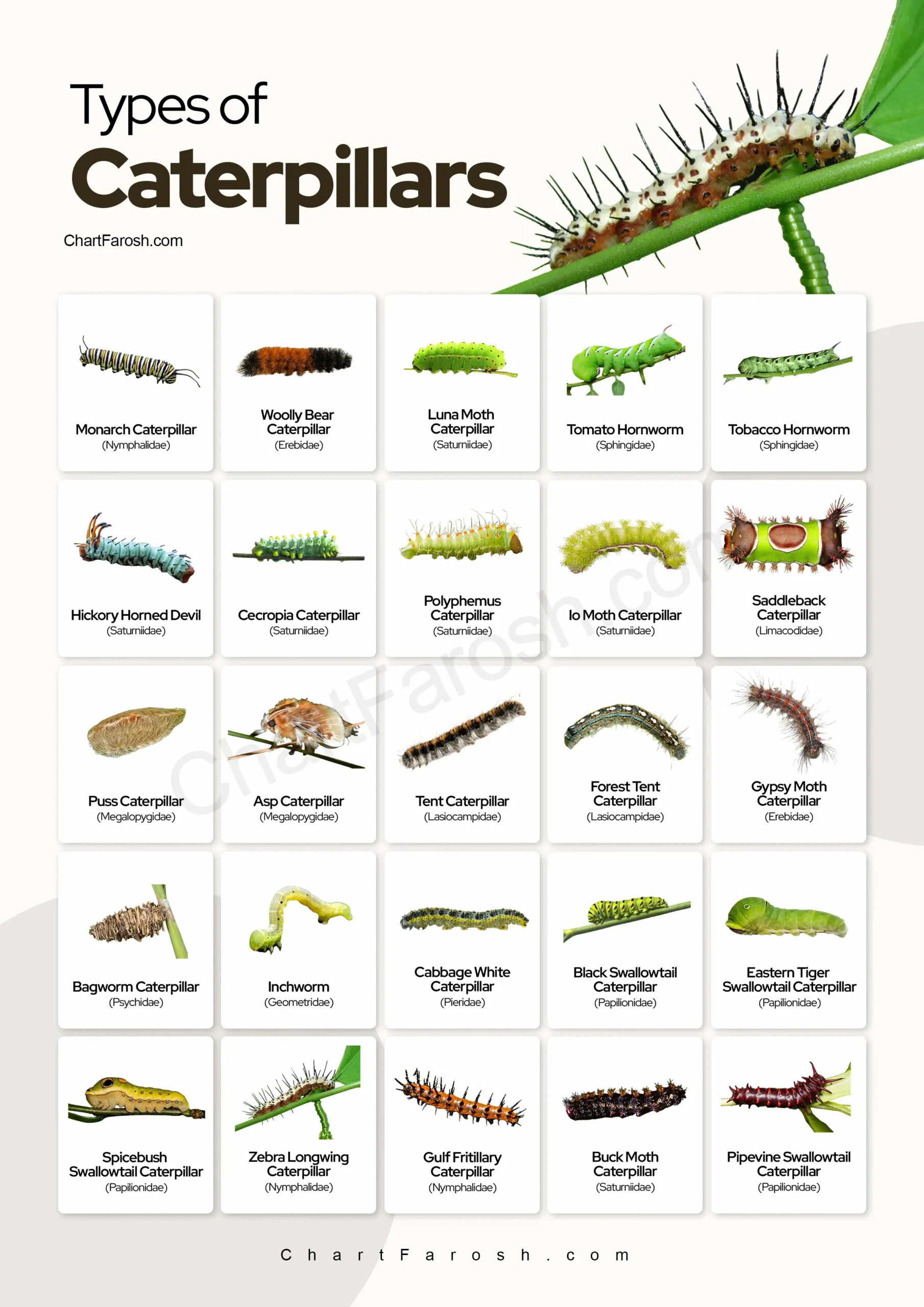
Table of Contents
Caterpillar Identification Chart (All 38 Types)
This chart lists all 38 caterpillar species covered here. Each row gives the family, rough size, main colors, and the one feature that helps you name it. The host plant is often the fastest clue, so the sections below pair each caterpillar with where it feeds.
| Caterpillar | Family | Size | Main Colors | Standout Feature |
| Luna Moth Caterpillar | Saturniidae | Large | Bright green | Smooth body with red spots |
| Cecropia Caterpillar | Saturniidae | Very large | Green, blue, yellow | Colorful knobby tubercles |
| Polyphemus Caterpillar | Saturniidae | Large | Green | Slanted side stripes |
| Promethea Caterpillar | Saturniidae | Large | Green with knobs | Bright red and yellow tubercles |
| Imperial Moth Caterpillar | Saturniidae | Large | Green or brown | Long hairs and spines |
| Hickory Horned Devil | Saturniidae | Very large | Blue-green & orange | Huge but harmless horns |
| Io Moth Caterpillar | Saturniidae | Medium | Bright green | Venomous stinging spines |
| Buck Moth Caterpillar | Saturniidae | Medium | Black & white | Venomous branched spines |
| Tomato Hornworm | Sphingidae | Very large | Green | Eight white V-marks, black horn |
| Tobacco Hornworm | Sphingidae | Very large | Green | Seven diagonal stripes, red horn |
| Oleander Hawk-Moth Caterpillar | Sphingidae | Large | Green with eyespots | Snake-like appearance |
| Death’s-head Hawk Moth Caterpillar | Sphingidae | Large | Yellow, green | Curved tail horn |
| Black Swallowtail Caterpillar | Papilionidae | Medium | Green, black, yellow | Bird-dropping mimic when young |
| Eastern Tiger Swallowtail Caterpillar | Papilionidae | Medium | Green | Large fake eyespots |
| Spicebush Swallowtail Caterpillar | Papilionidae | Medium | Green | Snake-like eyespots |
| Pipevine Swallowtail Caterpillar | Papilionidae | Medium | Dark brown & orange | Fleshy orange tentacles |
| Monarch Caterpillar | Nymphalidae | Medium | Black, white, yellow | Striped body with tentacles |
| Zebra Longwing Caterpillar | Nymphalidae | Medium | White with black spines | Long branching spines |
| Gulf Fritillary Caterpillar | Nymphalidae | Medium | Orange & black | Covered in spines |
| Silver-spotted Skipper Caterpillar | Hesperiidae | Medium | Green | Large dark head |
| Cabbage White Caterpillar | Pieridae | Small | Green | Common vegetable pest |
| Woolly Bear Caterpillar | Erebidae | Medium | Black & brown | Thick fuzzy hairs |
| White-Marked Tussock Caterpillar | Erebidae | Medium | Black, yellow | Toothbrush-like tufts |
| Sycamore Tussock Caterpillar | Erebidae | Medium | Orange & white | Hairy defensive coat |
| Fall Webworm | Erebidae | Medium | Pale yellow | Builds silk web nests |
| Spongy Moth Caterpillar (formerly gypsy moth) | Erebidae | Medium | Gray with blue and red spots | Invasive defoliator |
| Saddleback Caterpillar | Limacodidae | Small | Green & brown | Saddle-shaped mark, stinging |
| Monkey Slug Caterpillar (hag moth) | Limacodidae | Small | Brown | Curling arm-like projections, stinging |
| Puss Caterpillar (also called asp) | Megalopygidae | Small | Gray, tan, brown | Furry coat hiding venomous spines |
| Tent Caterpillar | Lasiocampidae | Medium | Black, blue | Builds silk tents |
| Forest Tent Caterpillar | Lasiocampidae | Medium | Blue & black | White keyhole markings |
| Bagworm Caterpillar | Psychidae | Small | Brown | Carries a protective case |
| Armyworm | Noctuidae | Medium | Brown, green | Travels in large groups |
| Cutworm | Noctuidae | Medium | Gray, brown | Cuts young plant stems |
| Corn Earworm | Noctuidae | Medium | Green, brown | Major crop pest |
| American Dagger Moth Caterpillar | Noctuidae | Medium | Pale yellow | Fuzzy with black hair pencils |
| Leaf Roller Caterpillar | Tortricidae | Small | Green | Rolls leaves into shelters |
| Inchworm | Geometridae | Small | Green, brown | Loops as it walks |
Every caterpillar here grows up into a moth or a butterfly. To see the adults, browse the types of moths guide and the butterfly identification chart.
Giant Silk Moth Caterpillars (Saturniidae)
Saturniidae produces the giants. These caterpillars are big, often green, and covered in knobs or spines. Most feed on tree leaves and grow fast through the summer.
The hickory horned devil is the showstopper. It can reach the length of a hot dog and sprouts curved orange horns, yet it is completely harmless. The cecropia and promethea caterpillars carry rows of colorful tubercles. The luna moth caterpillar is plain bright green with small red spots, and the polyphemus looks similar with slanted side stripes.
Two members of this family sting. The Io moth caterpillar is bright green with rows of venomous spines. The buck moth caterpillar is dark with branched spines and feeds on oak. Touch either one and you will feel a sharp, nettle-like burn. They are covered again in the stinging section below.
Hornworms and Hawk Moth Caterpillars (Sphingidae)
Hawk moth caterpillars are large, smooth, and named for the horn at the tail end. The two garden hornworms cause the most trouble, and people mix them up constantly.
The tomato hornworm has eight white V-shaped marks down each side and a black horn. The tobacco hornworm has seven straight diagonal stripes and a red horn. Both strip tomato, pepper, and potato plants. A simple trick helps: V for vine-ripened tomato, straight lines like cigarettes for tobacco. The good news is that a small parasitoid wasp often does the pest control for you, laying eggs on the hornworm’s back.
The tropical ones are built to bluff. The oleander hawk-moth caterpillar and the death’s-head hawk moth caterpillar both swell the front of the body and show eyespots, so a bird sees a small snake instead of a meal.
Swallowtail, Monarch and Longwing Caterpillars
These are the caterpillars of well-loved butterflies. Many are picky eaters, and the plant they sit on is half the identification.
Swallowtails specialize. The black swallowtail caterpillar feeds on parsley and dill and starts life looking like a bird dropping. The eastern tiger and spicebush swallowtail caterpillars wear large fake eyespots to scare predators. The pipevine swallowtail is dark with orange tentacles and grows up toxic from the pipevine it eats.
The brush-foots favor a different menu. The monarch caterpillar eats only milkweed and stores the plant’s toxins for protection. The zebra longwing and gulf fritillary caterpillars feed on passionflower vines and carry branching spines. The cabbage white is the small green one quietly eating your garden cabbage.
Tiger Moth, Tussock and Web Caterpillars (Erebidae)
Erebidae is a large, fuzzy family. Many of its caterpillars are hairy, and a few build communal nests.
The woolly bear is the famous one, black at both ends with a rusty band, and folklore claims the band predicts winter. It does not, but it is fun to check. The white-marked tussock and sycamore tussock caterpillars carry showy tufts of hair that can irritate sensitive skin.
Two are tree pests. The fall webworm wraps branch tips in messy silk webs in late summer. The spongy moth caterpillar, formerly called the gypsy moth, strips whole forests in outbreak years. The Entomological Society of America renamed the spongy moth in 2022, replacing a name that was an ethnic slur.
Stinging Caterpillars to Avoid
Most caterpillars are safe to handle. A small group is not. Their spines or hairs are hollow and carry venom, and a touch can mean hours of pain. This table ranks the ones worth knowing.
| Caterpillar | Family | Sting | Where you find it |
| Puss Caterpillar (asp) | Megalopygidae | Severe, the most venomous in the US | Oak, elm, citrus, gardens |
| Saddleback Caterpillar | Limacodidae | Painful, like a strong bee sting | Shrubs and trees |
| Io Moth Caterpillar | Saturniidae | Sharp, nettle-like burn | Gardens and forests |
| Buck Moth Caterpillar | Saturniidae | Burning sting, swells fast | Oak forests |
| Monkey Slug (hag moth) | Limacodidae | Mild to moderate irritation | Trees and shrubs |
The puss caterpillar, also called the asp, is the worst. It looks like a soft tuft of fur, which is exactly why children reach for it. Under that fur sit venomous spines.
he University of Florida lists the puss caterpillar as one of the most venomous in the United States. If you are stung, do not rub the area. Lift the broken spines off with tape, then use a cold pack, and get medical care if the pain is severe or spreads.
Tent, Bag and Crop-Pest Caterpillars
This last group is defined by behavior more than looks. Some build shelters. Some march through crops in numbers.
The tent caterpillar spins silk tents in the forks of branches in spring. The forest tent caterpillar shares the name but builds silk mats instead, marked with white keyhole shapes down the back. The bagworm drags a tough case of silk and leaves wherever it goes.
The field pests are mostly plain and nocturnal. The armyworm moves in large groups across crop fields. The cutworm hides by day and chews through young stems at night. The corn earworm bores into corn ears.
The fuzzy yellow American dagger moth caterpillar turns up on sidewalks in fall, and its hairs can irritate skin. The inchworm loops along leaves, and the leaf roller folds a leaf into a hideout. To rule out beetle and sawfly larvae, check the bug identification chart.
How to Identify a Caterpillar
Start with the host plant. Many caterpillars eat only one kind of plant, so what it sits on narrows the list fast. A green caterpillar on milkweed is almost certainly a monarch.
Then look at the body. Count the horns, spines, or tufts. Note the colors and any eyespots. Smooth and horned points to a hawk moth. Fuzzy points to a tiger moth. Spiny and bright often means a butterfly. Predators and parasitoids handle most of them naturally, as the beneficial insects chart explains.
FAQs
What is the most dangerous caterpillar?
In the United States, the puss caterpillar, also called the asp, is the most venomous. Its sting causes intense pain, swelling, and sometimes nausea. Buck moth, saddleback, and Io moth caterpillars also sting.
Are fuzzy caterpillars poisonous?
Some are. Many fuzzy caterpillars are harmless, but a few, like the puss caterpillar and tussock moths, have hairs that irritate or sting. As a rule, look but do not touch a hairy caterpillar you cannot identify.
What do caterpillars turn into?
Every caterpillar becomes either a moth or a butterfly. The caterpillar is the larval stage. It forms a cocoon or chrysalis, then emerges as the winged adult.
How can I tell a moth caterpillar from a butterfly caterpillar?
There is no single rule, but moth caterpillars are often hairy or build cocoons, while many butterfly caterpillars are smooth or spiny. The clearest answer comes from rearing it or matching the host plant.
What should I do if a caterpillar stings me?
Do not rub the spot. Lift the broken hairs away with sticky tape, wash the area, and apply a cold pack. Get medical care if the pain is severe or you feel unwell.
Which caterpillars are good for the garden?
Monarch and swallowtail caterpillars become pollinators, so they are worth protecting. You can read more on the beneficial insects chart and browse more species on the Animals Chart hub.