Types of Hornets
Last summer a hornet the size of my thumb landed on the porch rail and I froze. It was bigger than any wasp I had seen, with a heavy brown body and a dull orange head. I wanted to know what it was and whether it could hurt me.
That question pulled me into a long read. The word hornet gets pinned on all kinds of insects that are not hornets at all. The real group is small and specific, and the names people repeat are often wrong.
Scientists recognize 22 true hornet species, and every one belongs to the genus Vespa. The chart below lists all of them with size, color, range, and the trait that sets each apart. It also clears up the names that sound like species but are not, including the flying insects people mix up with hornets every summer.
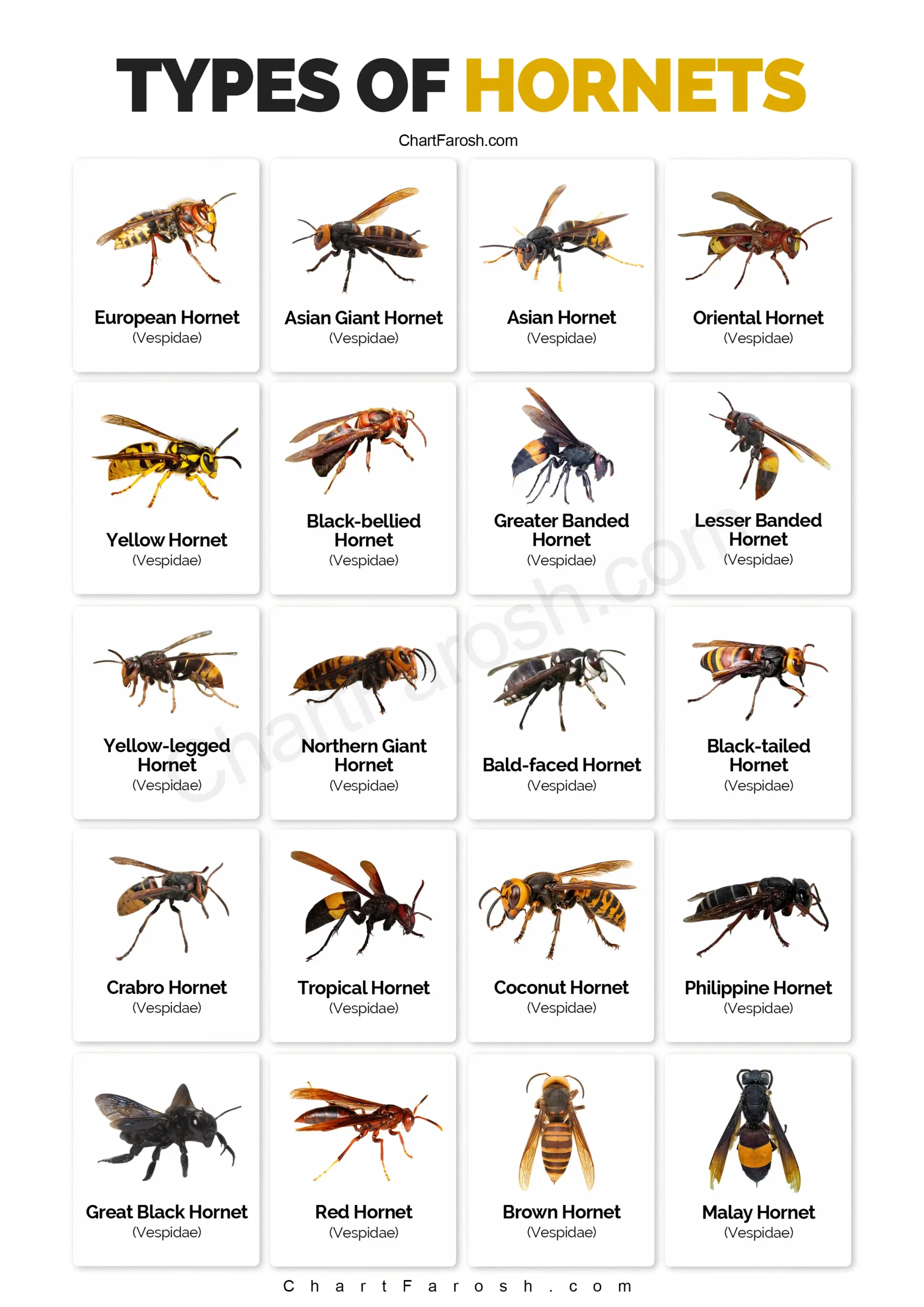
Table of Contents
Hornet species and their names
All true hornets sit in one genus, Vespa, inside the wasp family Vespidae and the subfamily Vespinae. They are the largest of the social wasps, and a queen can stretch past 5 centimeters. Most species live in tropical Asia, with only a few reaching Europe, the Middle East, and Africa.
The table covers all 22 recognized species. Some are household names, like the European hornet and the Asian giant hornet. Others are known mainly to entomologists and carry little published data beyond where they live.
| Common name | Scientific name | Size | Main colors | Distinctive feature | Native range |
| European hornet | Vespa crabro | 25–35 mm | Brown, yellow, reddish | Largest hornet in Europe; calm temperament | Europe, W Asia; intro. to North America |
| Asian giant hornet | Vespa mandarinia | 35–55 mm | Orange head, brown-black bands | World’s largest hornet; the “murder hornet” | East and South Asia |
| Southern giant hornet | Vespa soror | 30–50 mm | Dark body, yellow marks | Raids honey bee hives in groups | South China, SE Asia |
| Yellow-legged (Asian) hornet | Vespa velutina | 20–30 mm | Dark body, yellow leg tips | Invasive in Europe; honey bee predator | SE Asia; invasive in Europe |
| Oriental hornet | Vespa orientalis | 25–35 mm | Reddish-brown, yellow band | Heat tolerant; active in dry climates | Middle East, N Africa, SW Asia |
| Greater banded hornet | Vespa tropica | 25–30 mm | Black, one broad orange band | Hunts paper wasps | Tropical Asia |
| Lesser banded hornet | Vespa affinis | 22–30 mm | Black, one orange band | Strong nest defense; painful sting | Tropical and subtropical Asia |
| Black-bellied hornet | Vespa basalis | 25–30 mm | Black, reddish-brown | One of Taiwan’s most dangerous hornets | Taiwan, Nepal, Indonesia |
| Black-tailed hornet | Vespa ducalis | 24–37 mm | Brown, yellow, black tail | Smallest colonies of any hornet | East and SE Asia |
| Yellow-vented hornet | Vespa analis | 20–30 mm | Black, yellow abdomen tip | Wide range; yellow vent tip | E/SE Asia, Japan, Russia |
| Yellow hornet (Japanese) | Vespa simillima | 18–28 mm | Yellow and black | Japanese yellow hornet is the known form | Japan, Korea, Russia |
| Black shield hornet | Vespa bicolor | 20–28 mm | Yellow and black | Orchid pollinator; common in Hong Kong | South China, SE Asia |
| Dybowski’s hornet | Vespa dybowskii | 25–30 mm | Dark reddish-brown | Social parasite of other hornets | NE Asia |
| Bingham’s hornet | Vespa binghami | 25–30 mm | Dark with pale band | Rarely seen | Thailand, India, Russia |
| Philippine hornet | Vespa luctuosa | 25–30 mm | Black, yellow face | Endemic to the Philippines; potent venom | Philippines |
| Vespa philippinensis | Vespa philippinensis | Medium | Dark | Philippine endemic; few records | Philippines |
| Vespa bellicosa | Vespa bellicosa | Medium-large | Dark | Few field records | SE Asia |
| Vespa fervida | Vespa fervida | Medium | Dark, reddish | Found only on Sulawesi | Indonesia |
| Vespa fumida | Vespa fumida | Medium | Smoky dark | Limited published data | Mainland SE Asia |
| Vespa mocsaryana | Vespa mocsaryana | Medium | Black, banded | Close to the lesser banded hornet | SE Asia |
| Vespa multimaculata | Vespa multimaculata | Medium | Dark, many spots | Limited published data | SE Asia |
| Vespa vivax | Vespa vivax | Medium | Dark | Few field records | East Asia |
A few of these species have thin scientific records. Where the data is genuinely limited, the chart says so instead of guessing.
Largest hornet species
The Asian giant hornet, Vespa mandarinia, is the biggest hornet on Earth. Queens can reach about 5.5 centimeters with a wingspan near 7.5 centimeters. The press nicknamed it the murder hornet, though that name oversells the risk to people.
Its close cousin, the southern giant hornet (Vespa soror), runs a near second in size. Both launch group raids on honey bee hives and can clear a colony in hours, which is why beekeepers track them alongside other types of bees. The European hornet is the largest wasp in Europe, but it stays well below the giants of Asia.
Smallest hornet species
Not every hornet is a giant. The lesser banded hornet (Vespa affinis) and the black shield hornet (Vespa bicolor) sit at the small end, with workers around 20 to 25 millimeters. They look more like large yellowjackets than the heavy giants of the north.
The black-tailed hornet (Vespa ducalis) is modest in size and builds the smallest colonies of any hornet. A nest may hold only about 50 insects. That makes it far less of a threat than species that raise nests of several thousand.
Rarest hornets in the world
A handful of hornets are rarely seen and barely studied. Vespa fervida lives only on Sulawesi in Indonesia. The Philippine hornet (Vespa luctuosa) and Vespa philippinensis are limited to the Philippines, and field records for both are scarce.
Species like Vespa bellicosa and Vespa vivax turn up in museum collections but almost never in everyday sightings. Their colors and habits follow the usual hornet pattern, yet clear photographs and population data are hard to find.
Common and widespread hornets
Five species account for most hornet encounters. The European hornet ranges across Europe and has spread through the eastern United States since the 1840s. The Asian hornet, also called the yellow-legged hornet (Vespa velutina), has pushed into France, Spain, and the UK, where it hunts honey bees.
The oriental hornet thrives in the hot, dry climates of the Mediterranean and the Middle East. The Asian giant hornet draws the most news coverage. In southern China and Hong Kong, the black shield hornet is the large wasp people meet most often, and it is easy to confuse with the bees it sometimes hunts.
Dangerous vs less aggressive hornets
Hornet stings hurt, and a hornet can sting many times. The real danger depends on the species, the size of the colony, and how close you get to the nest. Some hornets defend their nests with force, while others mostly keep to themselves.
Venom strength varies too. The giant hornets carry large venom loads, and mass stinging can be life threatening, especially for people with allergies. For most people a single sting means pain and swelling rather than an emergency.
| Hornet | Threat level | Why |
| Asian giant hornet (V. mandarinia) | High | Large venom dose and group attacks on nests |
| Southern giant hornet (V. soror) | High | Coordinated hive raids and a heavy sting |
| Black-bellied hornet (V. basalis) | High | Aggressive defense; venom causes swelling |
| Yellow-legged hornet (V. velutina) | Medium (high for bees) | Defends its nest and preys hard on honey bees |
| Oriental hornet (V. orientalis) | Medium | Stings when the nest is disturbed |
| European hornet (V. crabro) | Low to medium | Large but calm; tends to avoid people |
| Black-tailed hornet (V. ducalis) | Low | Tiny colonies and a mild temperament |
Are any hornets endangered?
No true hornet is listed as endangered. Most Vespa species have never been formally assessed for conservation status, and the well-known ones are stable or expanding. The bigger story runs the other way.
Two species have turned invasive far from home. The yellow-legged hornet spread across Europe and reached the UK and the United States, where it threatens honey bees and native pollinators.
Wildlife agencies now trap and remove these nests, since hornets also work as beneficial insects that prey on garden pests in their home range.
Hornets by region
Europe has one native true hornet, the European hornet, plus the invasive yellow-legged hornet and the oriental hornet in the south. The European hornet is large but calm and helps control garden pests. The Asian hornet is the one beekeepers watch for.
Asia is the true home of hornets. Almost every Vespa species lives there, from the giant hornets of the mountains to the banded hornets of the tropics. Japan alone hosts the Japanese giant hornet and the Japanese yellow hornet, a subspecies of Vespa simillima.
North America has no native hornet. The only true hornet present is the European hornet, introduced in the 1800s. The famous bald-faced hornet is not a hornet at all, a point worth its own section below.
Hornet names that are not separate species
Many names that include the word hornet do not belong to a distinct species. Some are nicknames, some are duplicates, and one of the most famous is not a hornet.
The bald-faced hornet (Dolichovespula maculata) is a yellowjacket native to North America. It earns the hornet label from its size and its large aerial nest, but it sits in a different genus from true hornets.
People also use northern giant hornet and Asian giant hornet for the same insect, Vespa mandarinia, after a 2022 name change adopted in the United States.
Other labels describe color or place rather than a real species. Names like mountain hornet, forest hornet, brown hornet, red hornet, orange hornet, Taiwan hornet, and Himalayan hornet are local or descriptive uses, not separate entries in the genus. When you meet one, it usually maps back to one of the 22 recognized species in the chart above.
How to tell a hornet from a wasp
A few traits separate true hornets from the wasps and yellowjackets people confuse them with.
- Size: hornets are bigger than common wasps, often 25 mm or more.
- Head: hornets have a wide top margin behind the eyes.
- Body shape: the abdomen is rounded just behind the narrow waist.
- Color: most are brown or black with yellow, orange, or reddish bands.
- Nest: hornets build large papery nests from chewed wood.
- Behavior: most hunt other insects and only sting to defend the nest, and you can trace their early stages through insect egg identification.
FAQs
How many types of hornets are there?
Scientists recognize 22 true hornet species, all in the genus Vespa. Many other names you see are nicknames or yellowjackets, not separate hornets.
What is the largest hornet?
The Asian giant hornet (Vespa mandarinia) is the largest, with queens reaching about 5.5 centimeters. The southern giant hornet is a close second.
What is the smallest true hornet?
The lesser banded hornet and the black shield hornet are among the smallest, with workers near 20 to 25 millimeters.
Is the bald-faced hornet a real hornet?
No. The bald-faced hornet is a yellowjacket (Dolichovespula maculata), not a member of the true hornet genus Vespa.
What is the difference between a hornet and a wasp?
All hornets are wasps, but hornets are the largest social wasps in the genus Vespa. They have wider heads and build big papery nests.
Are hornets dangerous?
A hornet can sting many times, and giant species carry strong venom. For most people one sting causes pain and swelling, but allergic reactions and mass stings need medical care.
Where are hornets most common?
Most hornets live in tropical Asia. Europe has the native European hornet, and North America has only the introduced European hornet.