Types of Honey Bees
A few summers ago I stood in a friend’s apiary in the hills outside town. He lifted a frame crawling with bees and held it a few inches from my face. I froze. He just grinned and said, “These are Italians. They won’t bother you.”
He was right. The bees ignored me completely.
That afternoon I learned something that had never crossed my mind. A honey bee is not one bee. The gentle golden insect on that frame was Apis mellifera ligustica, an Italian. The darker, faster bees in the next hive were Carniolans. Neither was the same as the giant honey bees that hang open combs on Himalayan cliffs, or the dwarf bees of South Asia.
There are only eight honey bee species in the world. Most people know just one. The rest run from a black bee smaller than a grain of rice to a cliff-dwelling giant that makes hallucinogenic honey.
Below are all of them, plus the famous Western honey bee breeds, what each looks like, where it lives, and what makes it worth knowing.
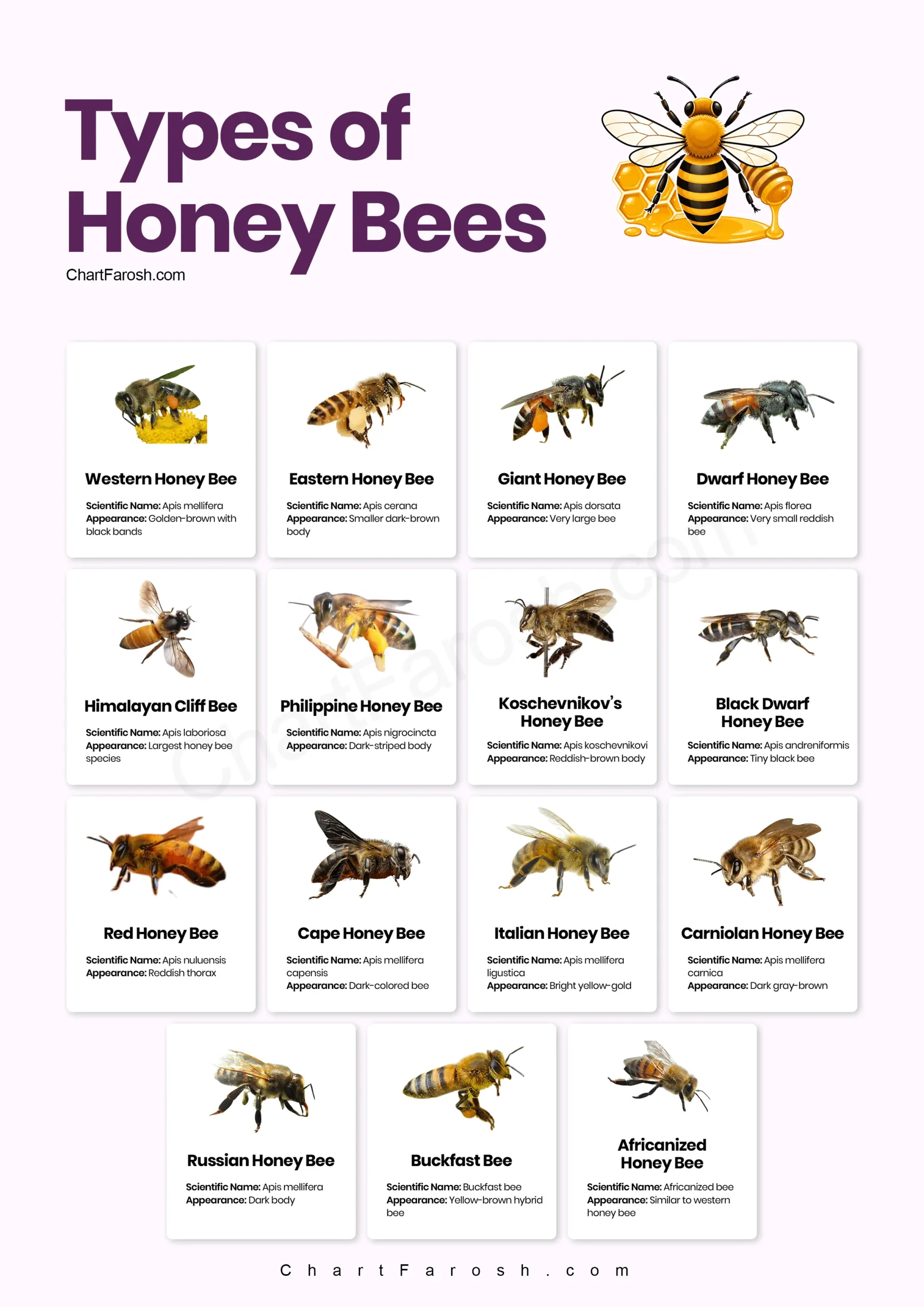
Table of Contents
Honey bee identification chart
Eight honey bee species are recognized today, along with dozens of Western honey bee subspecies and bred strains. The chart below lists the ones you are most likely to read about.
The eight true species come first, then the popular Apis mellifera races and hybrids. Look down the region column and one thing jumps out. Seven of the eight species live only in Asia.
| # | Honey Bee Type | Scientific Name | Appearance | Main Region | Special Feature |
| 1 | Western Honey Bee | Apis mellifera | Golden-brown with black bands | Europe, worldwide | Most common honey-producing bee |
| 2 | Eastern Honey Bee | Apis cerana | Smaller dark-brown body | Asia | Resists the Varroa mite |
| 3 | Giant Honey Bee | Apis dorsata | Very large bee | South & SE Asia | Builds huge open-air nests |
| 4 | Red Dwarf Honey Bee | Apis florea | Very small reddish bee | South Asia | Small exposed comb nests |
| 5 | Himalayan Cliff Bee | Apis laboriosa | Largest honey bee species | Himalayas | Produces red “mad honey” |
| 6 | Philippine Honey Bee | Apis nigrocincta | Dark-striped body | Philippines, Indonesia | Tropical forest bee |
| 7 | Koschevnikov’s Honey Bee | Apis koschevnikovi | Reddish-brown body | Borneo, Malaysia | Forest-dwelling species |
| 8 | Black Dwarf Honey Bee | Apis andreniformis | Tiny black bee | Southeast Asia | Smallest honey bee |
| 9 | Bornean Honey Bee | Apis nuluensis | Reddish thorax | Borneo highlands | Mountain species, status debated |
| 10 | Cape Honey Bee | Apis mellifera capensis | Dark-colored honey bee | South Africa | Workers can reproduce |
| 11 | Italian Honey Bee | Apis mellifera ligustica | Bright yellow-gold | Italy, worldwide | Gentle and productive |
| 12 | Carniolan Honey Bee | Apis mellifera carnica | Dark gray-brown | Central Europe | Calm temperament |
| 13 | Russian Honey Bee | Apis mellifera (bred stock) | Dark body | Russia, worldwide | Strong mite resistance |
| 14 | Buckfast Bee | Apis mellifera (hybrid) | Yellow-brown hybrid bee | Worldwide | Disease-resistant hybrid |
| 15 | Africanized Honey Bee | A. m. scutellata (hybrid) | Similar to Western honey bee | Americas | Highly defensive behavior |
A quick note on the list. Rows one through nine are separate species or close relatives in the genus Apis.
Rows ten through fifteen are all the same species, the Western honey bee Apis mellifera, sorted into regional subspecies and bred strains.
Beekeepers choose among those last six the way dog owners choose among retrievers. Same animal, different temperament and traits. To match a bee to a photo, the bee identification chart lines them up side by side.
The eight true honey bee species
The genus Apis splits into three natural groups by size and nest style.
The dwarf honey bees are the smallest. The red dwarf honey bee (Apis florea) and the black dwarf honey bee (Apis andreniformis) build a single open comb about the size of a hand around a twig. Apis andreniformis is the smallest honey bee in the world, a tiny black bee that nests in the forests of Southeast Asia.
The giant honey bees are the largest. The giant honey bee (Apis dorsata) hangs huge single combs from tall trees and buildings across South and Southeast Asia.
The Himalayan cliff bee (Apis laboriosa) is bigger still, the largest honey bee on Earth, with workers reaching about three centimeters (1.2 inches). It nests on cliff faces at high altitude and makes the famous red “mad honey,” which gets its kick from grayanotoxins in the rhododendron nectar the bees collect.
The cavity-nesting bees build sheltered combs inside hollows. This group holds the two species people actually keep: the Western honey bee (Apis mellifera) and the Eastern honey bee (Apis cerana).
Apis cerana is valued across Asia because it shrugs off the Varroa mite that devastates Western colonies. Three more cavity nesters round out the genus, all from Southeast Asian forests.
They are the Philippine honey bee (Apis nigrocincta), Koschevnikov’s honey bee (Apis koschevnikovi) from Borneo, and the mountain-dwelling Bornean honey bee (Apis nuluensis), whose rank as a full species is still argued over. These wild forest bees do far more pollinating than honey making, which is true of many beneficial insects.
| Honey Bee | Worker Body Length | Nest Type | Group |
| Black Dwarf Honey Bee | About 7 mm (0.28 in) | Single small open comb | Dwarf |
| Red Dwarf Honey Bee | 7-10 mm (0.3-0.4 in) | Single open comb | Dwarf |
| Eastern Honey Bee | 10-11 mm (0.4 in) | Multi-comb in cavities | Cavity |
| Western Honey Bee | 12-15 mm (0.5-0.6 in) | Multi-comb in cavities | Cavity |
| Giant Honey Bee | 17-20 mm (0.7-0.8 in) | Single large open comb | Giant |
| Himalayan Cliff Bee | Up to 30 mm (1.2 in) | Cliff-hanging open comb | Giant |
Read the table from the top and the size jump is hard to miss. The smallest honey bee would sit comfortably on the back of the largest.
Western honey bee subspecies and breeds
Every bee in this section is Apis mellifera. The differences come from geography and breeding, not from species.
The Italian honey bee (Apis mellifera ligustica) is the bright gold bee most Western beekeepers start with. It is gentle and productive, which is why it spread around the world.
The Carniolan honey bee (Apis mellifera carnica) is darker and gray-brown, from the Alps and the Balkans. It stays calm on the comb and builds up fast in spring, then scales back when forage runs low.
The Cape honey bee (Apis mellifera capensis) of South Africa has a strange trick. Its worker bees can lay eggs that hatch into females without mating, something no other honey bee does. That ability turns them into a serious problem when they slip into other colonies.
The Russian honey bee is not a subspecies but a bred stock. The USDA developed it from bees in Russia’s Primorsky region, which had lived alongside the Varroa mite for over a century and learned to handle it.
The Buckfast bee is a hybrid. A monk named Brother Adam created it at Buckfast Abbey in England in the early 1900s, after disease wiped out the local bees. He crossed Italian, dark European, and several other races into one disease-resistant, gentle, low-swarming bee.
The Africanized honey bee carries the fearsome reputation. It came from crossing the East African lowland bee (Apis mellifera scutellata) with European bees in Brazil in the 1950s.
A few queens escaped, and the hybrid spread north all the way into the southern United States. It pollinates and makes honey like any other Western bee. It just defends its nest far more aggressively, which earned it the “killer bee” nickname.
| Subspecies / Breed | Scientific Name | Temperament | Known For |
| Italian | A. m. ligustica | Gentle | High honey yield, popular worldwide |
| Carniolan | A. m. carnica | Calm | Cold tolerance, fast spring buildup |
| Cape | A. m. capensis | Variable | Workers lay female eggs unmated |
| Russian | A. mellifera (bred) | Slightly defensive | Varroa and tracheal mite resistance |
| Buckfast | A. mellifera (hybrid) | Gentle | Disease resistance, low swarming |
| Africanized | A. m. scutellata (hybrid) | Highly defensive | Spread across the Americas |
Which honey bees do beekeepers keep
Out of all eight species, only two are managed at scale: the Western honey bee and the Eastern honey bee. The Western honey bee does the bulk of the world’s commercial pollination and honey production. The Eastern honey bee is kept across Asia, where it handles local pests and climate better than imported Western stock.
The wild species matter too, in a different way. Giant and dwarf honey bees pollinate large stretches of crops and forest with no help from people. Many crops in southern Asia, including mango, coconut, and coffee, lean on wild Apis dorsata for their fruit set.
How to tell a honey bee from a wasp
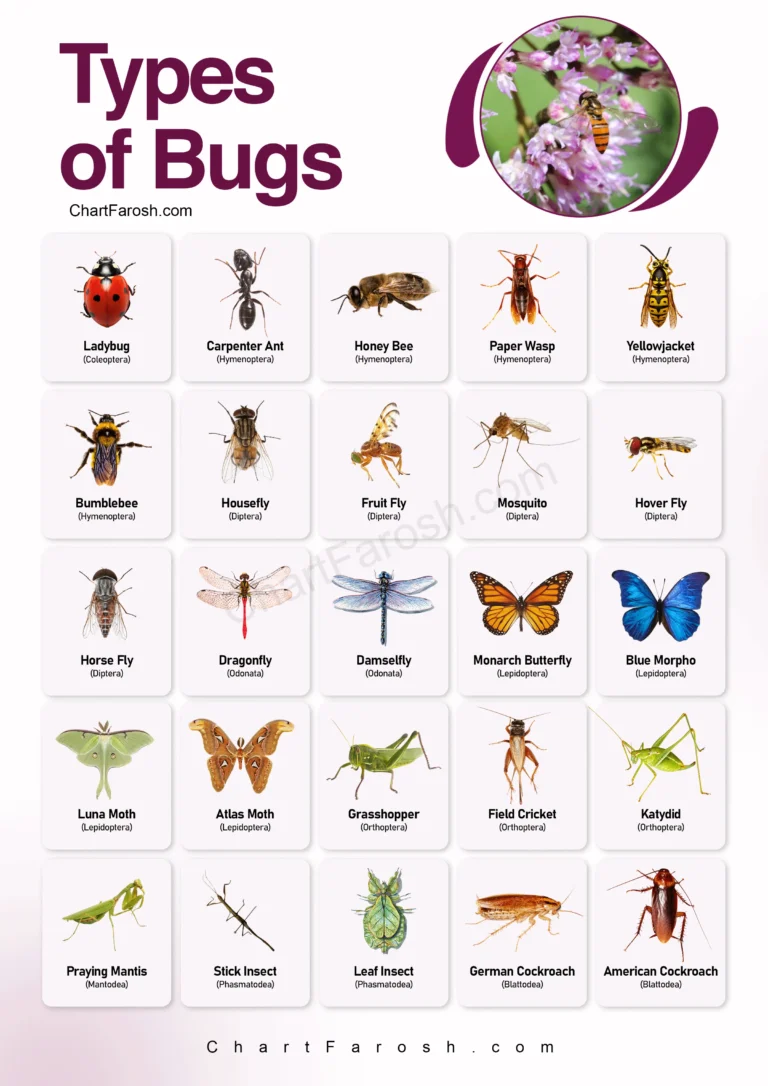
People mix up honey bees with wasps, bumble bees, and even hover flies all the time. A honey bee is small, golden to brown, and fuzzy, with a thick body and branched hairs that catch pollen. A wasp is slimmer, shinier, and almost hairless, with a sharp, pinched waist.
If the insect looks smooth and quick to anger, it is probably a wasp, and the wasp identification chart will sort it out. If it is round, hairy, and calm on a flower, it is a bee. For the borderline cases, a look through the bug identification chart usually settles it.
FAQs
How many types of honey bees are there?
There are eight recognized honey bee species in the genus Apis. The Western honey bee, Apis mellifera, also splits into more than 40 regional subspecies plus bred strains like Italian, Carniolan, and Buckfast, so the everyday count of “types” is much higher.
Which honey bee makes the most honey?
The Western honey bee (Apis mellifera) produces the most honey and does almost all commercial beekeeping worldwide. Among its breeds, Italian bees are known for heavy, reliable honey yields.
What is the largest honey bee?
The Himalayan cliff bee (Apis laboriosa) is the largest, with workers reaching about three centimeters. It builds combs on high cliff faces and is the source of the red “mad honey” sold in parts of Nepal.
What is the smallest honey bee?
The black dwarf honey bee (Apis andreniformis) is the smallest, at roughly seven millimeters. It lives in Southeast Asian forests and builds a single small comb around a twig.
Are Africanized honey bees a separate species?
No. The Africanized or “killer” bee is a hybrid of the same species, Apis mellifera. It comes from crossing the East African lowland bee with European bees. It is no more venomous than other honey bees, but it defends its nest far more aggressively.
Which honey bee resists the Varroa mite?
The Eastern honey bee (Apis cerana) has lived with Varroa for a long time and resists it naturally. Among Western bees, the bred Russian stock holds up best. For more identification help, see the bee identification chart and browse the wider Animals Chart collection.