Types of Weevils
Last winter I opened a bag of basmati rice and watched it move. Tiny dark specks were crawling between the grains. They were rice weevils. I tossed the bag, but the question stuck with me.
That one bag pulled me down a long path. I started reading, and I learned there are tens of thousands of weevils.
I had always pictured a weevil as one bug. The thing in my flour. The thing in my rice. They are a huge group of beetles, and they share one odd feature. A long snout. You cannot miss it once you know to look. Some attack stored grain. Some bore into tree trunks. One nearly wiped out cotton in the American South.
Below you will find 10 common types of weevils, the crop or food each one attacks, and how to tell them apart. You will also meet one famous fake.The bean weevil is not a real weevil at all. Each entry gives the scientific name, the main host, the size, and the damage to watch for. The weevil identification chart comes first.
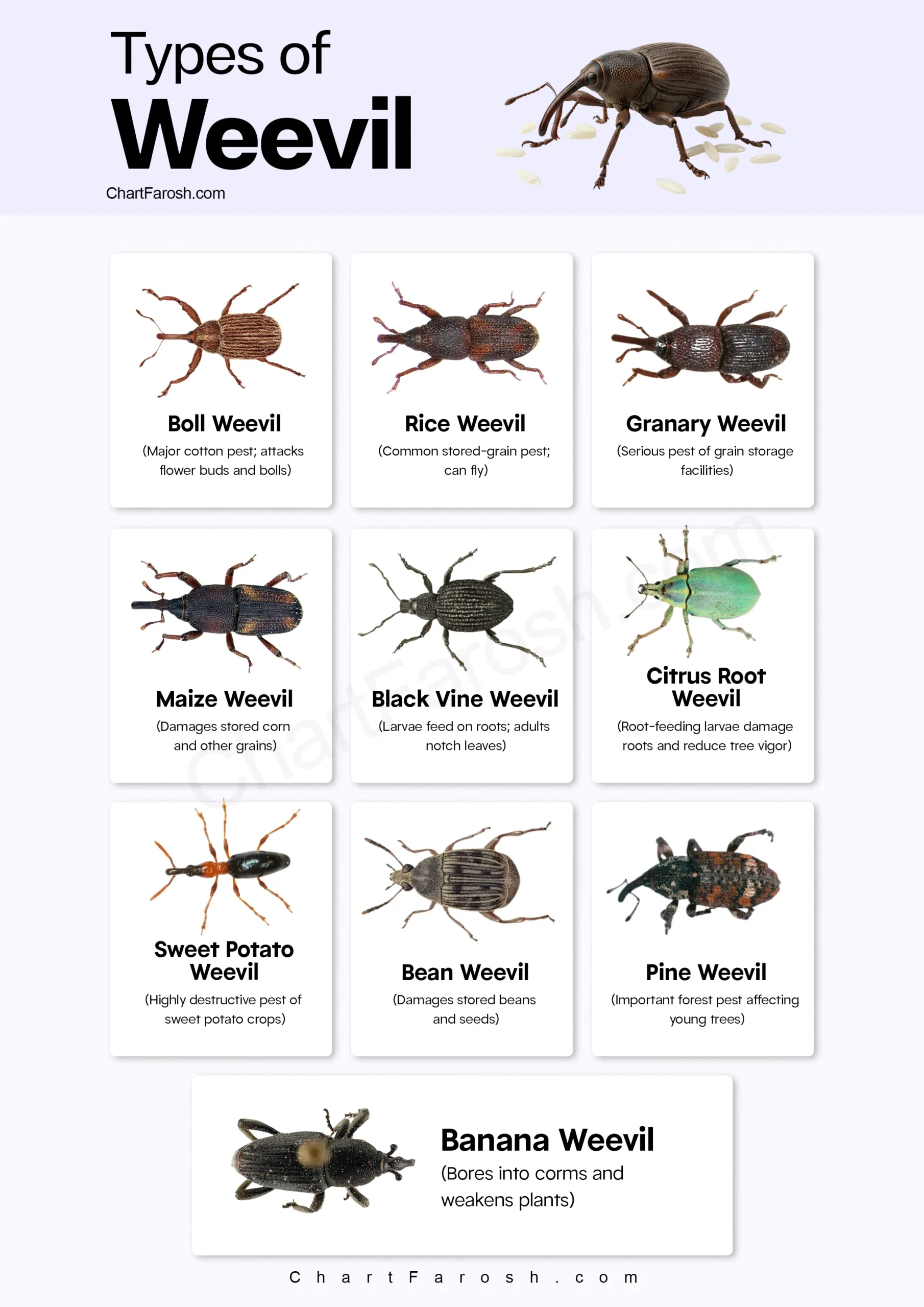
Table of Contents
Weevil identification chart
Here are the 10 weevils side by side. Use it to match a name to a host and a size. The detailed sections below break the group into grain pests, crop pests, and tree pests.
| Weevil | Scientific name | Main host or food | Adult size | Key ID feature |
| Boll weevil | Anthonomus grandis | Cotton | About 6 mm | Long snout, near half its body length |
| Rice weevil | Sitophilus oryzae | Rice, wheat, maize | 3 to 4.6 mm | Four faint pale spots; flies |
| Granary weevil | Sitophilus granarius | Stored grain, wheat | 3 to 5 mm | No spots; wings fused, cannot fly |
| Maize weevil | Sitophilus zeamais | Corn and cereals | 2.3 to 4.9 mm | Four clear spots; flies well |
| Black vine weevil | Otiorhynchus sulcatus | Ornamentals, strawberries | About 10 mm | Matte black; short broad snout; flightless |
| Citrus root weevil | Diaprepes abbreviatus | Citrus and 270+ plants | 10 to 19 mm | Large, colorful gray to orange forms |
| Sweet potato weevil | Cylas formicarius | Sweet potato | About 6 mm | Slender, ant-like; red and dark blue |
| Pine weevil | Hylobius abietis | Conifer seedlings | 8 to 14 mm | Dark brown with yellow scale patches |
| Banana weevil | Cosmopolites sordidus | Banana plants | 10 to 15 mm | Dull black; bores into the corm |
| Red palm weevil | Rhynchophorus ferrugineus | Palm trees | 25 to 40 mm | Rusty red-orange; one of the largest |
What makes a weevil a true weevil
A weevil is a beetle with a snout. The snout has a proper name, the rostrum. The tiny mouth sits right at the tip, and the elbowed antennae often fold into grooves along it. Around 97,000 weevil species are known, which puts the weevil family among the largest groups of animals alive. Most sit in one family, Curculionidae, the true weevils.
Not every bug with weevil in its name belongs here. The bean weevil is the classic mix-up. It is a seed beetle in the leaf beetle family, and it has no snout. Next to a real weevil it looks short and round. True weevils carry that long curved nose. Weevils are beetles, so the beetle identification chart helps you place them next to their close relatives.
Stored-grain weevils
Three weevils live in the pantry. The female drills a hole in a single kernel and lays one egg inside. The larva eats the grain from within, then chews its way out as an adult. You often spot only the adults and the hollow shells they leave behind.
The rice weevil (Sitophilus oryzae) runs 3 to 4.6 mm. It is dark reddish-brown with four faint pale spots on the wing covers. It flies and is drawn to light. One female lays 300 to 400 eggs over 4 to 5 months. It takes rice, wheat, maize, and many other stored grains.
The granary weevil (Sitophilus granarius) is a touch larger, 3 to 5 mm, dark brown to black, with no spots. Its wing covers are fused, so it cannot fly. It favors cool, temperate stores and can live well over a year.
The maize weevil (Sitophilus zeamais) looks almost identical to the rice weevil. The spots are clearer and the body is often a shade larger. It flies well. Corn is the favorite, though it will take pasta and milled cereals too. The legless larvae are small grubs hidden inside the grain; the grub identification chart shows what beetle larvae look like in soil and stored food.
| Weevil | Flies? | Wing-cover spots | Eggs and adult lifespan |
| Rice weevil | Yes | Four faint pale spots | 300 to 400 eggs; 4 to 5 months |
| Granary weevil | No (wings fused) | None | 50 to 250 eggs; up to a year or more |
| Maize weevil | Yes | Four clear spots | 300 to 400 eggs; 4 to 5 months |
Crop and tuber weevils
These weevils hit field crops and root crops, and one of them changed history. The boll weevil (Anthonomus grandis) is the most famous weevil in America. It is about 6 mm with a snout near half its body length. It feeds on cotton buds and bolls and lays eggs inside them. It crossed from Mexico in the 1890s and cost growers billions.
A national program started in 1978 has cleared it from over 99 percent of US cotton land, though a small pocket holds on in the Lower Rio Grande Valley of Texas. You can read the USDA boll weevil eradication program for the full story.
The sweet potato weevil (Cylas formicarius) is slender and ant-like, about 6 mm, with a red thorax and a dark blue body. It is the worst pest of sweet potato worldwide. Larvae tunnel through the vines and tubers. The plant fights back with bitter compounds that make the root taste foul, so even light feeding can spoil a whole harvest.
The banana weevil (Cosmopolites sordidus) is also called the banana root borer. It is a dull black weevil, 10 to 15 mm long. Adults hide at the base of the plant by day.
The larvae bore into the corm, the thick underground stem. Heavy tunneling weakens the plant, cuts the yield, and can topple it in a wind.
| Weevil | What it damages | Main regions | Control basics |
| Boll weevil | Cotton flower buds and bolls | Mexico, Central and South America; near gone in the US | Pheromone traps; area-wide eradication |
| Sweet potato weevil | Vines and tubers of sweet potato | Tropics and subtropics worldwide | Clean seed roots; crop rotation; pheromone traps |
| Banana weevil | Corm (underground stem) of banana | Every banana-growing region | Trap with cut pseudostems; clean planting material |
Tree and ornamental weevils
These weevils attack woody plants and garden stock. The black vine weevil (Otiorhynchus sulcatus) is about 10 mm, matte black, with a short broad snout. It cannot fly. In North America almost every one is female and breeds without a mate, so numbers climb fast. Adults notch leaf edges at night.
The larvae do the real harm, chewing the roots of yews, rhododendrons, strawberries, and other nursery plants. Gardeners often fight them with soil nematodes; the beneficial insects chart covers other natural helpers.
The citrus root weevil (Diaprepes abbreviatus), also called the Diaprepes root weevil, is large and colorful, 10 to 19 mm, in shades of gray, yellow, orange, and black. Native to the Caribbean, it reached Florida in 1964, then Texas and California. It feeds on more than 270 kinds of plants. Adults cut notches in leaves. Larvae feed on roots for 9 to 18 months and can girdle the taproot, killing the tree.
The pine weevil (Hylobius abietis), the large pine weevil, is the worst pest of conifer plantations in Europe. It is dark brown with patches of yellow scales, around 8 to 14 mm. Adults strip bark from young seedlings near the base. This ring-barking kills the seedling. Females lay eggs in the roots of freshly cut or dead conifers.
The red palm weevil (Rhynchophorus ferrugineus) is one of the largest weevils, 25 to 40 mm, rusty orange-red with black marks. Many call it the most destructive palm pest on Earth. It came from tropical Asia and spread through the Middle East and the Mediterranean, and it has turned up in California. The larvae tunnel up to a meter inside the trunk and kill the palm from the inside, often before anyone notices.
| Weevil | What it damages | Range and spread | Control basics |
| Black vine weevil | Roots of yews, rhododendrons, strawberries | Native to Europe; common in North America | Beneficial nematodes; sticky barriers |
| Citrus root weevil | Leaves and roots of citrus and many crops | Caribbean native; Florida, Texas, California | Soil nematodes; foliar sprays for adults |
| Pine weevil | Bark of young conifer seedlings | Across Europe and northern Asia | Wait before replanting; treated stock |
| Red palm weevil | Trunk and crown of palms | Asian origin; Middle East, Mediterranean, California | Pheromone traps; early detection; remove dead palms |
Rice vs granary vs maize weevil: how to tell them apart
These three grain weevils confuse almost everyone. They share a pantry and a body shape. A few features sort them out fast. The granary weevil cannot fly and has no spots. The rice and maize weevils both fly and both show four spots, but the maize weevil wears them more clearly and runs a little bigger.
| Feature | Rice weevil | Granary weevil | Maize weevil |
| Adult size | 3 to 4.6 mm | 3 to 5 mm | 2.3 to 4.9 mm |
| Spots on wing covers | Four, faint | None | Four, clear |
| Can it fly? | Yes | No | Yes |
| Eggs per female | 300 to 400 | 50 to 250 | 300 to 400 |
| Favorite grain | Rice and wheat | Stored wheat | Corn |
FAQs
What is the most common weevil in the house?
The rice weevil and the granary weevil. Both turn up in stored rice, flour, pasta, and whole grain. They ride in on grain you already bought.
Are bean weevils true weevils?
No. The bean weevil is a seed beetle in the family Chrysomelidae. It lacks the long snout that defines a true weevil, so it sits in a different group of beetles entirely.
Can weevils fly?
Some can. Rice and maize weevils fly and are drawn to light. The granary weevil and the black vine weevil cannot, because their wing covers are fused shut.
Do weevils bite or harm people?
No. Weevils do not bite people or pets and they carry no disease to humans. The harm they do is to crops and stored food, not to you.
How do I get rid of weevils in my pantry?
Throw out infested food and vacuum the shelves. Wipe the cracks where flour collects. Freeze new grain for three to four days to kill any hidden eggs before you store it.
What is the most destructive weevil?
Two stand out. The boll weevil cost US cotton growers billions over the last century. The red palm weevil is now the worst palm pest in the world.
Where can I learn to identify other insects?
Start with the beetle identification chart to place weevils among their beetle relatives, then use the bug identification chart for the other small pests you find around the home and garden.