Types of Buffalo
I always assumed a buffalo was one animal. Then I started reading, and it turns out the word covers two unrelated groups living on two different continents. One is the African buffalo, an animal so bad-tempered it will flip a lion if it gets the chance. The other is the Asian water buffalo, a patient workhorse that pulls plows across rice paddies and gives us the milk in real mozzarella.
Then there are the odd ones out. A tiny dwarf buffalo lives on one Philippine island, two shy island buffalo live in Indonesia, and the American “buffalo” is not really a buffalo at all.
This guide covers every real type of buffalo: where each one lives, how big it gets, what it does for a living, and how close it is to extinction. The full lineup is in the chart below, and I go through each type underneath it.
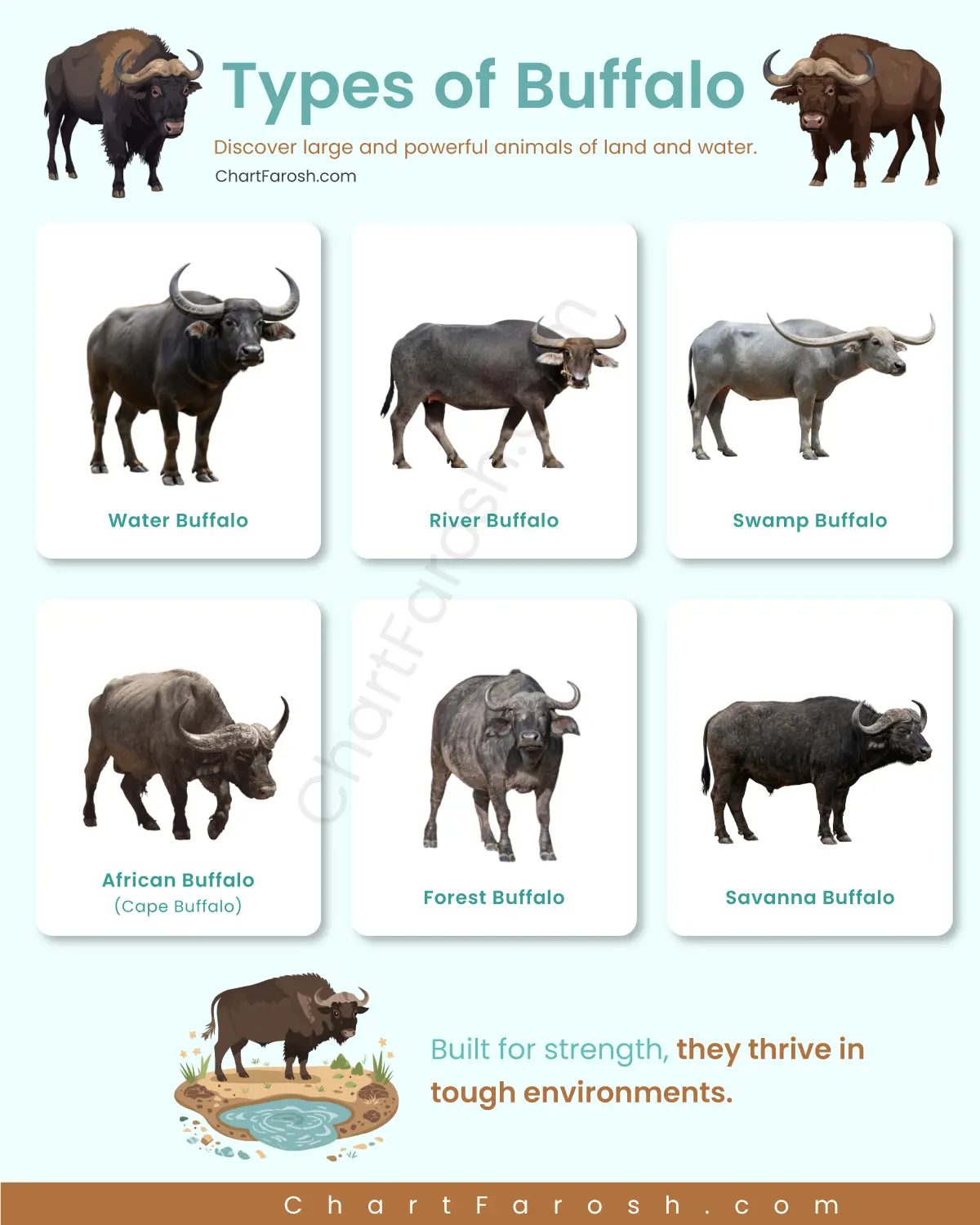
Table of Contents
Types of Buffalo
There are two true buffalo lines in the world. The African buffalo belongs to the genus Syncerus, and every Asian buffalo, wild or domestic, belongs to the genus Bubalus. Nearly everything people call a buffalo sits inside one of those two groups. The one famous exception, the American bison, comes up further down.
The table below is the quick version, listing each buffalo type, its scientific name, where it lives, a rough adult weight, and its status. The species notes after it fill in the rest.
| Buffalo type | Scientific name | Where it lives | Adult weight | Status |
| African buffalo | Syncerus caffer | Sub-Saharan Africa | 500–900 kg | Near Threatened |
| Cape buffalo | S. c. caffer | Southern & East Africa | 500–900 kg | (subspecies) |
| Forest buffalo | S. c. nanus | Central & West African rainforest | 250–320 kg | (subspecies) |
| West African savanna buffalo | S. c. brachyceros | West Africa | 300–600 kg | (subspecies) |
| Central African buffalo | S. c. aequinoctialis | Central African savanna | 300–600 kg | (subspecies) |
| Wild water buffalo | Bubalus arnee | India, Nepal, Southeast Asia | 700–1,200 kg | Endangered |
| Domestic water buffalo | Bubalus bubalis | Asia and worldwide | 300–550 kg | Domesticated |
| River buffalo (type) | Bubalus bubalis | South Asia, Mediterranean | 450–1,000 kg | Domesticated |
| Swamp buffalo (type) | Bubalus bubalis | Southeast Asia | 325–450 kg | Domesticated |
| Tamaraw (dwarf buffalo) | Bubalus mindorensis | Mindoro, Philippines | 200–300 kg | Critically Endangered |
| Lowland anoa | Bubalus depressicornis | Sulawesi, Indonesia | 150–300 kg | Endangered |
| Mountain anoa | Bubalus quarlesi | Sulawesi, Indonesia | 150–300 kg | Endangered |
Also read: Types of Deer for another large grazing-mammal group with surprising variety.
How Many Types of Buffalo Are There in the World?
It depends on how you count, because zoologists split buffalo by genus, species, and subspecies. At the species level there are only a handful of true buffalo. The African buffalo (Syncerus caffer) is one species with up to five subspecies, and the Asian side has more: the wild water buffalo (Bubalus arnee), the domestic water buffalo (Bubalus bubalis), the tamaraw (Bubalus mindorensis), and the two anoa of Sulawesi.
Most people, though, use “types of buffalo” to mean the kinds you actually run into: the African buffalo, the water buffalo, and the river and swamp forms the water buffalo splits into. This guide follows that order, then adds the rarer wild species at the end so the picture is complete. First, though, one thing trips up nearly everyone: the buffalo-versus-bison mix-up.
Difference Between Buffalo and Bison
In North America, people have called bison “buffalo” for centuries, but the two are not the same animal. Bison, both the American bison and the European wisent, are not true buffalo. The quickest tell is the shoulder: a bison has a big muscular hump and a shaggy beard, while a true buffalo has a flat back and a smooth coat.
| Feature | True buffalo | Bison |
| Shoulder hump | None | Large, muscular |
| Beard | None | Thick, shaggy |
| Horns | Long, swept back or curved | Short and sharp |
| Coat | Short and sparse | Heavy and woolly |
| Native range | Africa and Asia | North America and Europe |
| Climate | Warm, tropical | Cold, temperate |
So if it has a hump and lives on the American plains, it is a bison. If it has sweeping horns and lives in Africa or Asia, it is a buffalo. Now to the real types.
African Buffalo: Habitat, Behavior, and Facts
The African buffalo is the heavyweight of sub-Saharan Africa, and the one most people picture first. Adults weigh 500 to 900 kg and stand up to 1.7 m at the shoulder. Their horns fuse across the forehead into a thick bony shield called a boss, which works as armour in a fight.
They graze in herds that can run into the hundreds, staying close to water because they drink every day and eat a lot of grass. Lions hunt them, but a healthy adult buffalo is dangerous prey, and a whole herd will mob a lion to drive it off.
Their reputation is earned. On foot, the African buffalo is one of the most dangerous animals on the continent, because a wounded one will circle back and charge. Across its whole range, the IUCN lists it as Near Threatened on the IUCN Red List, and the population is falling from habitat loss and poaching. Zoologists split the species into four or five subspecies, and the three below are the ones you will actually read about.
Cape Buffalo: The Iconic African Buffalo
The Cape buffalo (Syncerus caffer caffer) is the big, black, classic version, and the largest subspecies. It ranges across southern and eastern Africa, from South Africa up through Tanzania and Kenya, and it is the buffalo in Africa’s “Big Five.”
Its horns meet in a heavy central boss, and bulls are darker and bulkier than cows. Old males that drift away from the herd, nicknamed dagga boys, are short-tempered and best avoided. If you have seen footage of a buffalo tossing a lion, it was a Cape buffalo nine times out of ten.
Forest Buffalo: Rainforest Dweller
The forest buffalo (Syncerus caffer nanus) is the smallest African subspecies, often weighing less than half what a Cape buffalo does. It lives in the rainforests of Central and West Africa, where dense cover suits a smaller, nimbler body.
It also looks different. The coat is reddish-brown instead of black, the ears are tufted, and the horns sweep back instead of curling into a big boss. Forest buffalo travel in small groups of about a dozen, since thick forest cannot support giant herds.
West African Buffalo: Sub-Saharan Buffalo Species
The West African savanna buffalo (Syncerus caffer brachyceros) sits between the Cape and forest types in size and colour, living in the savannas and woodlands of West Africa. A related subspecies, the Central African buffalo (S. c. aequinoctialis), lives further east, through Chad, South Sudan, and the Central African Republic.
These savanna subspecies blend into one another where their ranges overlap. Genetic studies show the lines between them are blurry. For a deeper taxonomy breakdown, the San Diego Zoo Wildlife Alliance fact sheets are a reliable reference.
Asian Water Buffalo: Domesticated and Wild Types
Cross over to Asia and the story flips. Here the buffalo is a partner to people, not a wild threat. The water buffalo splits into two branches: the wild water buffalo, which is rare and endangered, and the domestic water buffalo, which numbers around 180 million animals worldwide.
Domestic water buffalo do a huge amount of work. They give most of the world’s buffalo milk, plow fields across South and Southeast Asia, and carry loads where tractors cannot reach. The domestic side itself splits into two types, river and swamp, both covered below.
Wild Water Buffalo: Endangered Species of Asia
The wild water buffalo (Bubalus arnee) is the ancestor of every domestic buffalo, and far more impressive than its tame descendants. It is the largest buffalo on Earth, with big bulls reaching 1,200 kg and carrying the widest horns of any living cattle.
It survives in scattered pockets of India, Nepal, Bhutan, Thailand, and Cambodia, in protected wetlands, and fewer than 4,000 mature animals remain. The IUCN has listed it as Endangered since 1986. The biggest long-term threat is an odd one: interbreeding with domestic buffalo, which dilutes the wild gene pool.
River Buffalo: Common Domesticated Buffalo
The river buffalo is the dairy type. It likes clean, running water to wallow in, carries tightly coiled horns, and gives rich, high-fat milk. The famous breeds are all river types: Murrah and Nili-Ravi in South Asia, and the Mediterranean buffalo in Italy.
If you have eaten real mozzarella di bufala, you have tasted river buffalo milk. Most river buffalo live in India, Pakistan, Egypt, and southern Europe, where farmers keep them mainly for dairy.
Swamp Buffalo: Used for Farming and Draft Work
The swamp buffalo is the working type. It wallows in mud rather than open water, has wide horns that sweep back in a crescent, and pulls heavy loads. This is the buffalo of the Southeast Asian rice paddy, known in the Philippines as the carabao.
Swamp and river buffalo are the same species, but they differ right down to the chromosome: swamp buffalo have 48, river buffalo have 50. They can still interbreed, and the crosses are common across the region. Swamp buffalo dominate in Thailand, Vietnam, the Philippines, and southern China, where draft power still matters on small farms.
Also read: Types of Rhinos if you like big horned herbivores, or All Bear Species for another worldwide animal group broken down by region.
Buffalo Habitat and Geographic Distribution
Buffalo habitat tracks the two main groups. African buffalo live across sub-Saharan Africa in savannas, floodplains, swamps, and rainforest, always within reach of water. Domestication spread Asian buffalo far wider, though the wild species cling to a few protected wetlands in South and Southeast Asia.
The dwarf buffalo round out the map. The tamaraw lives only on Mindoro in the Philippines, while the two anoa live only on Sulawesi in Indonesia, the lowland anoa in marshy coastal forest and the mountain anoa higher up. Island life shrank all three into compact, stocky animals.
What Do Buffalo Eat? Diet and Feeding Habits
Every buffalo is a grazing herbivore. The bulk of the diet is grass and sedges, plus leaves, reeds, and water plants near rivers and swamps.
Like cattle, buffalo are ruminants: they swallow food fast, then bring it back up as cud to chew again while a four-chambered stomach ferments the rest. This lets them pull nutrition out of tough grass that other animals cannot digest. They feed in the cool hours and rest through the midday heat, chewing and wallowing to stay cool and keep insects off.
Are Buffalo Endangered? Conservation Status by Species
It is a mixed picture. Domestic water buffalo are in no danger, with roughly 180 million worldwide, but several wild buffalo are sliding toward extinction, and the smallest island species are the most at risk.
| Buffalo | IUCN status | Main threats |
| Domestic water buffalo | Not assessed | None – farmed worldwide |
| African buffalo | Near Threatened | Habitat loss, poaching, disease |
| Lowland anoa | Endangered | Hunting, forest clearing |
| Mountain anoa | Endangered | Hunting, forest clearing |
| Wild water buffalo | Endangered | Interbreeding, habitat loss |
| Tamaraw | Critically Endangered | Hunting, habitat loss, disease |
The tamaraw is the one to worry about most, with fewer than 600 left on Mindoro. The IUCN SSC Asian Wild Cattle Specialist Group tracks recovery work for it and the anoa.
FAQs
How many types of buffalo are there?
There are two true buffalo lines. The African buffalo is one species with up to five subspecies. The Asian buffalo (genus Bubalus) includes the wild water buffalo, the domestic water buffalo with its river and swamp types, the tamaraw, and two anoa species.
What is the difference between a buffalo and a bison?
Bison have a large shoulder hump, a shaggy beard, and a heavy coat, and live in North America and Europe. True buffalo have a flat back, a smooth coat, and sweeping horns, and live in Africa and Asia. American “buffalo” are really bison.
What are the two main types of water buffalo?
River buffalo and swamp buffalo. River buffalo prefer clean water, have coiled horns, and are bred for milk. Swamp buffalo prefer mud, have wide crescent horns, and are used for draft work in rice paddies.
Which buffalo is the most dangerous?
The Cape buffalo. Lone old bulls are aggressive, and a wounded buffalo will charge. That makes it one of Africa’s most dangerous animals on foot.
What is the largest type of buffalo?
The wild water buffalo (Bubalus arnee). Large bulls can reach about 1,200 kg and carry the widest horns of any living wild cattle.
What is the smallest type of buffalo?
The anoa of Sulawesi. The lowland and mountain anoa weigh as little as 150 kg, which is why they are called dwarf buffalo.
Are buffalo endangered?
Some are. Domestic water buffalo are abundant, but the African buffalo is Near Threatened, the wild water buffalo and both anoa are Endangered, and the tamaraw is Critically Endangered.