Types of Wasps
A wasp once built a nest under my patio table. I noticed it in July, about the size of a golf ball. By August it was bigger than my fist. I sat three feet from it every morning and never got stung. That surprised me. I had assumed every wasp was out to get me.
It turns out most are not. Of the thousands of wasp species, only a small group lives in large colonies and defends a nest. The rest live alone. Many hunt other insects and never bother people at all.
Wasps fall into a few broad camps. The types of wasps you notice most are social. They share a nest and sting to protect it. Solitary wasps work alone and rarely sting. A third group, the parasitoids, raise their young inside other insects.
The chart below covers 38 wasps, grouped by family and lifestyle. You will meet the umbrella-nest paper wasp, the cicada killer that hauls prey twice its weight, and a metallic wasp that hunts only spiders. Some sting hard. Most would rather avoid you.
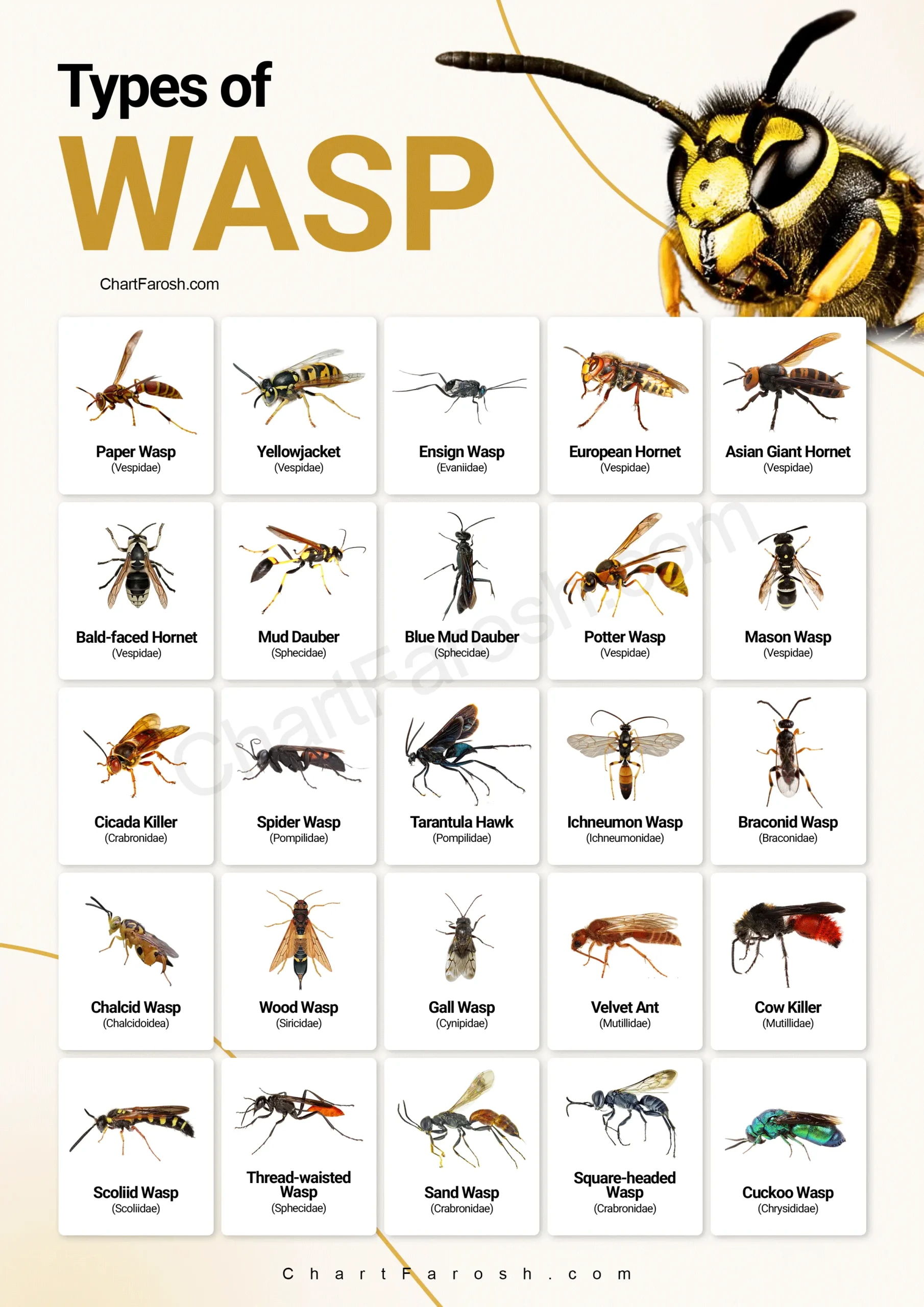
Table of Contents
Wasp Identification Chart (All 38 Types)
This chart lists all 38 wasp species covered here. Each row gives the family, rough size, main colors, and the one feature that sets the wasp apart.
Scan it first, then read the sections below for the detail. To match a nest you have found, see the wasp nest identification chart.
| Wasp | Family | Size | Main Colors | Standout Feature |
| Paper Wasp | Vespidae | Medium | Yellow, brown | Umbrella-shaped paper nests |
| Common Wasp | Vespidae | Small-medium | Yellow & black | Familiar nest-building social wasp |
| Yellowjacket | Vespidae | Small-medium | Yellow & black | Aggressive colony defender |
| German Yellowjacket | Vespidae | Small-medium | Yellow & black | Common urban pest |
| Red Wasp | Vespidae | Medium | Reddish-brown | Aggressive nest defender |
| Mexican Honey Wasp | Vespidae | Medium | Brown & yellow | One of the few wasps that make honey |
| Hornet | Vespidae | Large | Black, yellow, orange | Largest social wasps |
| European Hornet | Vespidae | Large | Brown & yellow | Active at night |
| Northern Giant Hornet (formerly Asian giant hornet) | Vespidae | Very large | Orange & black | Largest hornet species |
| Bald-faced Hornet | Vespidae | Large | Black & white | Large aerial paper nests |
| Oriental Hornet | Vespidae | Large | Reddish-brown & yellow | Heat-tolerant species |
| Mud Dauber | Sphecidae | Medium | Black, metallic blue | Builds mud tube nests |
| Blue Mud Dauber | Sphecidae | Medium | Metallic blue | Hunts spiders |
| Potter Wasp | Vespidae | Small-medium | Black, yellow | Makes pot-shaped mud nests |
| Mason Wasp | Vespidae | Small | Black & yellow | Solitary nest builder |
| Thread-waisted Wasp | Sphecidae | Medium | Black & red | Very thin waist |
| Great Black Wasp | Sphecidae | Large | Glossy black | Solitary hunter of katydids |
| Cicada Killer | Crabronidae | Very large | Black & yellow | Hunts cicadas |
| Spider Wasp | Pompilidae | Medium | Black, orange | Paralyzes spiders |
| Tarantula Hawk | Pompilidae | Very large | Metallic blue & orange | Hunts tarantulas |
| Sand Wasp | Crabronidae | Small-medium | Yellow & black | Burrows in sand |
| Square-headed Wasp | Crabronidae | Small | Black | Large square head |
| Digger Wasp | Crabronidae | Medium | Black, yellow | Digs underground burrows |
| Beewolf Wasp | Crabronidae | Medium | Yellow & black | Hunts honey bees |
| Scoliid Wasp | Scoliidae | Medium-large | Black with yellow spots | Parasite of beetle grubs |
| Mammoth Wasp | Scoliidae | Very large | Black & yellow | One of Europe’s largest wasps |
| Ichneumon Wasp | Ichneumonidae | Small-large | Black, orange | Long egg-laying ovipositor |
| Braconid Wasp | Braconidae | Tiny | Brown, black | Parasitoid of caterpillars |
| Chalcid Wasp | Chalcidoidea | Tiny | Metallic green, black | Very small parasitoids |
| Ensign Wasp | Evaniidae | Small | Black | Parasite of cockroach eggs |
| Jewel Wasp | Ampulicidae | Small | Metallic green | Parasitizes living cockroaches |
| Fig Wasp | Agaonidae | Tiny | Brown | Pollinates fig trees |
| Gall Wasp | Cynipidae | Tiny | Black, brown | Causes plant galls |
| Cuckoo Wasp | Chrysididae | Small | Metallic green, blue | Jewel-like appearance |
| Velvet Ant | Mutillidae | Small-medium | Red & black | Wingless female wasp |
| Cow Killer | Mutillidae | Large | Red & black | Extremely painful sting |
| Wood Wasp | Siricidae | Large | Black, yellow | Wood-boring larvae |
| Sawfly | Symphyta (Hymenoptera) | Small-medium | Black, yellow | Wasp relative without a narrow waist |
Family names matter more than they look. They tell you how a wasp lives, what it eats, and whether it is likely to sting. The sections below follow those families.
Social Wasps and Hornets (Vespidae)
Vespidae holds the wasps people know and fear. These are the social ones. A queen starts a paper nest in spring, raises workers, and the colony grows through summer. Workers sting to defend it, and they can sting more than once.
The paper wasp builds the open, umbrella-shaped nest you see under eaves. The common wasp and the German yellowjacket build bigger enclosed nests and turn up at picnics in late summer.
The red wasp defends its nest hard in the southern United States. The Mexican honey wasp is the odd one out, one of the few wasps that store real honey.
Hornets are the giants of the family. The European hornet hunts at night and is drawn to lights. The northern giant hornet, formerly called the Asian giant hornet, is the largest hornet in the world.
The Entomological Society of America renamed the northern giant hornet in 2022, and it was declared eradicated from the United States in 2024. The oriental hornet handles desert heat well.
One name fools people. The bald-faced hornet is not a true hornet at all. It is a large yellowjacket relative that builds the gray football-shaped nests in trees. For close-up identification, see the hornet identification chart.
Mud and Pot-Building Wasps
These wasps are solitary. No colony, no nest to defend, so they almost never sting people. Each female builds her own small nursery and stocks it with prey.
The mud dauber builds long mud tubes on walls and in sheds. The blue mud dauber is metallic blue and a dedicated spider hunter. The potter wasp shapes tiny clay pots that look handmade, then tucks a caterpillar inside for its larva. The mason wasp does similar work in existing holes.
Two are built for speed and digging. The thread-waisted wasp has a waist so thin it looks fragile. The great black wasp is a glossy black solitary hunter that stocks its burrow with katydids and grasshoppers. Both help control garden pests.
Hunting and Digging Wasps
This group lives by the hunt. Each wasp targets a specific prey, paralyzes it with a sting, and seals it in a burrow as fresh food for a single larva.
The cicada killer is huge but mild toward people. It drags a paralyzed cicada twice its own weight back to a sandy burrow. The spider wasp hunts spiders, and its biggest cousin the tarantula hawk takes on full-grown tarantulas. Its sting ranks at the very top of the pain scale, though it fades fast.
Others stay closer to the ground. The sand wasp and digger wasp burrow into loose soil. The square-headed wasp nests in dead wood. The beewolf hunts honey bees, paralyzes them, and stores them underground for its young.
Scoliid and Mammoth Wasps
Scoliid wasps are large, hairy, and useful in the garden. The females dig down to find beetle grubs in the soil, sting them, and lay an egg on each one.
The scoliid wasp keeps grub numbers down, which protects lawns and roots. The mammoth wasp is one of the largest wasps in Europe. It targets the grubs of rhinoceros beetles. Both look alarming and are slow to sting.
Parasitoid Wasps
Parasitoids are the quiet majority of wasps. Most are small to tiny, and many are too small to notice. They lay eggs in or on other insects, and the larva eats the host from inside. Farmers and gardeners rely on them as natural pest control. You can read about more of these helpers in the beneficial insects chart.
The ichneumon wasp carries a long ovipositor that can drill into wood to reach larvae hidden inside. The braconid wasp attacks caterpillars, including tomato hornworms. The chalcid wasp is among the smallest insects alive.
The ensign wasp targets cockroach egg cases. The jewel wasp is the strangest of all. It stings a cockroach in the brain, walks it to a burrow like a leashed dog, and lays an egg on it.
Tiny Specialist Wasps
A few wasps are so small and so specialized that you would never call them wasps at a glance.
The fig wasp is tied to fig trees. Each fig species depends on its own fig wasp to pollinate it, and the wasp depends on the fig to breed. Neither survives without the other. The gall wasp lays eggs in oak tissue, and the tree grows a round gall around the larva. The cuckoo wasp shines like a green and blue jewel. It sneaks its eggs into the nests of other wasps and bees.
Velvet Ants and Wasp Relatives
Some wasps break the usual mold. A few are wingless. One is not really a wasp at all.
The velvet ant looks like a furry ant, but it is a wasp. The females have no wings and run across the ground. The cow killer is the best-known velvet ant, named for a sting so painful that people imagined it could fell a cow.
It cannot, but it ranks near the top of the sting scale. Because it looks like an ant, people mix it up. The ant identification chart shows the real difference.
The wood wasp lays eggs in pine trunks, and the larvae bore through the wood. The sawfly is a wasp relative, not a true wasp. It lacks the narrow waist, so it looks thick-bodied. Its larvae look like caterpillars and feed on leaves.
Wasp Sting Pain Compared
Entomologist Justin Schmidt ranked insect stings from 0 to 4. The most painful wasp stings sit near the top. This table compares a few well-known wasps so you know which ones to respect.
| Wasp | Schmidt Level | What the sting feels like | Where you find it |
| Tarantula Hawk | 4 (top of scale) | Instant and electric, fades in a few minutes | Deserts of the Americas |
| Cow Killer (velvet ant) | About 3 | Deep, lasting burn, up to 30 minutes | Sandy ground |
| Paper Wasp | About 3 | Sharp and burning | Eaves and tree branches |
| Northern Giant Hornet | Severe, large venom dose | Intense, with heavy swelling | Eastern Asia |
| Yellowjacket | About 2 | Hot and sudden, a familiar sting | Near nests and food |
The pattern is clear. The hardest stings come from solitary hunters and defensive social wasps. The tiny parasitoids that do most of the real work cannot sting you at all.
Wasps vs Bees: How to Tell Them Apart
Wasps and bees are close relatives, so people confuse them. A few features split them apart.
Wasps have smooth, shiny bodies and a narrow waist. Bees are rounder and hairy, which helps them carry pollen. Wasps hunt other insects to feed their young. Most bees feed their young on pollen and nectar. A wasp at a sugary drink is common, a bee less so. For the bee side of the family, see the bee identification chart, or browse the full wasp identification chart.
FAQs
What is the most painful wasp sting?
The tarantula hawk holds the record among wasps. It scores a 4, the top of the Schmidt sting pain index, though the pain only lasts a few minutes. The cow killer velvet ant ranks close behind with a longer-lasting burn.
Are all wasps aggressive?
No. Only social wasps like yellowjackets and hornets defend a nest and sting readily. Solitary and parasitoid wasps, which make up most species, rarely sting people.
What is the difference between a wasp and a hornet?
Hornets are a type of wasp. They are simply the largest social wasps in the family Vespidae. So every hornet is a wasp, but not every wasp is a hornet.
Are wasps useful?
Yes. Parasitoid wasps control crop pests, hunting wasps reduce spider and insect numbers, and fig wasps pollinate every wild fig. Most species help far more than they harm.
Is a velvet ant a real ant?
No. The velvet ant is a wasp with wingless females. The famous cow killer is the one people meet most, and its sting is severe but not dangerous to large animals.
How do I tell a wasp from a bee?
Wasps are smooth, slim, and narrow-waisted. Bees are rounder and hairy. For a side-by-side look, use the bee identification chart and browse more species on the Animals Chart hub.