Millipede Lifespan Chart
The first millipede I really looked at was curled into a tight coil under a flowerpot, like a tiny clockwork spring. It was not a worm, not a centipede, and not an insect. Millipedes are their own thing, an ancient group of arthropods that have been recycling dead leaves for hundreds of millions of years. Some of them outlive a pet hamster.
For such gentle, slow animals, millipedes hold a few surprises. One species carries more legs than any animal on Earth. The big tropical ones can live for a decade, which is a long run for a creature you might find in your compost.
This chart lists the typical and maximum lifespan of 8 common millipede types. It also covers why the giants live so long, how many legs they really have, and how to tell a millipede from a centipede. Use it for a school project, a pet-care plan, or plain curiosity about the coiled thing under the pot.
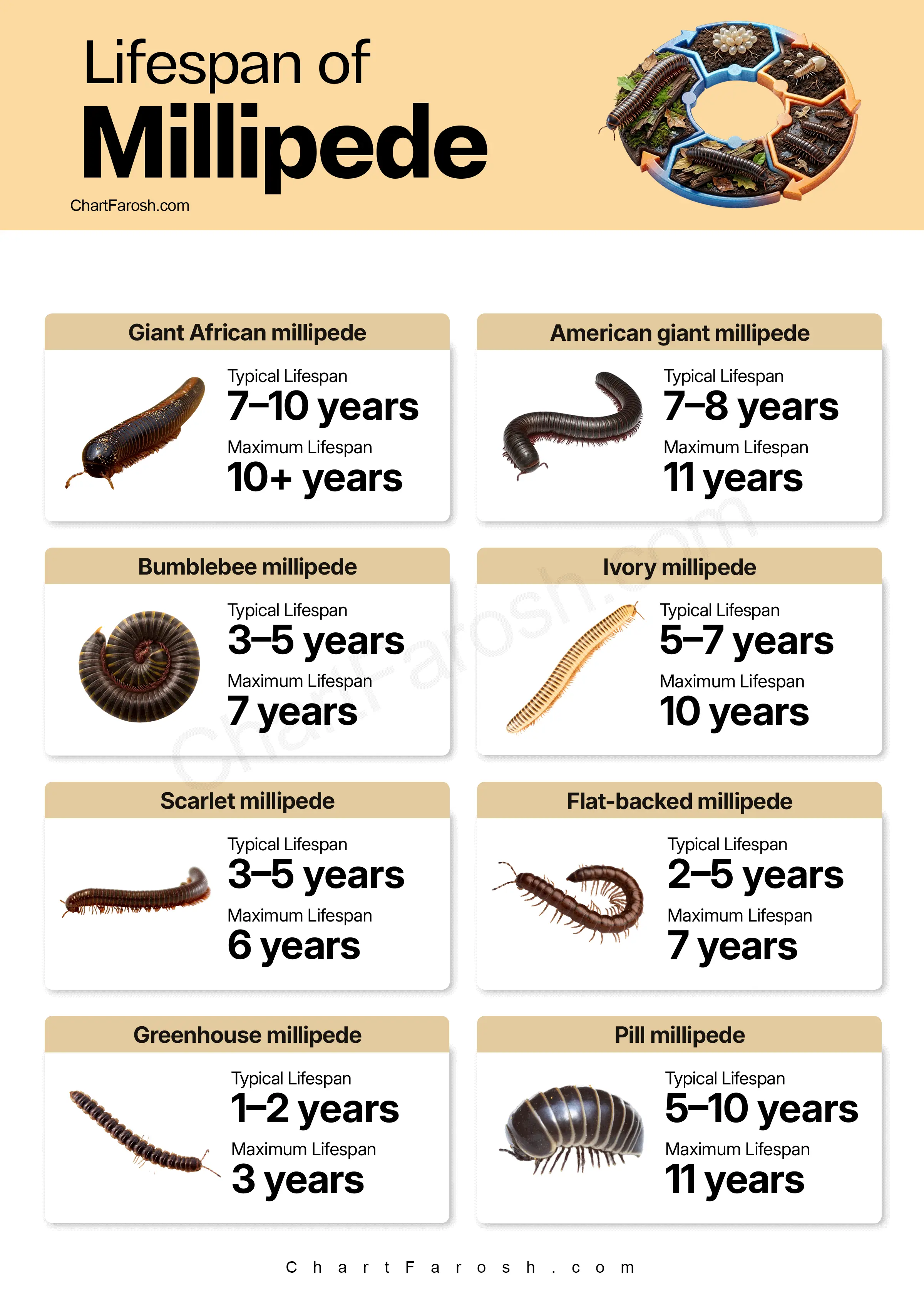
Table of Contents
Millipede Lifespan Chart
Millipedes are long-lived for invertebrates. The giant and pill species can pass a decade, while small greenhouse millipedes wrap up in a year or two. The typical column shows the usual range, and the maximum column shows the longest recorded for that type.
Most of these years are spent slowly, deep in leaf litter and soil. Millipedes grow gradually, molting many times, which is part of why the larger species take so long to mature and then keep going for years.
| Millipede Type | Scientific Name | Typical Lifespan | Maximum Lifespan |
| Giant African millipede | Archispirostreptus gigas | 7–10 years | 10+ years |
| American giant millipede | Narceus americanus | 7–10 years | 11 years |
| Bumblebee millipede | Anadenobolus monilicornis | 3–5 years | 7 years |
| Ivory millipede | Chicobolus spinigerus | 5–7 years | 10 years |
| Scarlet millipede | Trigoniulus corallinus | 3–5 years | 6 years |
| Flat-backed millipede | Various species | 2–5 years | 7 years |
| Greenhouse millipede | Oxidus gracilis | 1–2 years | 3 years |
| Pill millipede | Various species | 5–10 years | 11 years |
Which Millipedes Live the Longest?
The American giant millipede and the pill millipede top the list at up to 11 years, with the giant African millipede close behind. These are also among the most popular pet millipedes, partly because they live so long.
A decade-long invertebrate is rare, and it puts them closer to a small mammal than to most of the insects in our bug lifespan chart.
Which Millipedes Have the Shortest Lifespan?
The greenhouse millipede is the short-lived one here, finishing in one to two years. It is a small, fast-spreading flat-backed species often found in pots and greenhouses. Even its maximum, about three years, would be a long life for a housefly or a beetle.
The Millipede Life Cycle: Eggs, Molting, and Adding Legs
Millipedes belong to the class Diplopoda, a name that means “double foot.” That points to their defining trait: most body segments carry two pairs of legs, not one. They are not insects but myriapods, a separate branch of the arthropods. Live Science notes this two-pairs-per-segment feature is the clearest way to tell them apart from centipedes.
Their growth is the strange part. A millipede hatches from its egg with only a few segments and a handful of legs. With each molt it adds more segments, and each new segment brings more legs, so an older millipede has more legs than a young one. Biologists call this anamorphosis, and it is why leg counts vary so much even within a species.
Adults are detritivores, feeding on rotting leaves, wood, and other decaying matter, which makes them quiet but important decomposers. They do not bite. When threatened they curl into a spiral and release a defensive fluid from pores along the body. The New South Wales Government notes this fluid is harmless to people but may stain the skin. For the egg side of many small creatures, see our insect egg identification chart.
Factors That Affect Millipede Lifespan
Millipede lifespans depend on species and conditions. A few factors do most of the work.
- Species and size: large tropical millipedes live for years, while small flat-backed species finish in one or two.
- Moisture: millipedes need damp conditions and dry out quickly, so steady humidity extends their lives, especially in captivity.
- Temperature: warm, stable conditions speed growth, while cold slows it and can push them into dormancy.
- Diet: a steady supply of decaying leaves and calcium for the exoskeleton supports a longer, healthier life.
Predators: birds, frogs, and some beetles eat millipedes, though the chemical defense puts many predators off. Their role as decomposers is covered in our beneficial insects chart.
Millipede vs Centipede
Millipedes and centipedes get mixed up constantly, but they live very different lives. The quick test is the legs: two pairs per segment means a millipede, one pair means a centipede. The table below lays out the rest, and our centipede identification chart goes deeper on the fast, biting cousin.
| Feature | Millipede | Centipede |
| Class | Diplopoda | Chilopoda |
| Legs per segment | Two pairs | One pair |
| Body shape | Rounded, cylindrical | Flattened |
| Leg position | Tucked under the body | Splayed out to the sides |
| Speed | Slow | Fast |
| Diet | Decaying plants (detritivore) | Hunts insects (predator) |
| Danger to people | No bite; harmless secretions | Venomous bite; can sting |
The short version is simple. A millipede is a slow, harmless leaf-eater, while a centipede is a fast hunter that can bite. Like the spiders in our identification guide, both are arthropods, but neither is an insect.
Record-Holders: The Leggiest and Largest Millipedes
Despite the name, which means “thousand feet,” no millipede was known to have even 1,000 legs until recently. That changed in 2021 with Eumillipes persephone, a pale, eyeless millipede found 60 metres underground in Western Australia. As the journal Scientific Reports described, one female had 1,306 legs, making it the leggiest animal on the planet.
Most millipedes are far more modest, carrying somewhere between 34 and 400 legs. For size, the record goes to the giant African millipede, which can grow to about 33 centimetres, or just over a foot. It is the largest millipede in the world and, helped by a lifespan near a decade, one of the most popular in the pet trade.
FAQs
How long do millipedes live?
It depends on the species. Small greenhouse millipedes live one to two years, while giant and pill millipedes can reach 10 or 11 years.
How many legs does a millipede have?
Most millipedes have between 34 and 400 legs, not a thousand. The record-holder, Eumillipes persephone, has 1,306 legs, the most of any animal.
Are millipedes insects?
No. Millipedes are arthropods in the class Diplopoda, part of the myriapod group. Insects have six legs, while millipedes have two pairs on most segments.
What is the difference between a millipede and a centipede?
Millipedes have two pairs of legs per segment, eat decaying plants, and do not bite. Centipedes have one pair per segment, hunt prey, and can bite with venom.
Do millipedes bite?
No. Millipedes cannot bite or sting. Their only defense is to curl up and release a fluid that can stain skin but is harmless to people.
Which millipede lives the longest?
The American giant millipede and the pill millipede live longest, up to about 11 years. The giant African millipede is close behind at 10 or more.
What is the largest millipede?
The giant African millipede is the largest, growing to about 33 centimetres, just over a foot long. It is also a common pet millipede.