Types of Lemurs Chart with Pictures
The first time I watched a ring-tailed lemur troop cross a clearing, tails up like a row of furry question marks, I assumed they lived all over Africa. They do not. Every wild lemur on Earth lives on a single island, Madagascar, and almost nowhere else. That one fact shapes everything about them.
Lemurs are primates, distant cousins of monkeys and apes. But they split onto their own branch tens of millions of years ago and evolved into more than a hundred species in isolation.
They range from the indri, as big as a small child, down to a mouse lemur that fits in a teaspoon. Many live in one forest and nowhere else on the planet.
This article walks through 15 of the main types of lemurs, their scientific names, where each one lives in Madagascar, and which are the largest, smallest, and rarest. It also covers why this is now the most endangered group of mammals in the world.
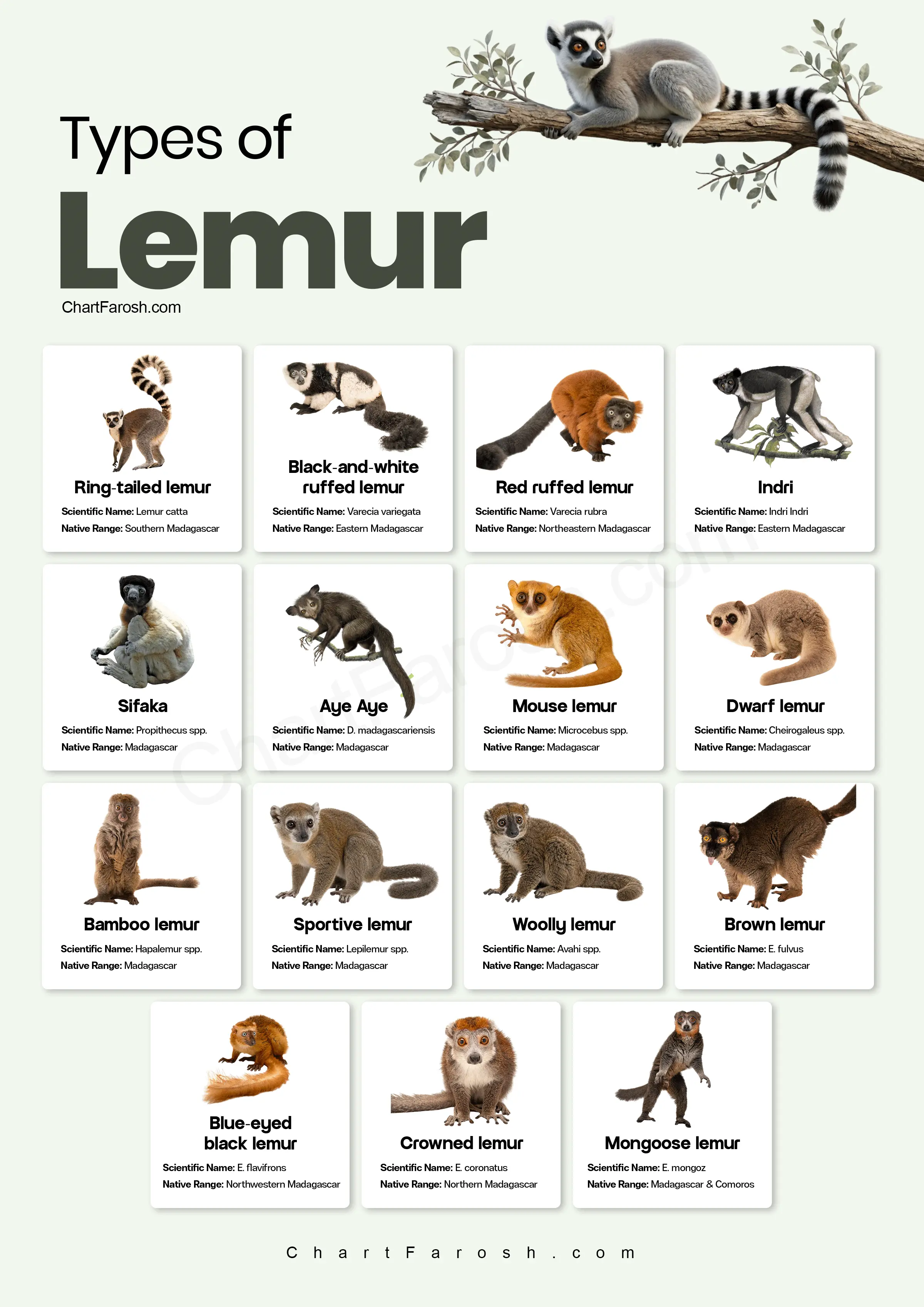
Table of Contents
Lemurs and Their Names
There are more than 100 lemur species, sorted into five families. The 15 below are the ones people look up most, from the famous ring-tailed lemur to whole groups like the mouse lemurs that hold dozens of species each. The table lists every one’s scientific name, rough adult size, home region, and what it is known for.
| Lemur Type | Scientific Name | Adult Size | Native Region | Known For |
| Ring-tailed lemur | Lemur catta | ~2.2 kg | Southern Madagascar | Striped tail; lives in ground troops |
| Black-and-white ruffed lemur | Varecia variegata | ~3.5 kg | Eastern Madagascar | Loud calls; key fruit pollinator |
| Red ruffed lemur | Varecia rubra | ~3.5 kg | Northeastern Madagascar | Deep red coat; Masoala only |
| Indri | Indri indri | 6–9.5 kg | Eastern Madagascar | Largest lemur; sings; almost no tail |
| Sifaka | Propithecus spp. | 3–6 kg | Madagascar | Leaps upright; “dances” across ground |
| Aye-aye | Daubentonia madagascariensis | ~2.5 kg | Madagascar | Taps wood; long thin middle finger |
| Mouse lemur | Microcebus spp. | 30–60 g | Madagascar | World’s smallest primates; nocturnal |
| Dwarf lemur | Cheirogaleus spp. | 0.1–0.5 kg | Madagascar | Only primates that truly hibernate |
| Bamboo lemur | Hapalemur spp. | 0.7–2.5 kg | Madagascar | Eats bamboo; tolerates cyanide |
| Sportive lemur | Lepilemur spp. | 0.5–1 kg | Madagascar | Nocturnal; leaps between trunks |
| Woolly lemur | Avahi spp. | ~1 kg | Madagascar | Woolly fur; nocturnal; monogamous |
| Brown lemur | Eulemur fulvus | ~2.5 kg | Madagascar | Adaptable; active day and night |
| Blue-eyed black lemur | Eulemur flavifrons | ~2 kg | Northwestern Madagascar | Only blue-eyed primate besides humans |
| Crowned lemur | Eulemur coronatus | ~1.5 kg | Northern Madagascar | Orange crown marking on the head |
| Mongoose lemur | Eulemur mongoz | ~1.5 kg | Madagascar & Comoros | Also lives outside Madagascar |
Largest Lemur Species
The indri is the largest lemur alive today, weighing 6 to 9.5 kilograms, about the size of a human toddler. It has almost no tail and is known for loud, wailing songs that carry for miles through the forest. Like the great apes in our types of apes guide, the biggest lemurs are slow to breed, which makes them harder to protect.
| Lemur | Scientific Name | Adult Weight | Note |
| Indri | Indri indri | 6–9.5 kg | Largest living lemur; loud songs |
| Diademed sifaka | Propithecus diadema | ~6 kg | One of the largest sifakas |
| Black-and-white ruffed lemur | Varecia variegata | ~3.5 kg | Largest of the true Lemuridae |
| Red ruffed lemur | Varecia rubra | ~3.5 kg | Found only on the Masoala Peninsula |
| Brown lemur | Eulemur fulvus | ~2.5 kg | Widespread and adaptable |
Smallest Lemur Species
At the other end, Madame Berthe’s mouse lemur is not just the smallest lemur but the smallest primate in the world. It weighs about 30 grams, close to a large strawberry, and could sit in the palm of your hand. Mouse lemurs and dwarf lemurs fill out this tiny end of the family, and most of them are active only at night.
| Lemur | Scientific Name | Adult Weight | Note |
| Madame Berthe’s mouse lemur | Microcebus berthae | ~30 g | Smallest primate in the world |
| Gray mouse lemur | Microcebus murinus | ~60 g | The most common mouse lemur |
| Dwarf lemur | Cheirogaleus spp. | 0.1–0.5 kg | Hibernates through the dry season |
| Sportive lemur | Lepilemur spp. | 0.5–1 kg | Nocturnal leaf-eater |
Rarest and Most Endangered Lemurs
Lemurs are the most endangered group of mammals on Earth. Around 95 percent of lemur species are now threatened with extinction, mostly because Madagascar has lost so much of its forest. Scientific American reported the figure when conservationists reassessed the group. It is a steeper risk than almost any other animal family faces.
The rarest of all is the northern sportive lemur, with only about 50 left in the wild. The blue-eyed black lemur, the only primate besides humans with naturally blue eyes, is also critically endangered, as the Lemur Conservation Network notes. The same forces threaten other famous animals, from rhinos to many of the species in our endangered birds chart.
| Lemur | IUCN Status | Wild Status / Note |
| Northern sportive lemur | Critically Endangered | Only about 50 left; the rarest lemur |
| Blue-eyed black lemur | Critically Endangered | Only blue-eyed primate besides humans |
| Indri | Critically Endangered | Cannot survive in captivity |
| Madame Berthe’s mouse lemur | Critically Endangered | Smallest primate; shrinking forest |
| Ring-tailed lemur | Endangered | Numbers down roughly 95% since 2000 |
| Aye-aye | Endangered | Often killed due to local superstition |
Where Lemurs Live in Madagascar
Every lemur is endemic to Madagascar, which means it lives there in the wild and nowhere else. The one exception is the mongoose lemur, which also lives on the Comoros islands, most likely carried there by people.
Within Madagascar, different lemurs belong to different corners of the island, much like the unique wildlife in our types of frogs guide.
| Region of Madagascar | Lemurs Found There |
| Southern Madagascar | Ring-tailed lemur |
| Eastern Madagascar | Indri, black-and-white ruffed lemur, sifakas |
| Northeastern Madagascar | Red ruffed lemur |
| Northern Madagascar | Crowned lemur |
| Northwestern Madagascar | Blue-eyed black lemur |
| Western Madagascar | Madame Berthe’s mouse lemur |
| Comoros (and Madagascar) | Mongoose lemur |
What Makes Lemurs Unique
Lemurs sit on their own branch of the primate family tree. They are strepsirrhine primates, the wet-nosed group, so they lean on smell far more than monkeys and apes do.
Most have a reflective layer behind the eye for night vision and a special grooming claw on one toe, traits the Duke Lemur Center studies in detail.
Their daily rhythms vary more than almost any primate group. Some are strictly nocturnal, some are active by day, and others are cathemeral, moving around at any hour.
The dwarf lemurs go further still, as the only primates known to truly hibernate, sleeping through Madagascar’s long dry season.
A few stand out on their own. The aye-aye taps on wood and hooks grubs out with a long, thin middle finger, the job a woodpecker does elsewhere.
Long before any of these, giant lemurs the size of a gorilla roamed the island, until they died out after people arrived a couple of thousand years ago. For more wild mammal guides, see our types of tigers and bear species pages.
FAQs
How many types of lemurs are there?
There are more than 100 species of lemur, grouped into five families. New species are still being described, so the exact count keeps rising.
Where do lemurs live?
Wild lemurs live only on Madagascar, an island off the east coast of Africa. The mongoose lemur is the lone exception, also found on the nearby Comoros islands.
What is the largest lemur?
The indri is the largest living lemur, weighing 6 to 9.5 kilograms. It has almost no tail and sings loud, far-carrying songs.
What is the smallest lemur?
Madame Berthe’s mouse lemur is the smallest, weighing about 30 grams. It is also the smallest primate in the world.
Are lemurs endangered?
Yes. Lemurs are the most endangered group of mammals on Earth, with roughly 95 percent of species threatened, mainly from forest loss in Madagascar.
Are lemurs monkeys?
No. Lemurs are primates but not monkeys. They belong to a separate, older branch of the primate family called the strepsirrhines, or wet-nosed primates.
What is the rarest lemur?
The northern sportive lemur is the rarest, with only about 50 individuals left in the wild. It is listed as critically endangered.