Animals With the Longest Lifespan
A while back I fell down a late-night reading hole after someone told me there was a clam older than the printing press still sitting on the seabed. I did not believe it. Then I read about Ming, an ocean quahog dated at around 507 years. It was alive when Henry VIII sat on the throne of England.
That sent me looking for the rest of the list, and the list is stranger than I expected. There is a shark that does not breed until it is 150. A jellyfish that can age backwards. A tortoise that watched two centuries pass from the same island.
Some of these animals with the longest lifespan barely age at all. Others just refuse to die on schedule. Below I have ranked fifteen of them with a clear chart of how long each lives and what makes it special.
A few numbers are solid science. A couple are famous claims that researchers still argue about, and I have flagged those so you know which is which.

Table of Contents
The 15 Longest-Living Animals, Ranked
Here is the full ranking. Read it top to bottom as a rough order of maximum potential age, not a precise stopwatch, since the first few animals do not age the way the rest do.
| Rank | Animal | Typical Lifespan | Notable Fact |
| 1 | Immortal jellyfish | Potentially unlimited | Can revert to its juvenile polyp stage and start over |
| 2 | Greenland shark | 250 to 500+ years | Longest-lived vertebrate; one was about 392 years |
| 3 | Ocean quahog clam | 400 to 500+ years | Oldest known individual, Ming, was about 507 |
| 4 | Bowhead whale | 200+ years | Longest-lived mammal known |
| 5 | Aldabra giant tortoise | 150 to 250+ years | One of the longest-lived land animals |
| 6 | Galapagos giant tortoise | 150 to 200+ years | An icon of longevity |
| 7 | Orange roughy | 150 to 200+ years | Deep-sea fish with very slow growth |
| 8 | Red sea urchin | 100 to 200+ years | Shows almost no signs of aging |
| 9 | Lake sturgeon | 100 to 150+ years | Fish from an ancient lineage |
| 10 | Tuatara | 100 to 150+ years | A living-fossil reptile from New Zealand |
| 11 | Koi fish | 25 to 50 years (typical) | One named Hanako reportedly 226, but disputed |
| 12 | Macaw | 50 to 80 years | Long-lived parrots; a few claimed near 100 |
| 13 | Laysan albatross | 60 to 70+ years | Wisdom is the oldest known wild bird |
| 14 | African elephant | 60 to 70 years | The largest living land mammal |
| 15 | Human | 70 to 90 years | Maximum recorded is about 122 years |
The Animals That Barely Age
Two animals on this list break the rules. The immortal jellyfish can roll its life cycle backwards, turning from an adult medusa back into a polyp colony when it is stressed or injured. In theory it can do this again and again. In practice predators and disease still kill it, so no individual lives forever.
The red sea urchin is the quieter marvel. It shows negligible senescence, which means a 100-year-old urchin is about as fertile and healthy as a young one. Detailed lifespan data on both is collected in the AnAge longevity database.
| Animal | Aging Pattern | Why It Matters |
| Immortal jellyfish | Reverts to polyp stage | No fixed lifespan, but still killable |
| Red sea urchin | Negligible senescence | Stays fertile and healthy for life |
Centuries in the Deep
Cold, dark, slow water seems to stretch a life out. The Greenland shark grows about a centimeter a year and does not reach sexual maturity until around 150.
Britannica notes the oldest known individual is roughly 400 years old, and you can read more on Arctic species in our types of sharks guide. The deep ocean also holds the record-setting ocean quahog and the slow-growing orange roughy.
The bowhead whale rounds out this group as the longest-lived mammal we know of. Cold-water living and a slow metabolism appear to be the shared trick. For more on these giants, see our types of whales overview.
| Deep-Sea Animal | Lifespan | Habitat |
| Greenland shark | 250 to 500+ years | Cold North Atlantic and Arctic |
| Ocean quahog clam | 400 to 500+ years | North Atlantic seabed |
| Bowhead whale | 200+ years | Arctic waters |
| Orange roughy | 150 to 200+ years | Deep open ocean |
Tortoises and the Living Fossils
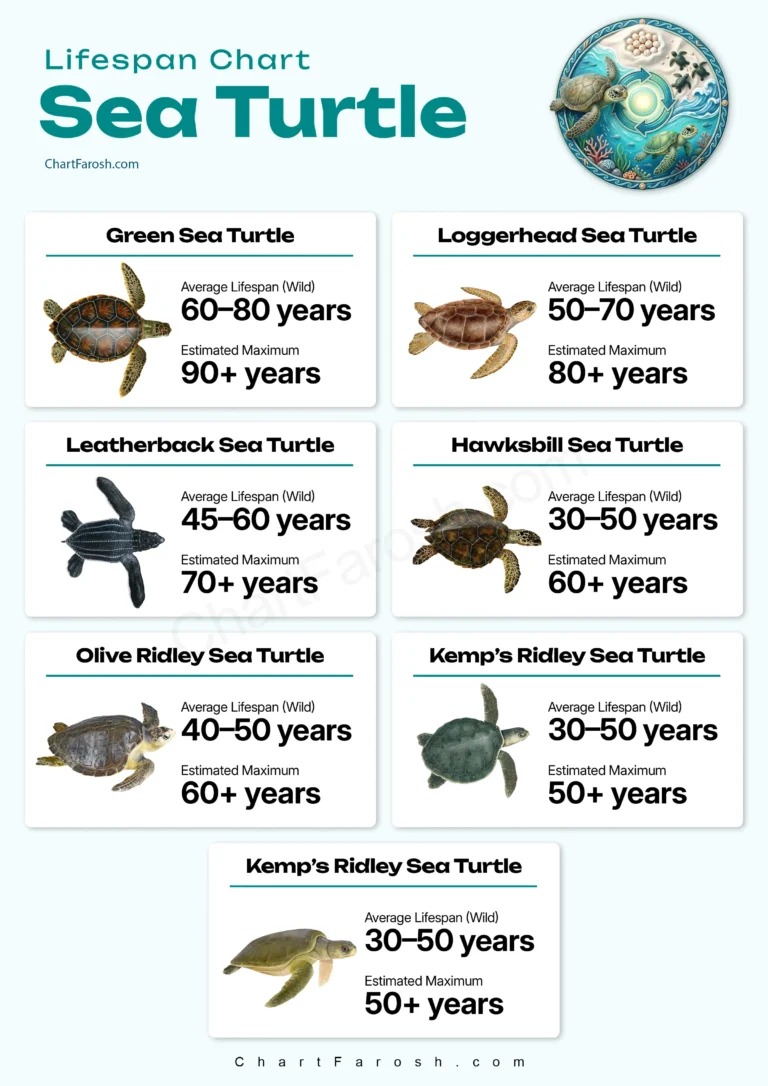
On land, giant tortoises are the longevity champions. Aldabra and Galapagos tortoises both push past 150 years, and some individuals have been credited with closer to 200. Their slow heartbeat and low-energy life seem to buy them the extra decades. You can compare shelled species in our turtle species list.
Two odd fish and reptiles share this bracket. The tuatara of New Zealand looks like a lizard but belongs to its own ancient order, and the lake sturgeon carries a body plan older than most dinosaurs.
| Animal | Lifespan | Group |
| Aldabra giant tortoise | 150 to 250+ years | Reptile |
| Galapagos giant tortoise | 150 to 200+ years | Reptile |
| Tuatara | 100 to 150+ years | Reptile (own order) |
| Lake sturgeon | 100 to 150+ years | Fish |
Familiar Long-Lived Fish, Birds, and Mammals
Not every long-lived animal hides in the deep. Some sit in garden ponds and aviaries. Koi can reach several decades with the right pond and cold winters, though the famous 226-year koi is a disputed claim rather than a proven record. Macaws are among the longest-living parrots, and you can see at-risk species in our endangered birds chart.
The Laysan albatross named Wisdom is still raising chicks in her seventies. Among land mammals, the African elephant lives 60 to 70 years, and humans top out around 122. For a closer look at the biggest land mammal, see our types of elephants guide.
| Animal | Lifespan | Record Holder |
| Koi fish | 25 to 50 years (typical) | Hanako, reportedly 226 (disputed) |
| Macaw | 50 to 80 years | Charlie, claimed near 114 |
| Laysan albatross | 60 to 70+ years | Wisdom, oldest wild bird |
| African elephant | 60 to 70 years | Up to about 86 in care |
| Human | 70 to 90 years | Jeanne Calment, 122 years |
Longest-Lived Animal by Group
If you sort the list by animal type, a clear record holder emerges in each group. This is the quick comparison most people are really after.
| Group | Record Holder | Lifespan |
| Invertebrate | Ocean quahog clam | About 507 years |
| Fish (vertebrate) | Greenland shark | 250 to 500+ years |
| Reptile | Aldabra giant tortoise | 150 to 250+ years |
| Mammal | Bowhead whale | 200+ years |
| Bird | Laysan albatross | 60 to 70+ years |
The clam wins outright if you count any animal. Among animals with a backbone, the Greenland shark takes it. Many of these species are also under pressure from fishing and habitat loss, and their status is tracked on the IUCN Red List.
FAQs
What animal has the longest lifespan?
If you count only true aging, the ocean quahog clam wins, with one individual dated at about 507 years. The immortal jellyfish can avoid death by age entirely, but predators and disease still kill it.
What is the longest-living vertebrate?
The Greenland shark. Radiocarbon dating of its eye lenses estimated one shark at roughly 392 years, with a possible range of 272 to 512.
What is the longest-living mammal?
The bowhead whale, which can live more than 200 years. Cold Arctic water and a slow metabolism seem to support its long life.
Is the immortal jellyfish really immortal?
Not literally. It can revert to an earlier life stage and avoid death by aging, but it can still be eaten or killed by disease. It is better called biologically immortal.
Did a koi fish really live 226 years?
That is the famous claim about a koi named Hanako. Fact-checkers and fish biologists say the scale-dating method is unreliable and no firm records confirm it, so treat 226 as a story, not a verified record.
How long do giant tortoises live?
Aldabra and Galapagos giant tortoises commonly live past 150 years, and some individuals have been credited with closer to 200.
Why do some animals live so long?
Cold environments, slow metabolism, slow growth, and few predators all help. For a single-species deep dive, see our capybara lifespan chart, and for a pet comparison see the cat lifespan chart. The Greenland shark’s longevity is explained well on Britannica.