Types of Camels: Complete Guide to All Camel Species
I used to think a camel was just a camel. Then I went looking for a toy one for my niece, the shop had two kinds, one hump and two, and I picked the wrong one. A six-year-old set me straight.
So I read up on it, and the short version surprised me. There are only three living camel species, plus a hybrid that people have bred for hundreds of years. One of them is so rare that most of us have never seen it.
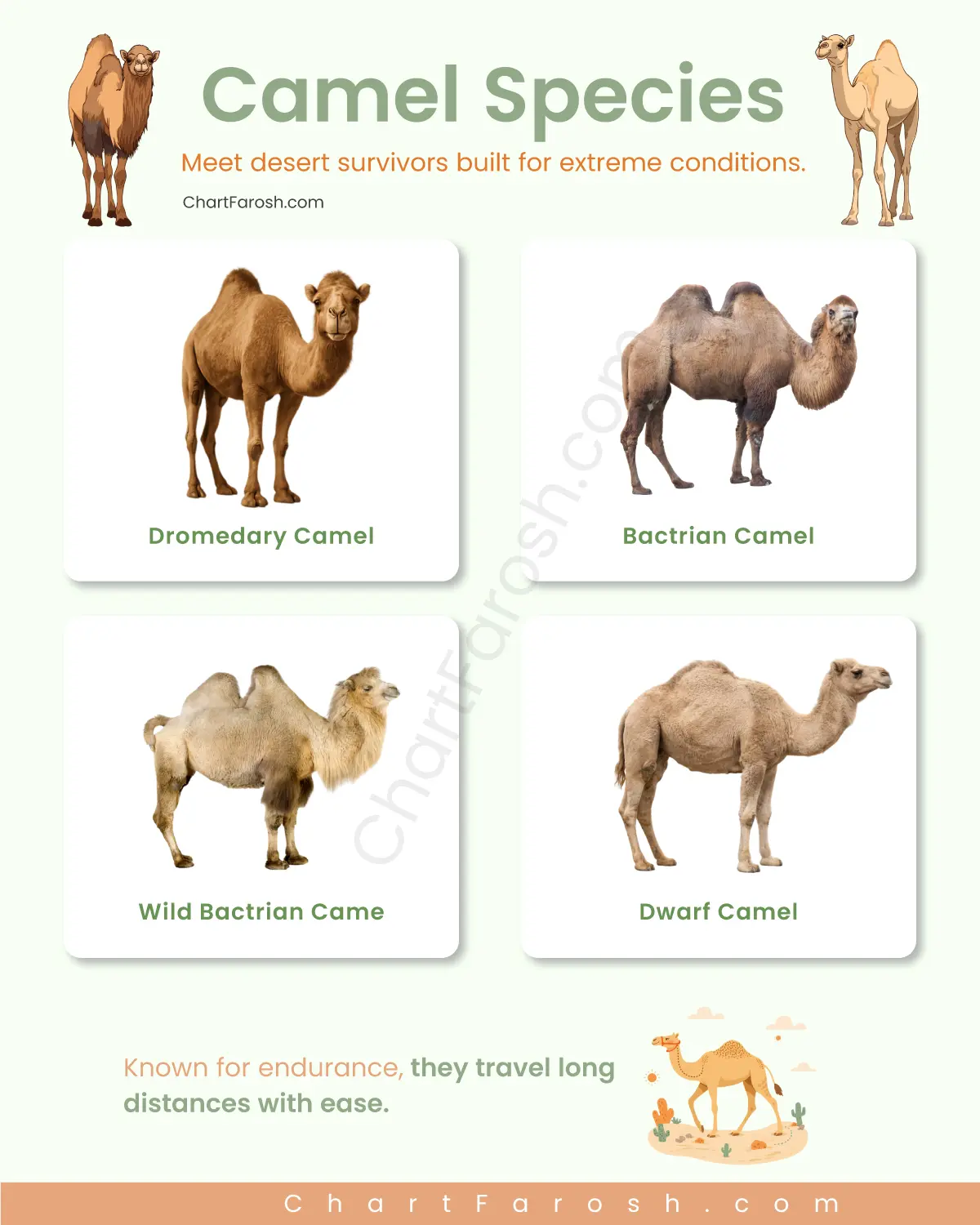
Table of Contents
How Many Camel Species Are There in the World?
There are three living camel species, and all of them belong to the genus Camelus in the family Camelidae. The dromedary has a single hump, while the Bactrian camel and the wild camel each have two. Most of the world’s camels are dromedaries, about nine in ten.
Camels are an old family with an odd backstory. Their ancestors first appeared in North America, then spread into Asia and Africa, while their cousins headed south and became the llamas and alpacas of South America.
You may also run into a “dwarf camel” online, but that isn’t a separate species. It is a small camel bred down in size and kept mostly as a novelty or pet, which I’ll come back to below the chart.
If you like wildlife round-ups like this one, we have similar guides on types of tigers and all bear species.
List of All Camel Species (With Facts)
Here is every camel type side by side, with the main facts in one place.
| Common Name | Scientific Name | Humps | Key Features | Habitat | Size / Weight |
| Dromedary Camel | Camelus dromedarius | One | Long legs, single hump, built for heat; all domesticated | Middle East, North Africa, Horn of Africa; feral in Australia | 1.8–2 m at shoulder; 400–600 kg |
| Bactrian Camel | Camelus bactrianus | Two | Stocky, thick winter coat, cold-adapted; about 2 million today | Central Asia (Mongolia, China) | Up to ~2.3 m; 450–1,000 kg |
| Wild Camel | Camelus ferus | Two | Critically Endangered; drinks salty water; genetically distinct | Gobi Desert (China and Mongolia) | About 2 m; 400–650 kg |
| Dwarf Camel* | Camelus spp. | One or two | Not a true species; a small, selectively bred camel | Kept locally as a novelty or pet | ~1.5–2 m; 300–400 kg |
* The dwarf camel is in the chart because people search for it, but it is a size variant of domestic camels, not its own species.
What Do All Camels Have in Common?
Before splitting them up, it helps to know what makes a camel a camel. Every camel stores fat in its humps rather than water, and that reserve keeps it going for weeks when food is scarce. The rest of the body is built to save water too: a camel can lose nearly a third of its body water and keep going, which would kill most animals.
The other features are just as practical. Each foot has two broad toes on a leathery pad, so the camel spreads its weight and crosses soft sand without sinking. A split upper lip lets it feed on thorny desert plants, while long lashes and nostrils that pinch shut keep the sand out in a storm. With all that toughness, it is no surprise they can live 40 to 50 years.
Dromedary Camel: One-Humped Desert Camel
The dromedary (Camelus dromedarius) is the camel most people picture: one hump, long legs, and a body built for heat. You will find it across the Middle East, North Africa, and the Horn of Africa, with one surprise on the far side of the world. Settlers shipped dromedaries to Australia in the 1800s as pack animals, and the outback now holds a large feral herd descended from them.
A dromedary stands about 1.8 to 2 metres at the shoulder and weighs 400 to 600 kg. Small details make a big difference in the desert: a split upper lip for feeding on thorny scrub, heavy eyelashes against blowing sand, and the ability to drink close to 100 litres of water in one go after a dry spell.
People first tamed the dromedary in Arabia around 3000 BCE, and it has carried people and goods ever since. Every dromedary alive today is domesticated, since the truly wild ones died out long ago. Most now live in India and the Horn of Africa, kept for milk, meat, wool, and transport.
Bactrian Camel: Two-Humped Camel of Central Asia
The Bactrian camel (Camelus bactrianus) trades the desert for the cold. It has two humps and a thick winter coat, and it copes with freezing steppes far better than its one-humped relative. Its home is Central Asia, mainly Mongolia and China.
It is shorter and stockier than a dromedary but heavier, sometimes reaching about 1,000 kg. The two humps store fat, not water, and the camel lives off that reserve when grazing runs thin. Around two million domestic Bactrians live across Asia today.
People tamed the Bactrian about 4000 BCE in the Central Asian steppes, even earlier than the dromedary. The name comes from Bactria, an old region in the area, and its wool is still prized for clothing and felt.
Wild Bactrian Camel: Endangered Wild Camel Species
The wild camel (Camelus ferus) is the rarest of the lot, and for years people assumed it was just a wild form of the Bactrian. Genetic work has since shown it to be a separate species in its own right. Fewer than 1,000 survive, split between the Gobi Desert in China (about 600) and Mongolia (about 350).
What sets it apart is how tough it is. It can drink salty, brackish water that would sicken other camels, and it ranges across the Gobi in small groups over huge distances to find food. It is also one of the least-studied large mammals on Earth.
The IUCN has listed the wild camel as Critically Endangered since 2002, and you can read more on its biology at Britannica. For more animals on the edge, see our guide to endangered birds.
Camel Hybrid: Crossbreeds Between Dromedary and Bactrian Camels
Dromedaries and Bactrian camels can breed with each other, and their offspring are fertile, which is unusual for an animal cross. It works cleanly because both species carry the same number of chromosomes.
The first-generation hybrid goes by tülü in Turkish and bukht in Kazakh. It usually has one large hump, sometimes with a small dip in the middle, and grows bigger and stronger than either parent, topping 1,000 kg. People in Turkey, Kazakhstan, and Iran have bred these camels for centuries as heavy pack animals, and in Turkey they are also raised for camel wrestling.
Differences Between Camels and Llamas or Alpacas
Camels, llamas, and alpacas are cousins that all sit in the family Camelidae, and the split between them is geographic. Camels are the Old World branch, while llamas and alpacas are the New World branch from South America.
The easiest tell is the hump, which llamas and alpacas simply do not have. They are also much smaller and kept mostly for wool rather than transport. Two wild relatives round out the South American side of the family: the guanaco and the vicuña.
| Feature | True Camels (Old World) | Llamas & Alpacas (New World) |
| Hump | Yes (one or two) | None |
| Native range | Asia, Middle East, North Africa | South America (Andes) |
| Family | Camelidae | Camelidae |
| Typical weight | 400–1,000 kg | Llama ~120 kg; alpaca ~60 kg |
| Main use | Transport, milk, meat, wool | Wool, pack carrying, guarding herds |
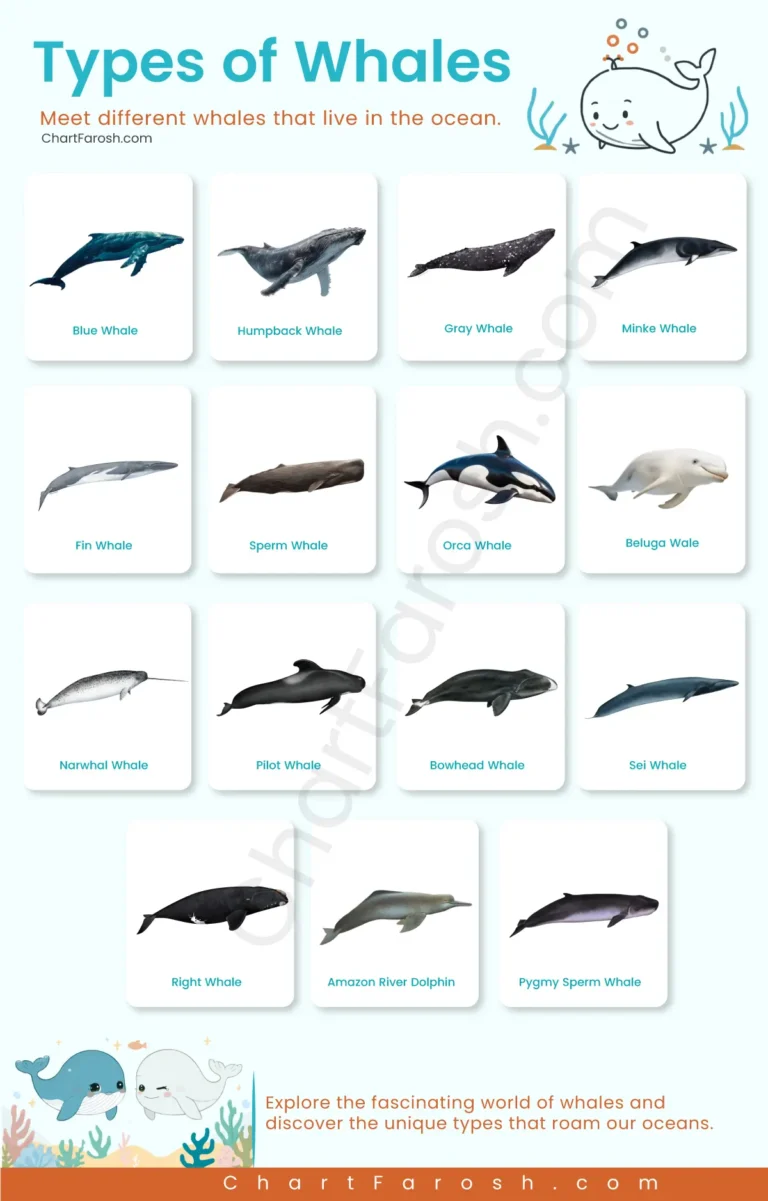
If you enjoy these comparisons, our types of whales and types of sharks guides use the same chart-first format.
Are Camels Endangered? Conservation Status by Species
Most camels are in no danger at all. Dromedaries and domestic Bactrians number in the millions and are farmed across the world.
The wild camel is the exception, and it is in real trouble. Habitat loss, hunting, and mining keep shrinking its range, and breeding with stray domestic camels is another threat, because it waters down the wild gene pool. The Wild Camel Protection Foundation, set up in 1997, works to keep the species alive.
FAQs
How many types of camels are there?
There are three living camel species: the dromedary, the Bactrian camel, and the wild camel. A fertile hybrid of the first two also exists.
What is the difference between a dromedary and a Bactrian camel?
The dromedary has one hump and lives in hot deserts. The Bactrian camel has two humps and a thick coat for cold climates.
Are camels and llamas in the same family?
Yes. Both belong to the family Camelidae. Llamas and alpacas are South American camelids and have no hump.
Which camel is endangered?
The wild camel (Camelus ferus) is Critically Endangered, with fewer than 1,000 left in the Gobi Desert.
Is a dwarf camel a real species?
No. A dwarf camel is a small, selectively bred camel, not a distinct species.
Can different camel species breed together?
Yes. A dromedary and a Bactrian camel can produce a fertile hybrid, known as a tülü or bukht.
How long do camels live?
Camels usually live 40 to 50 years, both in the wild and in human care.