Types of Monkey Chart with Pictures
A monkey stole my sandwich once. I was at a hill temple in the foothills when a macaque dropped off a wall, snatched it from my hand, and was gone before I understood what had happened. It sat on a ledge and ate the whole thing while watching me. I was annoyed and a little impressed. I should have known better.
For years I lumped all monkeys together. One word, one animal. They are nothing alike. A mandrill the size of a dog wears a blue and red face. A pygmy marmoset could sit in your palm. A gelada grazes grass like a small cow on an Ethiopian cliff. The range is wild, from palm-sized to dog-sized.
Below you will find 20 types of monkey, where each one lives, and what makes it stand out. They split into two great families: the New World monkeys of the Americas and the Old World monkeys of Africa and Asia. One famous animal does not make the list, and I will explain why. The chart comes first.
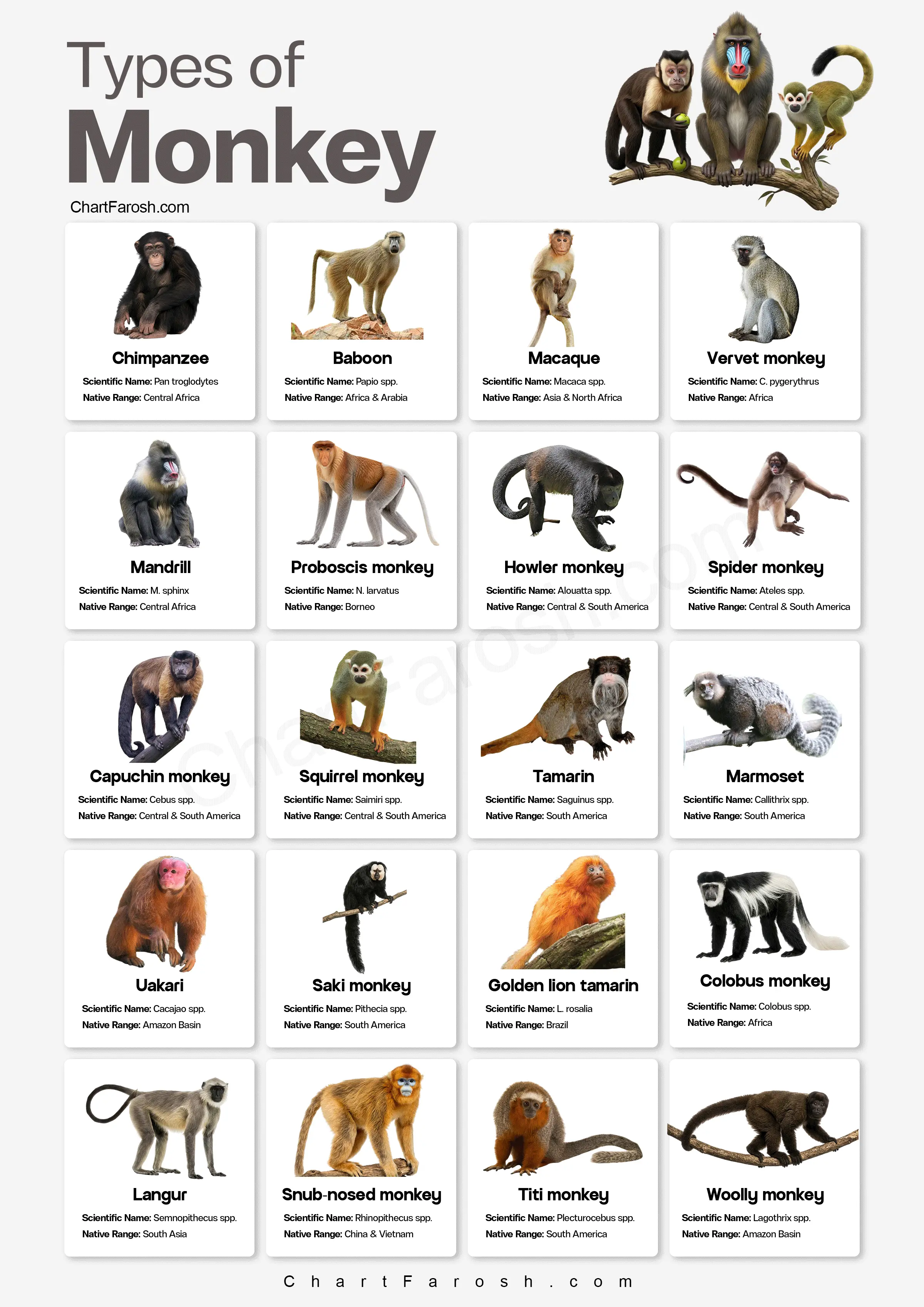
Table of Contents
Monkey identification chart
Here are the 20 monkeys side by side. Use it to match a name to a group, a home, and a claim to fame. The sections below take each group in turn, starting with the New World monkeys of the Americas.
| Monkey | Scientific name | Group | Native range | Notable for |
| Howler monkey | Alouatta spp. | New World | Central & South America | Loudest land animal |
| Spider monkey | Ateles spp. | New World | Central & South America | Long limbs, gripping tail |
| Woolly monkey | Lagothrix spp. | New World | Amazon Basin | Thick wool-like fur |
| Capuchin monkey | Cebus spp. | New World | Central & South America | Clever stone-tool user |
| Squirrel monkey | Saimiri spp. | New World | Central & South America | Huge fast-moving troops |
| Uakari | Cacajao spp. | New World | Amazon Basin | Bald bright-red face |
| Saki monkey | Pithecia spp. | New World | South America | Bushy coat, long leaps |
| Titi monkey | Plecturocebus spp. | New World | South America | Pairs entwine their tails |
| Marmoset | Callithrix spp. | New World | South America | Tiny, with claws |
| Tamarin | Saguinus spp. | New World | South America | Small, mustached faces |
| Golden lion tamarin | Leontopithecus rosalia | New World | Brazil | Orange mane; comeback story |
| Baboon | Papio spp. | Old World | Africa & Arabia | Large ground-living troops |
| Macaque | Macaca spp. | Old World | Asia & North Africa | Most widespread monkey |
| Vervet monkey | Chlorocebus pygerythrus | Old World | Africa | Distinct alarm calls |
| Mandrill | Mandrillus sphinx | Old World | Central Africa | Largest, most colorful monkey |
| Gelada | Theropithecus gelada | Old World | Ethiopian Highlands | Grass-grazer; red chest |
| Colobus monkey | Colobus spp. | Old World | Africa | Leaf-eater; reduced thumb |
| Langur | Semnopithecus spp. | Old World | South Asia | The sacred Hanuman langur |
| Snub-nosed monkey | Rhinopithecus spp. | Old World | China & Vietnam | Upturned nose; cold forests |
| Proboscis monkey | Nasalis larvatus | Old World | Borneo | Huge drooping nose |
What makes a monkey a monkey
A monkey is a primate with a tail. That tail is the quickest way to tell a monkey from an ape. Chimpanzees, gorillas, orangutans, and gibbons are apes, and not one of them has a tail.
So a chimp is not a monkey, even though people call it one all the time. If you want the tailless cousins, the types of apes guide covers them. Britannica lays out the same test.
There are more than 250 species of monkey, and they fall into two great branches. New World monkeys live in Central and South America. They have wide flat noses, and many have a tail that grips like a fifth hand.
Old World monkeys live in Africa and Asia. Their nostrils sit close together and point down, their tails cannot grip, and they spend more of their time on the ground. The table below lines the two groups up.
| Feature | New World monkeys | Old World monkeys |
| Where they live | Central and South America | Africa and Asia |
| Nostrils | Wide apart, facing sideways | Close together, facing down |
| Tail | Often grips like a hand | Cannot grip; sometimes short |
| Mostly | Up in the trees | More time on the ground |
| Examples | Capuchin, howler, marmoset | Baboon, macaque, mandrill |
Large New World monkeys
The big monkeys of the Americas live high in the trees and rely on a gripping tail. The howler monkey is the loudest land animal alive. A male’s dawn call can carry for kilometres, boosted by a hollow throat bone.
The spider monkey is all limbs, swinging through the canopy with a tail that works like a hand. The woolly monkey is the heavyset one, wrapped in thick fur. These three share the Amazon canopy with the slow-moving sloths.
| Monkey | Size | Diet | Standout feature |
| Howler monkey | Medium to large | Mostly leaves | A call that carries for kilometres |
| Spider monkey | Large, very long limbs | Fruit | A tail that grips like a hand |
| Woolly monkey | Large, heavy build | Fruit and leaves | A dense, woolly coat |
Capuchins and other New World monkeys
This is the busy middle of the New World group. The capuchin is the brainy one, famous for cracking nuts with stones and for the tricks that once landed it in films.
Squirrel monkeys race through the branches in troops that can number in the hundreds. The uakari startles people with its bald, blazing red face. The saki, bushy and shy, can leap huge gaps between trees. The titi monkey is the romantic of the bunch, since mated pairs sit side by side with their tails wound together.
| Monkey | Size | Diet | Standout feature |
| Capuchin monkey | Small to medium | Omnivore | Cracks nuts with stone tools |
| Squirrel monkey | Small | Insects and fruit | Troops of dozens to hundreds |
| Uakari | Medium, short tail | Seeds and fruit | A bald, scarlet face |
| Saki monkey | Medium, bushy coat | Seeds and fruit | Leaps wide gaps between trees |
| Titi monkey | Small | Fruit and leaves | Mated pairs sit tail in tail |
Marmosets and tamarins
These are the smallest monkeys on Earth, tiny tree-dwellers with claws instead of flat nails. The marmoset gnaws holes in bark and feeds on the sap. The pygmy marmoset, the smallest of all, weighs about as much as a few coins.
Tamarins are slightly larger and often raise twins, with the father doing much of the carrying. The golden lion tamarin is the star, a flame-orange monkey from Brazil that came back from the edge of extinction through captive breeding and replanted forest. Its recovery is tracked on the IUCN Red List.
| Monkey | Size | Diet | Standout feature |
| Marmoset | Tiny; the pygmy is smallest | Tree sap and gum | Has claws instead of flat nails |
| Tamarin | Small | Fruit and insects | Often twins; the father helps carry them |
| Golden lion tamarin | Small, bright orange | Fruit and insects | Saved from near extinction |
Baboons and macaques
Now to the Old World. These African and Asian monkeys are bigger and bolder, and far more at home on the ground. The baboon lives in large troops and crosses open country alongside zebra and elephants.
The macaque is the great survivor, the most widespread monkey of all, from Japanese snow monkeys soaking in hot springs to city raiders like the one that took my lunch. The vervet gives one alarm call for an eagle overhead, another for a snake, another for a leopard.
The mandrill is the giant, the largest monkey alive, with a face of electric blue and red that glows brighter as a male climbs in rank. The gelada is the oddest, a grass-eater that shuffles across Ethiopian cliffs on its backside.
| Monkey | Size | Diet | Standout feature |
| Baboon | Large | Omnivore | Troops that can top a hundred |
| Macaque | Medium to large | Omnivore | The snow monkey bathes in hot springs |
| Vervet monkey | Medium | Omnivore | A separate alarm call for each predator |
| Mandrill | Largest monkey, over 30 kg | Omnivore | Blue and red face brightens with rank |
| Gelada | Large | Almost all grass | Grazes seated, like a cow on a cliff |
Leaf-eating Old World monkeys
This last group lives on leaves, with special stomachs to break down tough greenery. The colobus wears a long mantle of black and white fur and has only a stub of a thumb. The langur is the monkey of South Asia, and the grey Hanuman langur is sacred across much of India.
The snub-nosed monkey climbs high into cold Chinese and Vietnamese mountains, its short upturned nose set in a blue face. The proboscis monkey of Borneo is unmistakable, with the male’s long drooping nose and a round belly full of leaves. In India the langurs keep a sharp watch for tigers.
| Monkey | Size | Diet | Standout feature |
| Colobus monkey | Medium to large | Leaves | A long fur mantle and a tiny thumb |
| Langur | Medium to large | Leaves | The grey Hanuman langur is sacred in India |
| Snub-nosed monkey | Medium to large | Leaves and lichen | Survives snowy mountain winters |
| Proboscis monkey | Large, pot-bellied | Leaves | The male’s long pendulous nose |
FAQs
Is a chimpanzee a monkey?
No. A chimpanzee is an ape. The simplest test is the tail. Monkeys have one, apes do not. Chimps, gorillas, orangutans, and gibbons are all apes.
What is the difference between New World and Old World monkeys?
New World monkeys live in the Americas, have wide noses, and often a gripping tail. Old World monkeys live in Africa and Asia, have narrow downward noses, and tails that cannot grip.
What is the largest and smallest monkey?
The mandrill is the largest, with big males over 30 kg. The pygmy marmoset is the smallest, at roughly 100 grams, light enough to perch on a finger.
What is the loudest monkey?
The howler monkey. Its call carries for several kilometres through the forest, amplified by an enlarged bone in its throat.
Do all monkeys have tails?
Almost all do, and the tail is the easy way to tell a monkey from a tailless ape. A few, like the Barbary macaque, have only a small stub.
Are monkeys endangered?
Many are. Habitat loss and hunting put plenty at risk, from the proboscis monkey of Borneo to several snub-nosed monkeys in China. The golden lion tamarin shows that recovery is possible.
Where can I learn about apes and other primates?
Apes are the tailless cousins of monkeys. See the gorilla guide for one of the great apes, then browse the wider Animals Chart hub for more species.