Octopus Lifespan Chart
Last year I stood in front of an octopus tank for almost an hour. A keeper walked past and mentioned the animal was already old. I asked how old. She said two and a half. I assumed she meant decades. She meant years.
That stuck with me. An animal this smart and this strange, clever enough to open a jar from the inside, and it gets maybe two or three years on the clock. The giant Pacific octopus, the biggest of them all, tops out near five. Most species never reach two.
So I started reading, and the numbers were all over the place. An octopus lifespan depends heavily on the species and the water temperature, and on whether the animal lives wild or in a tank. I built one chart to line the main species up side by side, wild against captivity, scientific names attached.
Below is that chart, plus the strange biology behind why these animals burn so bright and so fast. The short version: an octopus gets one shot at breeding, and that single shot is what ends it.
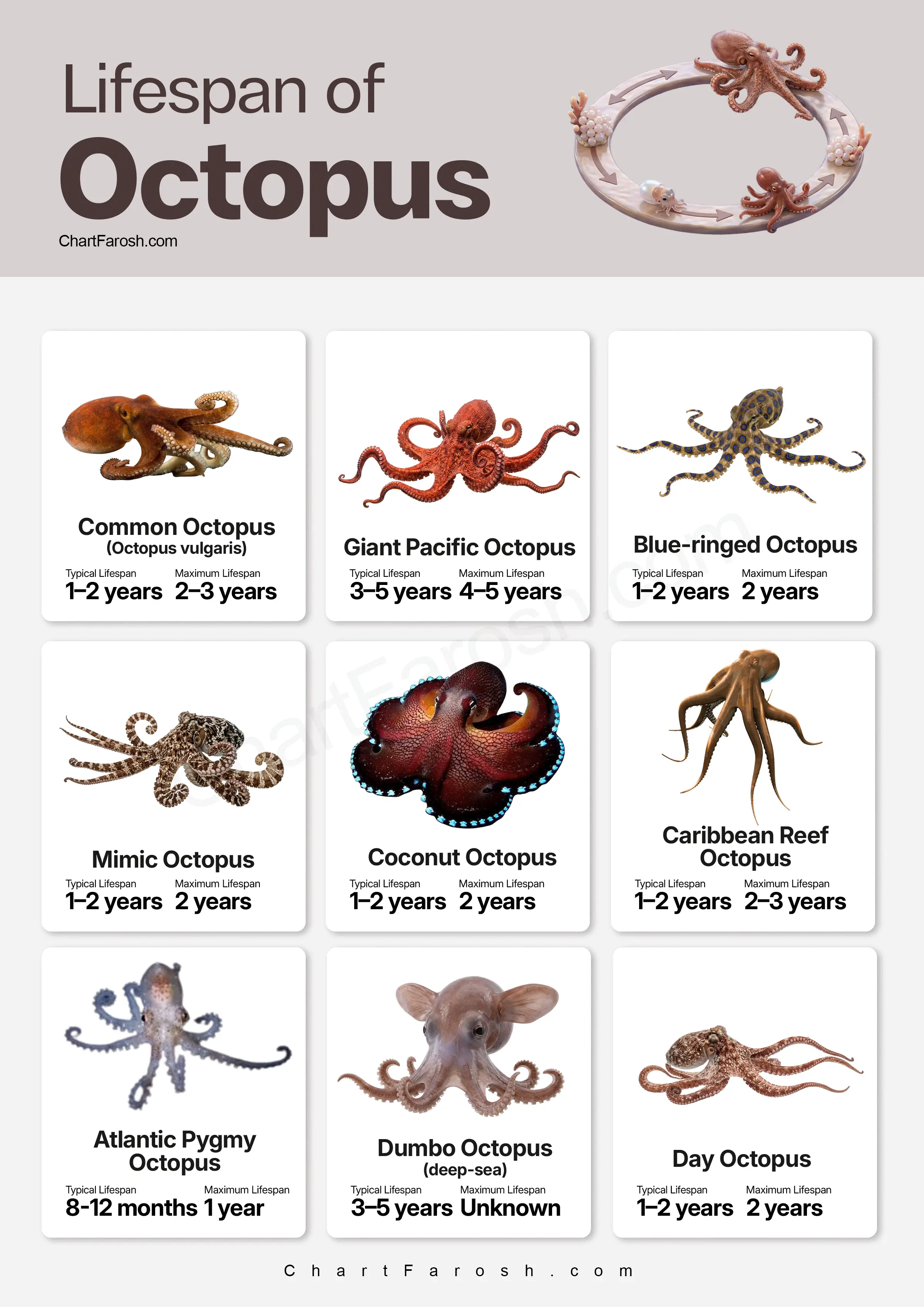
Table of Contents
Octopus Lifespan Chart
Nine common species, from the eight-month pygmy to the five-year giant Pacific. Figures are typical ranges, not hard limits. If you want the animals themselves rather than their clocks, the types of octopus guide walks through each one.
| Octopus Species | Scientific Name | Wild | Captivity | Quick Note |
| Common octopus | Octopus vulgaris | 1-2 years | ~2 years | Most studied octopus |
| Giant Pacific octopus | Enteroctopus dofleini | 3-5 years | 3-5 years | Largest, longest-lived |
| Blue-ringed octopus | Hapalochlaena spp. | 7 mo-2 yrs | ~2 years | Varies by species |
| Mimic octopus | Thaumoctopus mimicus | 12-18 mo | ~1 year | Copies other animals |
| Coconut octopus | Amphioctopus marginatus | 1-1.5 yrs | ~1.5 years | Carries shell shelters |
| Caribbean reef octopus | Octopus briareus | 10-12 mo | 10-17 mo | Warm reef species |
| Atlantic pygmy octopus | Octopus joubini | 8-12 mo | ~1 year | Among the shortest |
| Dumbo octopus | Grimpoteuthis spp. | 3-5 years | Rarely kept | Deep, cold water |
| Day octopus | Octopus cyanea | 12-15 mo | ~1 year | Hunts by day |
Why Octopuses Live Such Short Lives
Octopuses are semelparous. They breed once, then they die. After mating, a gland behind the eyes triggers a fast decline called senescence. The animal stops eating, its color dulls, and within weeks it is gone.
A female guards her eggs through this decline and rarely survives the hatch. The males go first, usually within months of mating. It is the same blueprint across the family, and cuttlefish share it. Big brains, fast lives, one shot at the next generation.
This is why a tank cannot buy an octopus much extra time. The clock is internal. Remove every predator and the optic gland still fires on schedule.
Short-Lived Reef and Shallow-Water Species
Most octopuses sit here, under two years. These are warm, shallow species with fast metabolisms. The Atlantic pygmy octopus is among the shortest at eight to twelve months. Reef hunters like the day octopus and Caribbean reef octopus run a year, sometimes a little more.
| Species | Wild Lifespan | Why It Stays Short |
| Atlantic pygmy octopus | 8-12 months | Tiny body, fast warm-water metabolism |
| Caribbean reef octopus | 10-12 months | Breeds within a year of hatching |
| Day octopus | 12-15 months | Active daytime hunting burns energy |
| Common octopus | 1-2 years | Dies soon after a single breeding event |
| Mimic octopus | 12-18 months | Short window, still mimics 15+ animals |
| Coconut octopus | 1-1.5 years | Small tropical species, one brood |
| Blue-ringed octopus | 7 mo-2 yrs | Greater species ~2 yrs, southern ~7 mo |
The mimic octopus is the standout. In barely a year it learns to impersonate more than fifteen animals, from lionfish to sea snakes. Short life, deep bag of tricks.
The Longer-Lived Octopuses
Two species break the pattern, and both do it the same way: cold water. Cold slows metabolism, and slow metabolism stretches a life.
| Species | Lifespan | Why It Lives Longer |
| Giant Pacific octopus | 3-5 years | Cold North Pacific water slows its metabolism |
| Dumbo octopus | 3-5 years | Near-freezing deep sea slows aging to a crawl |
The giant Pacific octopus reaches three to five years in the chilly North Pacific, the longest of any shallow-water species, per the Monterey Bay Aquarium. The dumbo octopus may match it in the deep sea, where the water sits just above freezing. The Natural History Museum estimates the same three to five years for dumbos, though they are too deep to study closely.
Wild vs Captivity: Does a Tank Help?
People expect captivity to add years, the way it does for parrots or tortoises. With octopuses it barely moves the needle. A tank removes sharks and other predators, but biology, not safety, sets the limit.
| Species | Wild | Captivity | Takeaway |
| Common octopus | 1-2 years | ~2 years | Roughly the same |
| Giant Pacific octopus | 3-5 years | 3-5 years | No real gain |
| Caribbean reef octopus | 10-12 mo | 10-17 mo | Slight edge in a tank |
| Atlantic pygmy octopus | 8-12 mo | ~1 year | Roughly the same |
| Dumbo octopus | 3-5 years | Rarely kept | Too deep to study |
A reef species might gain a couple of months in clean, well-fed conditions. A giant Pacific gains nothing measurable. The dumbo octopus almost never survives capture, so its captive lifespan stays a blank.
What Changes How Long an Octopus Lives
Five things move the number. Temperature does most of the work. The rest nudge it up or down.
| Factor | Effect on Lifespan |
| Water temperature | Cold water slows metabolism and stretches life. Warm reef species die fastest. |
| Body size | Bigger species like the giant Pacific live longer than tiny pygmy octopuses. |
| Breeding (semelparity) | Each octopus breeds once, then declines and dies within months. |
| Depth | Deep-sea dumbo octopuses live longest because the cold dark slows everything. |
| Captivity | A safe tank removes predators but rarely adds time. Biology sets the clock. |
Notice the pattern. Cold and big means longer. Warm and small means shorter. Compared to long-lived marine animals like dolphins, every octopus lives on fast-forward.
FAQs
How long do octopuses live on average?
Most octopuses live one to two years. The giant Pacific and the deep-sea dumbo are the exceptions at three to five years.
Which octopus lives the longest?
The giant Pacific octopus has the longest confirmed lifespan among shallow species at three to five years. The dumbo octopus may live as long in the deep sea, but the data is thin.
Why do octopuses die so young?
They breed only once. A gland behind the eyes triggers a rapid decline after mating, and the animal dies within weeks. Males usually go first, females after their eggs hatch.
Do octopuses live longer in captivity?
Rarely. A tank removes predators but does not change the internal clock. Most species live about the same in a tank as in the wild.
Which octopus has the shortest lifespan?
The Atlantic pygmy octopus is among the shortest at eight to twelve months. Other tiny tropical species can live under a year too.
How does an octopus lifespan compare to other sea animals?
It is short. Where a sea turtle can live for decades, almost every octopus is gone within a few years. For the species behind these numbers, see the types of octopus guide and the full Animals Chart hub.