Types of Badgers
I always assumed there was just one kind of badger. The grumpy, stripe-faced one that turns up in British nature documentaries, digging around in the dark.
Then I went looking, and the picture got a lot messier.
There is a badger in Africa that hunts cobras and shrugs off bee stings. There is one in North America that can dig faster than you can shovel. And there is a whole cluster of small, tree-climbing ferret-badgers across Asia that most people have never heard of.
Some of these animals are closely related. Others only share the name because somebody, a long time ago, decided they looked badger-ish.
So I put this guide together to sort them out: how many badger species there really are, where each one lives, and how to tell the true badgers from the imposters.
The chart below covers every species, with size, habitat, and the feature that sets each one apart.
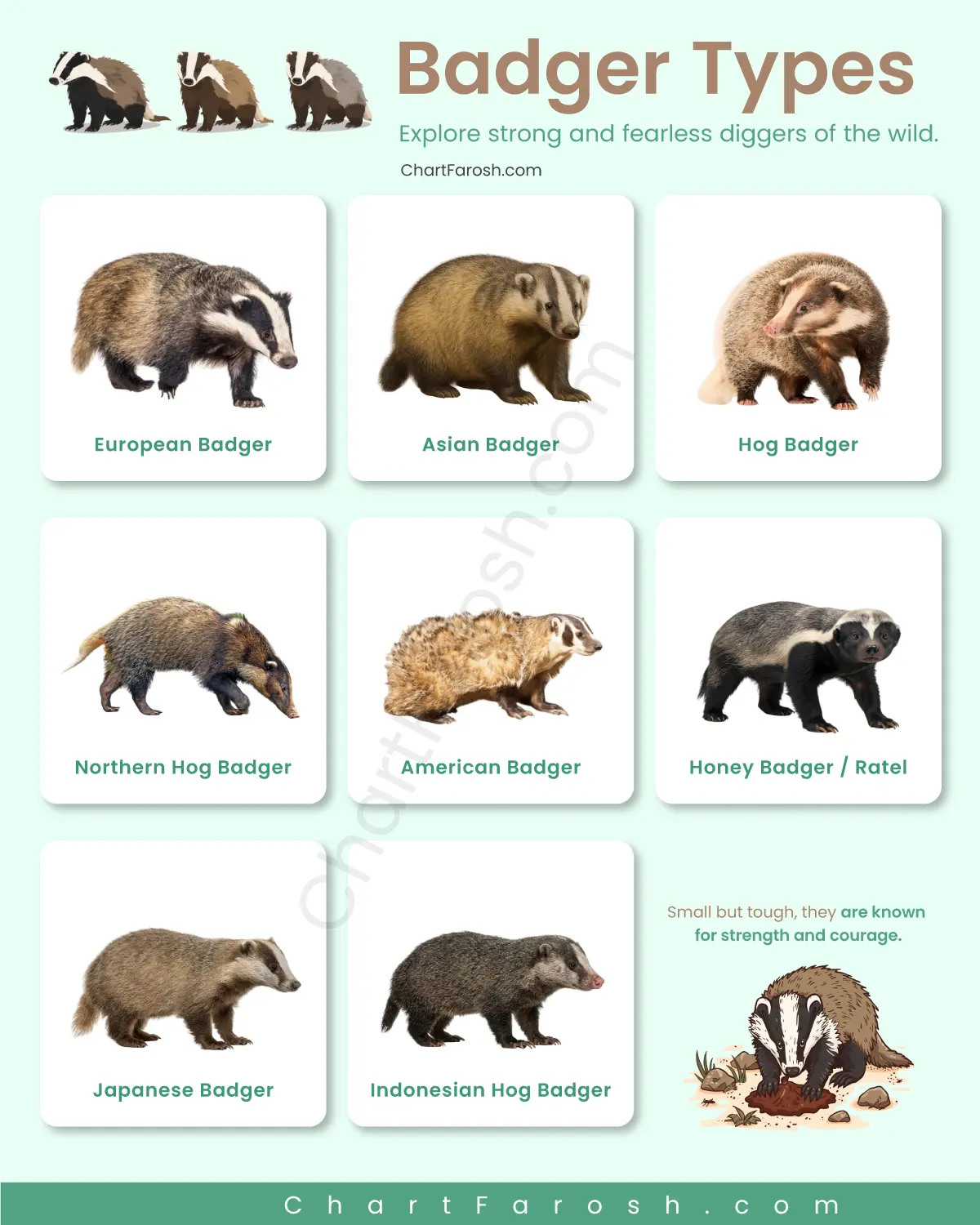
Table of Contents
How Many Types of Badgers Are There?
Short answer: somewhere between 11 and 15, depending on who is counting and how they split a few of the trickier groups.
The disagreement is not sloppiness. It is that “badger” was never a precise scientific category to begin with. It is a common name that got attached to several different animals that happen to dig, have stocky bodies, and wear some version of a striped face.
Most of them sit in the weasel family, Mustelidae, alongside otters, ferrets, and wolverines. But they are spread across branches of that family that split off millions of years ago. A honey badger is about as closely related to a European badger as a house cat is to a hyena: same broad neighbourhood, different street.
For this guide I have grouped the species into four practical buckets:
- True badgers (the Eurasian Meles species, plus the American badger on its own branch)
- Hog badgers (the Arctonyx species, named for their pig-like snouts)
- The honey badger, which gets a group of one
- Ferret-badgers (the small, tree-climbing Asian Melogale species)
There is also a fifth oddity worth a mention, the stink badgers, which turned out not to be badgers at all. More on them further down. If you like “types of” round-ups like this, the All Bear Species guide follows the same format.
What Is a Badger?
A badger is a burrowing, mostly meat-eating mammal in the weasel family, built low to the ground with short legs and long front claws made for digging.
That is the honest, slightly boring definition. The catch is that it describes animals that are not each other’s closest relatives.
What they tend to share: a wedge-shaped body, powerful forelimbs, a habit of digging (either to make a home or to dig up food), and a coat that is usually some mix of grey, brown, and black, often with stripes on the face or back.
What they do not share is almost everything else. European badgers live in big family groups inside elaborate tunnel systems called setts. American badgers are loners. Honey badgers will eat nearly anything and pick fights with animals several times their size.
So “badger” is less a tight family tree and more a body plan that evolution kept reinventing. The same thing happens with the All Fox Species group, where “fox” covers animals that are only loosely related.
Where Do Badgers Live?
Badgers turn up on every continent except Antarctica and Australia.
True badgers cover most of Europe and Asia, with the American badger handling North America by itself. Honey badgers range across sub-Saharan Africa, the Middle East, and into the Indian subcontinent. Hog badgers and ferret-badgers are an Asian story, concentrated in the forests and grasslands of South and Southeast Asia.
Habitat varies as much as range. You will find badgers in woodland, grassland, scrub, farmland edges, mountain forest, and the occasional suburban garden. The common thread is diggable soil and enough food, usually some combination of worms, insects, small mammals, roots, and fruit.
The ones that struggle most are the island specialists. The Bornean ferret-badger, for example, is tied to a single region, which makes it far more vulnerable than a continent-spanning generalist like the European badger.
European Badger
The European badger (Meles meles) is the one most people picture: black-and-white striped face, grey body, roughly the size of a small dog at 60 to 90 cm and up to about 13 kg.
It is also the most social badger by a wide margin. They live in groups called clans inside multi-generational setts that can be centuries old and run for tens of metres underground.
Their diet leans heavily on earthworms, which is part of why they stick to damp grassland and woodland across Europe, parts of the Middle East, and western Russia. They are nocturnal, territorial, and, in the UK at least, a protected and much-argued-about species because of their link to bovine tuberculosis. The UK Mammal Society keeps a good profile of the species.
Asian Badger
For a long time the Asian badger (Meles leucurus) was lumped in with the European one as a single species. They are close cousins and look the part.
The differences are subtle. The Asian badger tends to be a touch paler, with thinner or less contrasting facial stripes, and it is generally more solitary than its European relative. It ranges across Central Asia, Siberia, Mongolia, and much of China. Same general build, around 60 to 70 cm and 7 to 12 kg, same digging habits, slightly different address.
Japanese Badger
The Japanese badger (Meles anakuma) is the smallest of the Meles trio, found only on the Japanese islands of Honshu, Shikoku, and Kyushu.
It is more compact, often 6 to 10 kg, with darker, narrower facial markings. Being island-bound, it is less wide-ranging and more affected by habitat loss and roads than its mainland cousins. It is also a bit of a cultural star: the anaguma shows up in Japanese folklore, sometimes muddled with the equally mythologised tanuki, which is actually a raccoon dog and not a badger at all.
American Badger
The American badger (Taxidea taxus) is the odd one out among the true badgers. It sits on its own branch, genus Taxidea, and split from the Eurasian badgers a very long time ago.
It is flatter and broader than a European badger, with a yellowish-grey coat and a single white stripe running from its nose back over the head. And it digs. Faster than almost any mammal its size; it can vanish into hard prairie soil in under a minute when it wants to.
Unlike the social European badger, it is a solitary hunter of ground squirrels, prairie dogs, and other burrowing rodents across the central and western US, Canada, and northern Mexico. There is a well-documented partnership where badgers and coyotes hunt together, the coyote chasing prey above ground while the badger covers the escape tunnels below.
Honey Badger
If badgers had a celebrity, it would be this one.
The honey badger, or ratel (Mellivora capensis), is not a true badger at all. It is the only member of its own subfamily. It looks the part, with a low, stocky body and a pale grey cape over a black underside, but what it is famous for is attitude. It has loose, thick skin that is hard to bite through, a serious tolerance for venom, and almost no sense of self-preservation.
Honey badgers raid beehives, which is where the name comes from, dig out rodents, and have been recorded killing and eating venomous snakes, occasionally passing out from a bite and then waking up to finish the meal. They range across Africa, the Middle East, and into India. Pound for pound, they may be the most fearless animal on this entire list.
Hog Badger
The hog badger gets its name from its most obvious feature: a long, mobile, pig-like snout it uses to root through leaf litter and soil.
It is a Southeast Asian animal, bulkier than it looks at 8 to 14 kg, with a bristly coat, a pale throat, and big claws. There are actually a few hog badger species rather than one. The greater hog badger (Arctonyx collaris) is the largest. The northern hog badger (Arctonyx albogularis) reaches further north into China and Russia and sports a distinct white throat. The small Sumatran hog badger (Arctonyx hoevenii) is a rare, dark-furred mountain species. All of them are heavy diggers and largely solitary.
Bornean Ferret-badger: Rare Island Species
The ferret-badgers are the badgers nobody pictures: small, slim, weasel-ish animals with masked faces, long tails, and a willingness to climb trees.
The Bornean ferret-badger (Melogale everetti) is the rarest of the bunch. It lives only in the mountains of northern Borneo, mostly within Sabah, which makes its entire world quite small. Because that range is so limited, even modest habitat loss is a real threat, and it is classed as endangered. We know less about its day-to-day life than almost any other animal here, which is its own kind of problem. It is hard to protect a species you barely understand.
Chinese Ferret-badger
The Chinese ferret-badger (Melogale moschata) is the most common and best-studied of the Melogale group.
It is small, often around 1 to 3 kg, with a dark body, a pale facial mask, and a scent gland it uses defensively, a bit like a skunk. It ranges across southern China, Taiwan, and parts of Southeast Asia, and unlike most badgers it is a confident climber that is comfortable up in the trees. It eats insects, worms, small vertebrates, and fruit, and it is adaptable enough to live near farmland and villages.
Javan Ferret-badger
The Javan ferret-badger (Melogale orientalis) is restricted to Java and Bali in Indonesia, mostly in forested and mountainous areas.
It is similar in size and shape to its Chinese relative but far more localised and much less studied. As with most island and forest specialists on this list, the pressures on it are habitat conversion and the plain fact that there are not many of them spread over a small area.
Burmese Ferret-badger
The Burmese ferret-badger (Melogale personata), sometimes called the large-toothed ferret-badger, is the bigger-skulled member of the group.
It ranges from northeastern India through Myanmar and into parts of Southeast Asia. Like the others it is nocturnal, omnivorous, and partly arboreal, with the same masked face and long tail. The “large-toothed” name points to its more robust teeth, suited to a slightly tougher diet than its smaller cousins. The IUCN keeps current status notes for all four ferret-badgers on its Red List.
A Quick Note on Stink Badgers (the Imposters)
Worth flagging: two animals called stink badgers, the Sunda stink badger and the Palawan stink badger, used to be counted as badgers.
They are not. Genetic work moved them into the skunk family, Mephitidae. They dig and have a vaguely badger-like build, but their closest relatives are skunks, and they back up the resemblance with a skunk’s signature defence: a foul spray. If you see them on a “types of badgers” list, that list is out of date. For more of these naming mix-ups, the Types of Deer guide has a few of its own.
Types of Badgers Chart
Here is every species above in one place. Body lengths for the ferret-badgers exclude the tail, which adds a fair bit on those animals.
| Common name | Scientific name | Group | Size / weight | Distribution | Standout feature |
| European Badger | Meles meles | True badger | 60–90 cm; 7–13 kg | Europe, W. Russia, Middle East | Social; lives in large setts |
| Asian Badger | Meles leucurus | True badger | 60–70 cm; 7–12 kg | Central Asia, Siberia, Mongolia, China | Paler, more solitary cousin |
| Japanese Badger | Meles anakuma | True badger | 55–70 cm; 6–10 kg | Japan (Honshu, Shikoku, Kyushu) | Smallest Meles; island-only |
| American Badger | Taxidea taxus | True badger | 60–75 cm; 7–14 kg | Central & W. USA, Canada, N. Mexico | Fastest digger; hunts with coyotes |
| Honey Badger (Ratel) | Mellivora capensis | Honey badger | 60–70 cm; 9–14 kg | Africa, Middle East, India | Fearless; venom-resistant |
| Greater Hog Badger | Arctonyx collaris | Hog badger | 55–70 cm; 8–14 kg | Southeast Asia | Long, pig-like snout |
| Northern Hog Badger | Arctonyx albogularis | Hog badger | 60–70 cm; 10–15 kg | China, Russia, NE Asia | White throat patch |
| Sumatran Hog Badger | Arctonyx hoevenii | Hog badger | 50–60 cm; 6–10 kg | Sumatra, Indonesia | Rare, dark mountain species |
| Chinese Ferret-badger | Melogale moschata | Ferret-badger | 33–43 cm; 1–3 kg | S. China, Taiwan, SE Asia | Climbs trees; skunk-like scent |
| Burmese Ferret-badger | Melogale personata | Ferret-badger | 33–43 cm; 1–3 kg | NE India, Myanmar, SE Asia | Larger, tougher teeth |
| Javan Ferret-badger | Melogale orientalis | Ferret-badger | 35–40 cm; 1–2 kg | Java & Bali (Indonesia) | Localised island species |
| Bornean Ferret-badger | Melogale everetti | Ferret-badger | 30–44 cm; 1–2 kg | N. Borneo (Sabah) | Endangered; tiny range |
Sizes are typical adult ranges and vary by sex, season, and region. Hog badger and ferret-badger taxonomy is still debated, so a few sources count more or fewer species.
Differences Between Honey Badgers and True Badgers
This is the comparison people search for most, so it is worth doing properly.
The honey badger and the European badger look related and share a name, but they sit on different branches of the weasel family and behave almost nothing alike.
| Feature | True badgers (e.g. European) | Honey badger (ratel) |
| Family group | Subfamily Melinae | Subfamily Mellivorinae |
| Build | Stocky, grey, bold facial stripes | Low, stocky, pale cape over black body |
| Temperament | Shy; mostly avoids conflict | Famously fearless and aggressive |
| Diet | Mostly earthworms, insects, roots | True omnivore: honey, snakes, rodents, fruit |
| Social life | Often live in family groups (clans) | Solitary |
| Range | Europe and Asia | Africa, Middle East, India |
| Standout trait | Elaborate burrow systems (setts) | Venom resistance; thick, loose skin |
The short version: true badgers are shy, earthworm-and-insect diggers that mostly want to be left alone in their burrows. The honey badger is a solitary brawler that will dig out a beehive, take on a snake, and stand its ground against animals far larger than itself. Same nickname, very different animal.
FAQs
How many types of badgers are there?
There are roughly 11 to 15 species, depending on how the hog badgers and ferret-badgers are classified. They fall into four main groups: true badgers, hog badgers, the honey badger, and ferret-badgers.
Is a honey badger a real badger?
Not in the strict sense. It shares the name and a similar build, but it belongs to its own subfamily and is only distantly related to true badgers like the European badger.
What is the most aggressive type of badger?
The honey badger, by a wide margin. It is known for attacking venomous snakes, raiding beehives, and standing up to predators much larger than itself.
Which badger is the rarest?
Among the species here, the Bornean ferret-badger is the rarest and most range-restricted. It is found only in the mountains of northern Borneo and is classed as endangered.
Do badgers live in groups?
It depends on the species. European badgers are unusually social and live in family clans inside shared setts, while American badgers, honey badgers, and most others are solitary.
Are stink badgers real badgers?
No. Despite the name, stink badgers were reclassified into the skunk family. Their closest relatives are skunks, not true badgers.
What is the difference between a badger and a ferret-badger?
Ferret-badgers are much smaller and slimmer, can climb trees, and have a long tail and a masked face. True badgers are larger, ground-bound, and built for heavy digging.